R. A. Salvatore on the Motivation to Write
Excerpt From Part 5 (“Having a Driving Reason to Write”) of Chapter 1 “A Portrait of a Novelist” in The 101 Habits of Highly Successful Novelists (ed. Andrew McAleer)
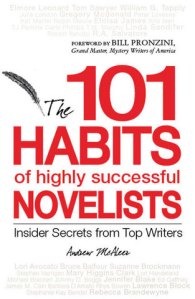
There’s way too much pain in this business for anyone who doesn’t have to write. I always tell beginning writers, “If you can quit, then quit. If you can’t quit, you’re a writer.” I’m not being facetious. The idea that writing is a way to get something else, be it fame or fortune, is ludicrous. The odds are astounding, and I’d wager that they’re even more astounding against someone who doesn’t love the power of the word.
~R. A. Salvatore
(quoted from pp. 11–12)
Pinable:

About the book:
Learn from the MASTERS!
In The 101 Habits of Highly Successful Novelists, more than fifty of the greatest fiction writers of our time show you how they practice their craft. You’ll gain insight into every aspect of fiction writing, including:
Coming up with ideas
Knowing what makes a great story
Developing dialogue
Overcoming writer’s block
Creating a pitch synopsis
Promoting yourself
The 101 Habits of Highly Successful Novelists is a “who’s who” of today’s great fiction writers that will quickly become your most trusted writing companion!
__________________________________________
Work Cited:
Salvatore, R. A. Quoted in “Having a Driving Reason to Write” in The 101 Habits of Highly Successful Novelists. Andrew McAleer, ed. Avon, MA: Adams Media, 2008. 3–20. Print.
Mary Balogh on the Gift of Observation in Creating Characters
Excerpt From Part 3 (“Being a Natural Observer”) of Chapter 1 “A Portrait of a Novelist” in The 101 Habits of Highly Successful Novelists (ed. Andrew McAleer)
The ability to create realistic characters obviously depends very largely upon one’s ability to observe other people. Being an introvert is probably an advantage here. But it is not enough merely to look and listen and get to know people from external signs, however detailed and accurate one’s observation is. It is more being able to put oneself right inside the body, mind, and soul of another person, to be able to imagine what it is like to be that person. True understanding and empathy can come only from that type of observation.
Characters in a book can seem as real as living persons to the reader if the writer has the gift of portraying them from deep within, from the level of their very being, with all the myriad factors that have made them the unique individuals they are.
~Mary Balogh
(quoted from pg. 8)
Pinable:
About the book:
Learn from the MASTERS!
In The 101 Habits of Highly Successful Novelists, more than fifty of the greatest fiction writers of our time show you how they practice their craft. You’ll gain insight into every aspect of fiction writing, including:
Coming up with ideas
Knowing what makes a great story
Developing dialogue
Overcoming writer’s block
Creating a pitch synopsis
Promoting yourself
The 101 Habits of Highly Successful Novelists is a “who’s who” of today’s great fiction writers that will quickly become your most trusted writing companion!
__________________________________________
Work Cited:
Balogh, Mary. Quoted in “A Portrait of a Novelist” in The 101 Habits of Highly Successful Novelists. Andrew McAleer, ed. Avon, MA: Adams Media, 2008. 3–20. Print.
Creativity, Originality, and Storytelling (from THE 101 HABITS OF HIGHLY SUCCESSFUL NOVELISTS)
Excerpt From Parts 1 (“Being Creative and Original”) and 2 (“Being a Natural Storyteller”) of Chapter 1 “A Portrait of a Novelist” in The 101 Habits of Highly Successful Novelists (ed. Andrew McAleer)
Your novel is what your thoughts make it. Your life is unique and like no other. There will never be another one of you. Your singular experiences help make you who you are and what you are about. Inside of you are your unique novel, characters, and storyline. Only you can create the novel you wish to create. No one else can do it but you. …
Readers want, indeed demand, and are entitled to originality. They want to explore the new world you have created and to meet the original and exciting people who exist in your mind and not in some other writer’s work. …
[T]he natural storyteller requires more than just wanting to tell a story. Storytelling is having a love and full appreciation for the art of telling a story and how the story is created from its inception. Storytelling is an appreciation for the way someone else tells a story and for how it sounds and how it appears in short form, on the big screen, and in a novel. How was this story told and how might you tell it? What makes this story a failure? Storytelling is more than just words, words, words.
~Andrew McAleer
(Quoted from pgs. 4–6)
Pinable:
About the book:
Learn from the MASTERS!
In The 101 Habits of Highly Successful Novelists, more than fifty of the greatest fiction writers of our time show you how they practice their craft. You’ll gain insight into every aspect of fiction writing, including:
Coming up with ideas
Knowing what makes a great story
Developing dialogue
Overcoming writer’s block
Creating a pitch synopsis
Promoting yourself
The 101 Habits of Highly Successful Novelists is a “who’s who” of today’s great fiction writers that will quickly become your most trusted writing companion!
__________________________________________
Work Cited:
McAleer, Andrew. “A Portrait of a Novelist” in The 101 Habits of Highly Successful Novelists. Andrew McAleer, ed. Avon, MA: Adams Media, 2008. 3–20. Print.
Donald Maass on Setting (from THE FIRE IN FICTION)
Excerpts from Chapter 4, “The World of the Novel,” in The Fire in Fiction by Donald Maass

Do you ever skip description in a novel? I do, too. Obviously, merely describing how things look, sound, taste, feel, and smell is not, by itself, going to bring a location to life. Something more is required. Is it a setting that is unusual, exotic, or unexpected? If so, our job would be easy. We merely would have to find a spot on the face of the earth where a novel has not previously been set. …
The trick is not to find a fresh setting or a unique way to portray a familiar place; rather, it is to discover in your setting what is unique for your characters, if not for you. You must go beyond description, beyond dialect, beyond local foods to bring setting into the story in a way that integrates it into the very fabric of your characters’ experience.
In other words, you must instill the soul of a place into your characters’ hearts and make them grapple with it as surely as they grapple with the main problem and their enemies. How do you do that? It takes work but the basic principles of powerful settings are not exceptionally hard to grasp.
(quoted from pages 81–82)
Pinable:

About the book:
Discover the Difference Between a So-So Manuscript and a Novel Readers Can’t Forget
We’ve all read them: novels by our favorite authors that disappoint. Uninspired and lifeless, we wonder what happened. Was the author in a hurry? Did she have a bad year? Has he lost interest altogether?
Something similar is true of a great many unpublished manuscripts. They are okay stories that never take flight. They don’t grip the imagination, let alone the heart. They merit only a shrug and a polite dismissal by agents and editors.
It doesn’t have to be that way. In The Fire in Fiction, successful literary agent and author Donald Maass shows you not only how to infuse your story with deep conviction and fiery passion, but how to do it over and over again.
__________________________________________
Work Cited:
Maass, Donald. “The World of the Novel” in The Fire in Fiction: Passion, Purpose, and Techniques to Make Your Novel Great. Cincinnati, Ohio: Writer’s Digest Books, 2009. 81–116. Print.
Fun Friday: Tom Hiddleston and The Pirate Fairy

Some eye- and ear-candy for your Friday. 😀
Donald Maass on Exposition and Backstory (from THE FIRE IN FICTION)
Excerpts from Chapter 8, “Tension All the Time,” in The Fire in Fiction by Donald Maass
Maass on Exposition:
How do you handle exposition? Are there passages of interior monologue in your manuscript that are just taking up space? If there are, you can cut them, or possibly you can dig deeper into your character at this moment in the story and find inside of him contradictions, dilemmas, opposing impulses, and clashing ideas that keep us in suspense.
To put it another way, exposition is an opportunity not to enhance the dangers of the plot (exposition doesn’t do that) but to put your characters’ hearts and minds in peril. Remember, though, that true tension in exposition comes not from circular worry or repetitive turmoil; it springs from emotions in conflict and ideas at war.
(quoted from page 204)
Maass on Backstory:
Backstory is the bane of virtually all manuscripts. Authors imagine that readers need, even want, a certain amount of filling in. I can see why they believe that. It starts with critique groups in which writers hear comments such as, “I love this character! You need to tell me more about her!” Yes, the author does. But not right away. As they say in the theater, make ’em wait. Later in the novel backstory can become a revelation; in the first chapter it always bogs things down.
(quoted from page 208)
Pinables:

About the book:
Discover the Difference Between a So-So Manuscript and a Novel Readers Can’t Forget
We’ve all read them: novels by our favorite authors that disappoint. Uninspired and lifeless, we wonder what happened. Was the author in a hurry? Did she have a bad year? Has he lost interest altogether?
Something similar is true of a great many unpublished manuscripts. They are okay stories that never take flight. They don’t grip the imagination, let alone the heart. They merit only a shrug and a polite dismissal by agents and editors.
It doesn’t have to be that way. In The Fire in Fiction, successful literary agent and author Donald Maass shows you not only how to infuse your story with deep conviction and fiery passion, but how to do it over and over again.
__________________________________________
Work Cited:
Maass, Donald. “Tension All the Time” in The Fire in Fiction: Passion, Purpose, and Techniques to Make Your Novel Great. Cincinnati, Ohio: Writer’s Digest Books, 2009. 188–231. Print.
Books Read in 2014: WHEN CALLS THE HEART by Janette Oke
When Calls the Heart by Janette Oke (1983)
Book Blurb:
Elizabeth Thatcher is young, pretty, cultured, and educated. But when she journeys west to teach school in the foothills of the Canadian Rockies, she’s completely unprepared for the conditions she encounters. Still, she’s determined to succeed at the formidable task of fitting in with the locals and shaping the hearts and minds of the schoolchildren in her care.She’s just as determined not to give her heart to any of the local frontiersmen. Until she meets Wynn Delaney, a member the Royal Canadian Mounted Police….
My Review:

1983 Rating: 4.5 stars (I read the version with the cover on the right)
2014 Rating: 3 stars
- Goodreads bookshelves: books-read-in-2014, hist-20th-c-edwardian-to-wwi, historical-inspy-romance
Read from March 17 to March 20, 2014
This is the first time I’ve re-read this book since it came out thirty years ago. As a YA reader, I absolutely adored it and the first two or three sequels (I think I read four books in this series as they came out); it went quite well with the Sunfire romances from Scholastic that I was reading at the time. I do remember that I enjoyed them much more than the Love Comes Softly series that I was reading around the same time. (I went to a very small, very conservative Christian school for junior high, and Oke’s books were available in the school library and so were acceptable to carry around and read on breaks; most of the rest of what I read at home wasn’t.)
I’ve been . . . well, “enjoying” is a bit strong of a term . . . entertained recently by the Hallmark series inspired by When Calls the Heart, so I thought now would be as good a time as any to re-read it. I’m going to count this as my Inspy Historical Romance in my 2014 Genre Reading Challenge, though there are a few things about this book that, even by my definition, disqualify it from that genre.
First, it’s written in first-person. I’m not a big fan of first-person historicals and I have a hard time counting anything but those in the Gothic subgenre as “romance” novels—because for me, romance novels need to include the hero’s POV as well as the heroine’s.
Second, though she gets a glimpse of the hero about 1/3 of the way into the book, she doesn’t actually meet him and have a conversation with him until 50% of the way in. There’s “insta-love” (because, let’s recall, this is an Inspy romance, so it’s definitely not insta-lust) on her part. His? We don’t know—because, again, we don’t get his POV.
Third, there’s very little relationship development between the two of them in the last 50% of the book because they’re so rarely together. A picnic here, a family dinner there. All the while, he’s maintaining his attitude that Mounties shouldn’t marry because it’s selfish—unfair to the woman, who won’t be able to handle the kind of rough living that a Mountie in the outback of Canada (can I call it that?) would have to deal with.
Other than those things, it’s pretty standard Prairie Romance fare: City Girl goes West to teach in Country Town and has to learn how to rough-it while falling in love with Local Law Man. It even includes the Big Misunderstanding trope: she believes he’s married and the father of one of the boys in her school. This Big Misunderstanding carries through most of the last half of the book because, let’s face it, there is almost no relationship development, so there’s no conversation in which the truth can be revealed. And Wynn never uses the terms “my sister-in-law” or “my nephew,” which might clue her in. If he’s as interested in Elizabeth as he’s supposed to be, you’d think that, after continually getting the cold shoulder from her, he might take the opportunity to drop a few terms like that into a conversation to see if that makes a difference.
This book is basically Christy-lite: first person, wide-eyed, naive heroine; country school house; learning the quirks of a small town, etc. The good thing here, though, is that there’s no love triangle forced upon the heroine. (Oh, and as far as that goes, in Christy, I’m Team-David all the way!)
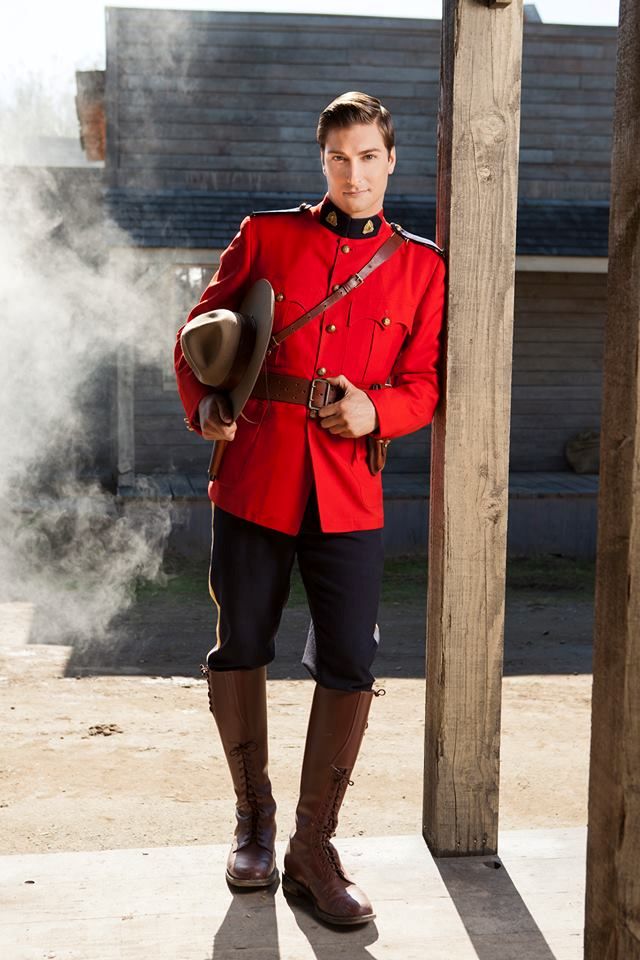
Daniel Lissing as Mountie Jack Thornton in Hallmark Channel’s When Calls the Heart
Another thing that surprised me going back to this one was how light it is on the Inspy part. It’s clean, she goes to church, she prays, she’s shown reading her Bible. There was one long “internal sermon” section that I skipped over (when she’s having a long internal monologue over what she’s just read in her quiet time), but other than that, there isn’t any Bible thumping, verse quoting, witnessing/evangelizing, or sermonizing in this book (unlike in Love Comes Softly, where there’s a full presentation of the gospel so Marty can get saved to be worthy of Clark’s love).
All said, this was a quick, light read, and, while at twelve years old, I couldn’t wait for the next book in the series, I do believe that a revisit to the first volume is quite enough for me now.
______________________________________________
My rating matrix:
5 STARS = one of the best I’ve ever read
4 STARS = a great read, highly recommended
3 STARS = it was okay/not a favorite
2 STARS = I didn’t enjoy it all that much, not recommended
1 STAR/DNF = I hated it and/or Did Not Finish it
Scenes That Can’t Be Cut (a.k.a., Finding a Scene’s Purpose) from THE FIRE IN FICTION by Donald Maass
Excerpt from Chapter 3, “Scenes That Can’t Be Cut,” in The Fire in Fiction by Donald Maass
I suspect many sagging middle scenes slump the way they do not because of bad planning or bad luck but because their purpose hasn’t yet emerged. Authors, as they plow through the middle portion of their manuscripts, tend ot write what they think ought to come next; furthermore, they write it in the first way that occurs to them to do so. In successive drafts such scenes tend to stay in place, little altered. Unsure what to do, an author may leave a scene in place because…well, just because. …
[I]t’s first helpful to realize that every scene set down by an author usually has a reason to be. The author may not grasp the reason yet, but the impulse to portray this particular moment, this particular meeting, this particular action, springs from the deep well of dreams from which stories are drawn.
This scene has a point. The task is to draw that purpose out? How? Changing the words on the page won’t work. We authors are wedded to our words. Our instinct is to preserve them. So it’s the whole scene that needs to be explored again. Scene revision is, to me, less a matter of expression and more a way of seeing.
To re-envision a scene, look away from the page and look toward what is really happening. What change takes place? When does that change occur (at what precise second in the scene)? In that moment, how is the point-of-view character changed? The point of those questions is to find the scenes’ turning points (note the plural).
Having identified the turning points, you will find focusing the scene becomes easier. Everything else on the page either contributes to, or leads readers away from, those changes. All the extra stuff—the nifty scene setting, clever character bits, artful lead-ins and lead-outs—are now expendable, or perhaps they are tools to help selectively enact the scene’s main purpose.
(quoted from pages 54–55)
About the book:
Discover the Difference Between a So-So Manuscript and a Novel Readers Can’t Forget
We’ve all read them: novels by our favorite authors that disappoint. Uninspired and lifeless, we wonder what happened. Was the author in a hurry? Did she have a bad year? Has he lost interest altogether?
Something similar is true of a great many unpublished manuscripts. They are okay stories that never take flight. They don’t grip the imagination, let alone the heart. They merit only a shrug and a polite dismissal by agents and editors.
It doesn’t have to be that way. In The Fire in Fiction, successful literary agent and author Donald Maass shows you not only how to infuse your story with deep conviction and fiery passion, but how to do it over and over again.
__________________________________________
Work Cited:
Maass, Donald. “Scenes That Can’t Be Cut” in The Fire in Fiction: Passion, Purpose, and Techniques to Make Your Novel Great. Cincinnati, Ohio: Writer’s Digest Books, 2009. 54–80. Print.
Protagonists vs. Heroes from THE FIRE IN FICTION by Donald Maass
Excerpts from Chapter 1, “Protagonists vs. Heroes,” in The Fire in Fiction by Donald Maass
[T]hink about the people whom you deeply admire. Who are the individuals for whom you would cancel other plans? Who stirs in you awe, respect, humility, and high esteem? Are these regular people, no different than anyone else? They may not be famous but they are in some way exceptional, right? …
To create an immediate bond between reader and protagonist, it is necessary to show your reader a reason to care. Pushing a shopping cart is not a reason to care. Demonstrating a character quality that is inspiring does cause readers to open their hearts.
(quoted from page 10)
Is your protagonist great? In establishing her at the outset, it is important to look not toward what she will do later in the story but the impact she has on others now. Her actions will speak, I have no doubt; but who in your hero’s circle already has respect, feels awe, so that we can feel it too? …
It does not matter whether your intent is to portray someone real or someone heroic. To make either type matter to your readers, you need only find in your real human being what is strong, and in your strong human being what is real. Even greatness can be signaled from the outset.
How do you find the strong or human qualities in your protagonist? What will be most effective to portray? The answer to those questions lies in you, the author. What is forgivably human to you? What stirs you to respect? That is where to start.
Next, when will you show the readers those qualities in your hero? Later on? That’s too late. Too many manuscripts begin at a distance from their protagonists, as if opening with a long shot like in a movie. That’s a shame. Why keep readers at arm’s length?
Novels are unique among art forms in their intimacy. They can take us inside a character’s heart and mind right away. And that’s where your readers want to be. Go there immediately.
(quoted from pages 31–32, emphasis mine)
About the book:
Discover the Difference Between a So-So Manuscript and a Novel Readers Can’t Forget
We’ve all read them: novels by our favorite authors that disappoint. Uninspired and lifeless, we wonder what happened. Was the author in a hurry? Did she have a bad year? Has he lost interest altogether?
Something similar is true of a great many unpublished manuscripts. They are okay stories that never take flight. They don’t grip the imagination, let alone the heart. They merit only a shrug and a polite dismissal by agents and editors.
It doesn’t have to be that way. In The Fire in Fiction, successful literary agent and author Donald Maass shows you not only how to infuse your story with deep conviction and fiery passion, but how to do it over and over again.
__________________________________________
Work Cited:
Maass, Donald. “Protagonists vs. Heroes” in The Fire in Fiction: Passion, Purpose, and Techniques to Make Your Novel Great. Cincinnati, Ohio: Writer’s Digest Books, 2009. 9–34. Print.
Lessons from MANY GENRES, ONE CRAFT: The Danger of Perfectionism with Anne Harris (@jessicafreely)
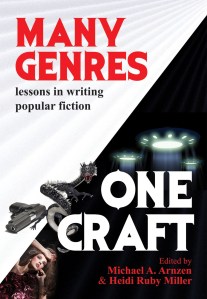
In Many Genres, One Craft, award-winning author Michael A. Arnzen and Heidi Ruby Miller gather the voices of today’s top genre writers and writing instructors alongside their published students. It fosters the writing process in a way that focuses almost exclusively on writing the novel. Using a compilation of instructional articles penned by well-known authors affiliated with Seton Hill University’s acclaimed MFA program in Writing Popular Fiction, the book emphasizes how to write genre novels and commercially appealing fiction. The articles are modeled after actual “learning modules” that have successfully taught students in the program how to reach a wider audience for over a decade.
Excerpt from “Perfect Disaster: Don’t Let Perfectionism Squash Your Creativity” by Anne Harris
Perfectionism destroys productivity, and what’s worse, it robs you of the joy of creating. After all, no one and nothing is perfect. Holding your work to that standard will only set you up for failure. Writing used to be an agonizing process for me. I dreaded it. I avoided it for days and weeks and when I finally did sit down and write, I’d type that first sentence, and then I’d rework it until it was just the way I wanted it. I would not move on to the second sentence until the first sentence was perfect and the same for paragraphs and chapters. Needless to say, when I got midway through the book and needed to change something I’d written at the beginning, it was tantamount to amputating a body part. The whole process was slow, difficult work, rife with self-criticism and second-guessing. It wasn’t much fun. . . .
Writers do not build careers on perfection. They build careers on consistency: being able to regularly produce stories that entertain their fans. That’s the meat and potatoes of a popular fiction writer. From a commercial standpoint, it’s better to have five good books on the shelves than one perfect one.
__________________________________________
Work Cited:
Harris, Anne. “Perfect Disaster: Don’t Let Perfectionism Squash Your Creativity.” Many Genres, One Craft. Eds. Michael A. Arnzen and Heidi Ruby Miller. Terra Alta, WV: Headline Books, Inc., 2011. 59–60. Print.

 KayeDacus.com