Becoming a Writer: How Do I Get Started?
 Last week, I posted a “Dear Prudence” letter that got my head spinning with story ideas. This weekend, after a conversation with my grad-school “sorority” sisters (not a real sorority, but it’s the closest most of us have ever come to one), I wrote up a story treatment based on an idea for a character inspired by a certain news broadcaster I think is good looking.
But there’s a huge difference between “getting an idea” for a story and actually beginning to write that story. So there are two issues we need to examine: how to choose the story idea and how to get started writing it.
How do I choose which story to write?
“If the work comes to the artist and says, ‘Here I am, serve me,’ then the job of the artist, great or small, is to serve.”
~Madeleine L’Engle
As of the writing of this post (February 2009), I have completed six manuscripts. Before I started seriously studying the craft of writing and preparing myself to pursue publication, I would write and toy around with whatever I felt like working on at the time. For ten years, as I’ve mentioned on this blog many times, I wrote and rewrote a manuscript that grew to almost 200,000 words (though with as much rewriting as I did on it, I probably wrote something more like 500,000 words when all was said and done). It isn’t a complete story—it’s a collection of scenes and vignettes—really just things that I wrote to spend time with the characters I’d come to love so dearly. But before, and even during, the time I worked on that manuscript, I had so many story ideas that I would start writing—and usually got a page or ten into before setting it aside from disinterest. (See this post from the First Lines series for an example of some of those started and abandoned ideas from over the years.)
So how did I choose which stories would be the ones I would spend six, eight, nine, twelve, thirty-six months writing? How did I choose which of the many ideas that bombard me day-in and day-out?
For me, the stories I’ve written—either the unfinished ten-year project, or the completed manuscripts—came from ideas that just wouldn’t leave me alone. And for me, it stems from the characters. Characters are where my stories begin. Many of those partials that I have on my computer—those abandoned ideas—were started because I had an idea for a character in some kind of situation that might be interesting, but it never grew from there. Either the character or the situation ended up not being interesting enough for me to want to come back to it time and again to see what was going to happen next.
There’s a difference, though, between discovering your story/character isn’t interesting enough to sustain a novel and getting to a point where you feel like the words just won’t come anymore. In the second case, you’re most likely just blocked—and you’ll probably discover that if you continue to focus on the story in other ways (such as casting your characters or putting together graphic storyboards), you’ll find yourself overcoming your creative block and getting back into the story again.
There are several things to consider when choosing which story idea to pursue:
- Are the characters interesting enough to you, with sufficient mysteries and depth to them, that you’ll want to spend month upon month thinking about and talking to them? Are they real enough? Is there something they’ll need to learn/do that will give your main character(s) a growth-arc over the length of a novel?
- Even if your idea is character-driven, is there sufficient potential for a plot that will drive the story on to a climax and conclusion? If someone asked you what your story is about, would you be able to tell them?
- Is this a story idea that’s been formulating in your mind for a while and just won’t let you go, or is it something you came up with on a whim?
- Is there more than just an interesting character or a flashy plot to your idea? Will it have emotional depth? Depth that goes beyond emotional/physical?
- Do you have a theme? Conflicts beyond the main plot?
Now, not everyone goes through these questions when beginning to write a story. But when you get to a point where you’re ready to give up on an idea after three, ten, or twenty chapters, these questions may come in handy when trying to determine if it wasn’t a good choice or if you just have writer’s block.
How do I get started writing a book?
“The empty page is a Sphinx, blankly ferocious.”
~Richard Rhodes
Putting the first words of a story down on page is like cutting into an expensive piece of silk to sew a garment. If the crafter doesn’t know how to sew, doesn’t know what a dress pattern looks like nor how to read the instructions on it, they are going to end up ruining the silk and being discouraged from ever trying again. So what is the amateur to do?
When learning to sew, we start with simple patterns and cheap fabrics—but we still choose to make something that we’ll like in finished form. Just like the first-time crafters wouldn’t expect to turn out a perfect red-carpet evening gown on her first attempt, you can’t sit down to start writing expecting to turn out a perfect story/manuscript the very first time.
Where do you start? It depends on what kind of a writer you are. I have to start at the beginning and write through in linear order to the end—even though I stink at writing openings. I have to see the story evolve on page just as if I were reading a book from cover to cover. Upon a rare occasion, when a scene comes to me fully formed, I might write ahead, just to make sure I don’t lose the idea—and many times, this might help me gain momentum in the linear writing, to write toward that scene. However, sometimes, I end up not using that scene—but it did teach me something about the characters I might not have otherwise known.
Before I started full-steam writing A Case for Love a month ago, I had several bits and pieces of scenes, dialogue, and narrative as a way to start priming the pump and getting into the characters’ heads to figure out exactly where I wanted to start the first draft. When I finish the first draft, I may decide that it wasn’t the right place to start. But until the draft is completed, I won’t know that. And every story has to start somewhere.
The most important thing to keep in mind when you sit down to that Sphinx-like blank page is that you’re not sitting down to write “a book.” You’re writing a Chapter or a Page or a Paragraph or a Sentence. If you sit down at the beginning of a project with the weight of a 100,000-word manuscript hanging on your shoulders, you may find yourself crushed by it. If you write a page a day, you’ll have completed a novel in a year.
So, now, since most of my readers are also writers with more than one manuscript finished, I’ll turn these two questions on you: how do you choose which stories to write, and how do you get started writing?
SIG Sightings
Since I posted a bunch of places where Stand-In Groom has been “seen” online, yesterday I did what I’ve been meaning to do for a while, which is go around to the bookstores nearest me and get some shots of SIG on the shelves.
First, I wanted to share this one, that my sister sent to me back before Christmas, when she found SIG on the shelf at the Lifeway store in Baton Rouge:
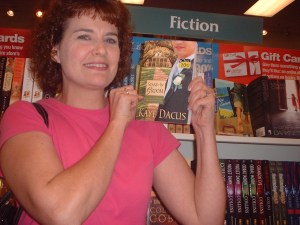
Two weeks ago, my aunt Linda McLellan posted on my Facebook wall: “I finally made it to Lifeway Wednesday and purchased 6 of your books, so I probably cleaned out their shelf!”
The next day, my brother-in-law, Scott, called to tell me he’d been at Lifeway (the same one in the two instances above) and they were indeed sold out of Stand-In Groom. Since the placard was still on the Lifeway Recommends shelf, he took it up to the counter and asked them if they’d be getting any more in. They said yes, definitely, more were on order, but they were having a hard time keeping it in stock.
Earlier this week, my sister e-mailed again that she’d gone to Barnes & Noble on January 28, which was apparently the date B&N said they’d be shelving it. However it wasn’t out. She also checked at Wal-Mart, but I don’t think they’ll carry anyone who’s not at the sales level of a Wanda Brunstetter, Frank Peretti, Ted Dekker, or Karen Kingsbury. But it did make me curious to see if it was out at the B&Ns around here.
I started out my trip Friday at the B&N at the Opry Mills Mall (a.k.a., “Shopryland”). Like the B&N in Baton Rouge, they didn’t have it out. However, there was a pretty big hole on the shelf between Kathryn Cushman’s and Ted Dekker’s books. So we’ll pretend that they shelved it Wednesday and were sold out by noon Friday. So I left a pile of bookmarks where the book should be.

I also left bookmarks on the table where they had a display of wedding-planning books and on the table (just inside the main door) where they had a display of books for Valentine’s Day.
From there, I went to the Lifeway store on Broadway in downtown Nashville—the store where I first saw the book. As my good friend Ruth had informed me a couple of weeks ago, Stand-In Groom was not only on the top “Lifeway Recommends” shelf of the fiction section, but it was the very first book on the shelf, so it was the first one people would see when walking back to that section. There were five or six books on that shelf, and five or six down below in its regular spot, between Kathryn Cushman and Bryan Davis.
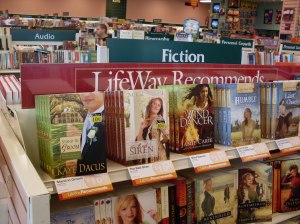
(Notice it’s right next to M.L. Tyndall’s book The Red Siren, which I happen to be reading right now and highly recommend. MaryLu and I, along with Mary Connealy, will be going on a book signing tour together at the end of March, so it’s fun to see our books shelved side-by-side.)
From downtown, I drove down to Cool Springs to the Lifeway there. Again, it was on the top shelf, with only three copies remaining. However, there weren’t any copies in the regular slot—not even a hole for them between Cushman and Davis.
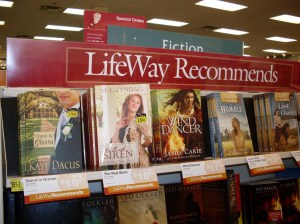
From Lifeway, I drove over to the B&N. This location didn’t have it either—nor even a hole that indicated it might have been there, like at the other one. So, once again, I left some bookmarks there and on the Valentine’s Day display table (couldn’t find a wedding table at this store).
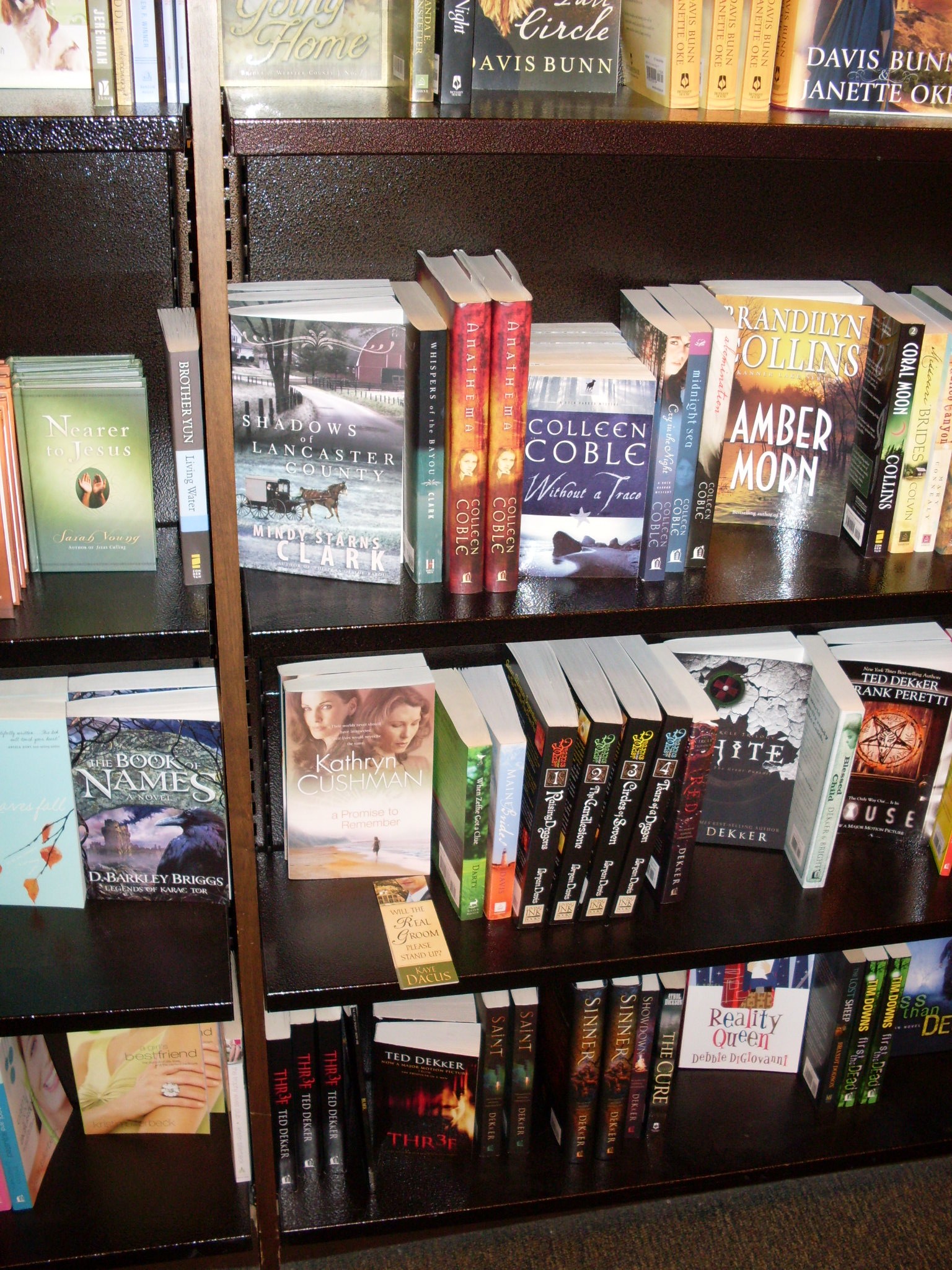
In heavier traffic than I saw down there on a Saturday two weeks before Christmas, I drove over to the Borders store. Their Christian fiction section is way back at the back of the store—right next to the restrooms. Oh, yay, what placement! But, I guess that means that there is actually more traffic past that shelf than past that section in B&N, where it’s buried between other sections on the other side of the store. But I digress. They did have two copies—with a hole that indicated that two or three copies had sold. So I faced-out one copy. Even though in this picture, I put it on top of the Kathryn Cushman books next door, there was enough room farther up the shelf that I was able to slide everything to the left enough that I was able to move my book face out beside Cushman’s. And I ended up moving the second copy onto a separate, small, free-standing shelf displaying copies of The Shack. Even though you can’t tell in this picture, the shelf my book is on is right at eye-level.

So, I’m disappointed that B&N apparently isn’t carrying it. Next week, I may take some time to call them or go visit and talk to them about carrying it (and also about the possibility of scheduling a book signing or two, not just for me but for the Middle Tennessee Christian Writers).
Fun Friday: Indulging in Some Self-Promotion

First, congrats to Patricia Woodside for winning the mini-contest from Wednesday!
Since there are a lot of folks out there who’ve taken time out of their lives to read and review Stand-In Groom, and some have even taken more time to interview me and do extra promotion for me and my book. So I thought it would be nice to promote their sites where those reviews and interviews appear!
As part of the Christian Fiction Blog Alliance blog tour, the first chapter of Stand-In Groom is posted here.
To kick things off, let’s start with Patricia Woodside’s review of Stand-In Groom on Readin’ ‘n’ Writin’ with Patricia. (You know what, Patricia—I’m not sure how we “met” online either, but I’m sure glad we did!)
- “My very favorite book features are those for debut authors. These are the writer folks among we aspirants who finished the book, submitted it, hung through the sands of many rejections and finally made that first strike against bedrock!”
Regular reader and commenter (and fellow Lostie!) Leslie (a.k.a. “Greyfort”) reviewed SIG on her site, Footprints in the Sand.
- “Kaye’s book is a sweet, solid romance full of second chances and forgiveness. Something that I think we can all use a little bit more of.”
I was interviewed for the ACFW E-zine, Afictionado. Click here to find out my agent had to say about me!
Tracy Ruckman featured me on her Pix-n-Pens blog in a contest (but we didn’t get any entries). Read the interview here to read the entire review.
- “I found myself sighing with pleasure many times throughout the book – it was touching, tender, and sweet, but had enough conflict and drama to keep me turning those pages.”
Keli Gwyn featured me on Romance Writers on the Journey. Click here to read the interview and find out whom I would interview if I could interview anyone in the world.
Kim Ford and Kelly Klepfer reviewed Stand-In Groom on Novel Reviews. Click here for the full review.
- “If you enjoy romance with more twists and turns than a roller-coaster, Kaye Dacus’ Stand-In Groom is exactly what you’ve been looking for!” ~Kim Ford
“Stand-in Groom is a unique story that is full of humor, angst and Southern flair.” ~Kelly Klepfer
Kelly also interviewed me for her Scrambled Dregs blog. The interview can be found here. Find out what crayon best describes me on a bad day.
Vicki Tiede posted a review of Stand-In Groom here.
Here’s the four-star review from Romantic Times.
Louisianan Jessy Ferguson gave me a charming review on her site.
- “What really thrilled me about this book is that I don’t only like the heroine Anne Hawthorne, I admire her. She’s real. She’s not a cliche. She’s a lady I’d like to know in real life. In fact, she the kind of lady I might like to be.”
Overlooked Orchids’ review was short and sweet:
- “This was a good book. Entertaining, funny…It’s a keeper!”
(Yes, that’s the whole of it.)
I did an interview for Christian Bookworm Reviews. Click here to find out which character in the book is my favorite!
Harriet Klausner posted one of the first reviews of Stand-In Groom way back at the beginning of December on Genre Go Round Reviews.
- “Fans of amusing contemporary romances with an interwoven inspirational message will enjoy this fine tale of misconceptions and forgiveness.”
Jan Parrish’s interview is the most recent—it was just posted yesterday. Click here to find out what my favorite brand and flavor of coffee are.
Lena Nelson Dooley, who is one of the best at promoting newly published authors, featured me on her blog with an interview right after Christmas. Click here to find out what animal I would be.
Jenny posted a review as part of the CFBA tour on My Buckling Bookshelf.
- “Stand-In Groom was so enjoyable, and George and Anne have such great chemistry, that I’m definitely looking forward to see what Kaye Dacus has in store in book two in this series.”
The person who reviewed it for Reading Grounds apparently had a hard time getting into it when she first started it, set it down, then came back to it and apparently enjoyed it the second time through.
- “I really enjoyed the fact that the author gave the characters flaws, it made them really believeable and it was interesting to see them work through each obstacle.”
Brittanie not only enjoyed SIG, but apparently used it as part of a reading challenge for 2009. At least, that’s how I found A Book Lover in the Google search! Caution—she uses vulgar language in her review. She called the book [gasp!] chick lit!!! 8)
- “I loved this book. It is going on my keeper shelf.”
M. Lovato reviewed SIG for her blog on The Signal.
- “Stand-In Groom, by Kaye Dacus, proves that all things work together for good, for those who are in Christ Jesus.”
Jennifer AlLee, whom I’ve slowly been getting to know online, reviewed SIG as part of the CFBA blog tour as well on her blog Musings on This, That, and the Other Thing.
- “I completely enjoyed this sweet, charming story of two people who deserve to find love… whether they know it or not!”
Jendi, of Jendi’s Journal, doesn’t think that “wedding planner” is a job she’d want.
- “Stand-In Groom has the all-knowing view. The reader knows what is going on in both lives. If it were a movie I would have been talking to the characters.”
Sunny, over on That Book Addiction, isn’t the only person to have liked the fact that Anne isn’t the typical rail-thin romance heroine. I’m so glad that’s something that resonated with readers.
- “I love that she’s a ‘normal’ woman, not a toothpick-thin beauty queen who turns every one’s head. But she did turn George’s head. He is also not a glamorous hot-body but an average looking man full of respect and integrity.”
Heidi, on Reviews & Reflections, posted her review as part of the CFBA tour.
- “I took this book along with me on vacation and read it while we were on the road. I LOVED it!”
Peg Phifer, with whom I served on the board at ACFW a long time ago, reviewed SIG for her Sips ‘n’ Cups Cafe blog.
- “Great characters, interesting setting, fascinating plot. Kaye Dacus covered it all. Well done!”
Michelle Sutton reviewed me on her Edgy Inspirational Author blog.
- “I highly recommend this story to people who enjoy tension between the hero and heroine and don’t want a fluffy same-old same-old read. This story had guts and heart tugging action, which earned my respect.”
AusJenny is someone I’ve been running into around the blogosphere for a while.
- “I read this book this week and wanted to keep reading more each time I would pick it up. Kaye has created a wonderful story and seeing how it plays out was fun.”
Pam posted a review on Daysong Reflections.
- “A story of grace and forgiveness, Stand-In-Groom leaves the reader satisfied that God really does work out things in His timing.”
Of course, a lot of reviews can be found over on Amazon.
This is in no way an exhaustive list, but it’s 3 a.m. and I really need to get some sleep!
Becoming a Writer: Finding Story Material (Example)
I’ll be writing more on this topic next week, but this prime example of where story ideas can come from in the real world was too good not to share. See if this doesn’t make your creative juices start flowing:
- When I was a freshman in college, I had a tight group of friends. Two of them got together and married last summer. We three were close in college but less so since we graduated. I found out from mutual friends that the groom recently committed suicide. Since people in the group hadn’t heard from his wife, I was put in charge of contacting her. She said there was nothing to talk about and asked me not to visit. I then contacted her brother, who had been close to them, and this was the first he’d heard of her husband’s death. She apparently had a closed funeral and told no one, because she said that is how he had wanted it, even though he had many friends and was always outgoing and happy. His college friends are distraught and don’t know what to believe, especially since there is no record of this in any of the area newspapers. Also fishy is a rumor that he got one of his female friends pregnant. I checked–she is pregnant and says he’s the father. His parents live overseas, and his wife never got along with them; as far as we know, no one has contacted them. How can his friends be sure he died, so we can come to terms with everything? I have a crazy idea that maybe she found out about the other girl and killed him in a fit of rage. What is the polite way to make sure our dear friend is resting peacefully and not locked away somewhere?
(from the “Dear Prudence” column, 1/29/08, www.slate.com)
Becoming a Writer: A Writing Exercise (and a giveaway!)
The last few posts in this series have been laden with lots of information. I don’t know about y’all, but I’m still trying to digest some of it.
So it’s your turn to help write this blog—it’s time for a writing exercise!
Write an opening paragraph (no longer than five sentences—or about 100–125 words) for a scene/story using at least five of the following words:
Eggplant
Agreeable
Bowelless
Misanthropic
Ursaphobia
Curdle
Antagonize
Opine
Wrest
Nor’easter
Unnerve
Stealth Bomber
Old Codger
Maiden
Use your imagination, be creative, and get inspired. Comments must be posted by 4 p.m. Central time on Thursday 1/29. I’ll pick a winner, which I’ll announce on Friday, who will win his/her choice of a signed copy of Stand-In Groom now or be placed at the top of the waiting list for a signed copy of either Menu for Romance or Ransome’s Honor, which both come out in July.
Becoming a Writer: Creativity & Inspiration
What’s the difference between imagination and creativity?
Well, the biggest difference is that imagination is passive while creativity is active. Just look at the root of the words: image and create. One’s a noun, one’s a verb. With our imaginations, we form images in our minds; with our creativity, we do something with those images, whether it’s painting, acting, composing music, or writing poems or stories.
So if imagination lays the foundation upon which our story is to be built, creativity is the process by which we begin construction.
“The creative process has a lot to do with faith…
at the moment of creation, [the artist] must have complete faith,
faith in their vision, faith in their work.”
~Madeleine L’Engle
In most artistic disciplines, the practitioners will often times speak of “the process” or the methods unique to creating that particular type of art. What kinds of brushes, paints, and canvas did the artist use? What kinds of brush strokes? What masters does his work most resemble? What musical style did she write in? Who were the musicians who came before her who influenced how she uses her voice/instrument?
For most people, analyzing authors in such a way is usually left up to academics and literary critics. Sure, when we write reviews of novels we’ve read, we might compare one author’s work to another’s, but it’s usually more about how the story made us feel than any real analysis of the authors’ process—of their creativity.
One topic I’ve been asked about in numerous ways in interviews over the past couple of weeks is what my writing process is. It’s usually asked this way by other writers: “Are you a seat-of-the-pants writer or an outliner/plotter?”
My answer: I’m somewhere in between.
There are more than two processes to creating novels. And our own personality and approach to creativity is what determines our own personal process of writing. You may play the whole scene out in your head before you ever start writing, or you may have a vague idea for something and won’t be able to imagine it until you actually start putting words on paper. The process of creativity is as unique as the person doing the creating.
“Everyone engaged in any kind of creative activity is as enamored of the process of making as of the thing made.”
~Denise Levertov
Inspiration, the Breath of Life
So we’ve imagined something that’s sparked our creativity—our urge to create, to construct something. But there’s this third, vital element: inspiration. I’ve written before about how the origin of the word inspiration is the same as the word for breathe (inspire). But what does that really mean when it comes to the creative process?
You can have the greatest imagination in the world; but without inspiration, without breathing life into it through a creative action—like writing or painting or sculpting—what you imagine isn’t going to go far.
Where does inspiration come from? Well, in Walking on Water, Madeleine L’Engle wrote that inspiration “far more often comes during the work than before it.”
Have you ever used an old-fashioned water pump? If it hasn’t been used in quite a while, you’re going to have to work long and hard to get anything out of it. But if it’s used regularly—every day—when you go to it wanting a drink of water, the pump is already primed. The water is right there, waiting to pour out.
Inspiration comes when we prime the creative pump. It is not thinking about a final product that gives us inspiration. What gives us inspiration is what leads us to write in the first place: the joy we take not just in imagination but also in creating, a.k.a., creativity. When we are in the creative process and inspiration hits, everything else falls away. We lose track of time; we’re deaf to anything going on around us; nothing fills us with more joy than creating a story from our imagination. Or, as Gordon Dickson put it, we “fall through the words into the story.” That’s inspiration.
“The writer in the midst of writing, like the penitent in the midst of prayer—finds the self falling away. Or getting out of the way. Only when we slip out of our writer bodies do we truly don the skin of story. We become one with the piece we are creating.”
~Jane Yolen
Becoming a Writer: Imagine That!
“All my seven Narnian books…began with seeing pictures in my head. At first they were not a story, just pictures. The Lion all began with a picture of a Faun carrying an umbrella and parcels in a snowy wood. This picture had been in my mind since I was about sixteen. Then one day, when I was about forty, I said to myself: ‘Let’s try to make a story about it.'”
~C.S. Lewis
What is Imagination?
Well, if you go to the dictionary, you’ll read this:
- 1. the faculty of imagining, or of forming mental images or concepts of what is not actually present to the senses.
2. the action or process of forming such images or concepts.
3. the faculty of producing ideal creations consistent with reality, as in literature, as distinct from the power of creating illustrative or decorative imagery. Compare fancy (def. 2).
4. the product of imagining; a conception or mental creation, often a baseless or fanciful one.
5. ability to face and resolve difficulties; resourcefulness: a job that requires imagination.
6. Psychology. the power of reproducing images stored in the memory under the suggestion of associated images (reproductive imagination) or of recombining former experiences in the creation of new images directed at a specific goal or aiding in the solution of problems (creative imagination).
7. (in Kantian epistemology) synthesis of data from the sensory manifold into objects by means of the categories.
8. Archaic. a plan, scheme, or plot.
If you do a little more research and go to the encyclopedia, you’ll find concepts like these:
- the process or form of images or concepts
- plays a key role in the learning process
- the ability to invent partial or complete relative realms within the mind
- the process behind invention
- helps in problem-solving
- helps us develop our perception of the world
The ancient Greeks defined art as an imitation of reality. This precept stood for nearly two thousand years; however, by the 19th century, philosophers and artists alike questioned that if art really were merely a reflection of reality, then why did art so often diverge from reality, forming the basis of the Romantic movement. The concept of imagination replaced imitation.
“None of our conscious interaction with the world
around us is free from the imagination’s input.”
~Janine Langan
The brain is like a kitchen. Reason provides the raw ingredients, imagination is the recipe, understanding and knowledge the pot and stove; the product is a complete, well-rounded “meal” or worldview.
Imagination gives us the ability to distance ourselves from oppression or stress. Over the past twenty years, multiple studies have been conducted on the efficacy of creative writing as therapy. Results have shown that college students’ test scores increased an average of about one letter-grade; blood pressure and heart rate can decrease; it can improve immune function and reduce the rate of minor illnesses such as colds and flu; it can reduce psychological distress over a traumatic experience by reducing “intrusive” thoughts about the event; and so on.
Other things imagination helps us with:
- empathizing with situations different from our own
- seeing other points of view/making compromises
- generating hope—allowing us to create optimistic goals and actions even when circumstances are dire
- defying the idea of fate/destiny
Where Does Imagination Come From?
“I know very little about how this story was born. That is, I don’t know where the pictures came from. And I don’t believe anyone knows exactly how he ‘makes things up.’ Making up is a very mysterious thing. When you ‘have an idea,’ could you tell anyone exactly how you thought of it?”
~C.S. Lewis
Some anthropologists and psychologists would tell you that the imagination is what separates humans from all other animal species on the planet. I say some because others have enough imagination to imagine that other creatures might have the capability of imagination!
For those who are spiritual, they consider the imagination not just a gift, but a reflection of the Infinite. It is the thumbprint of their deity on them. It is a tiny glimpse into the power behind the creation of the universe and the infinite diversity of what surrounds us. Or, as Luci Shaw put it in her essay “Beauty and the Creative Impulse”: “It is … grace in action … grace in astonishing three-dimensional color with better-than-Dolby sound, and fragrance, taste, and texture thrown in to make it even more memorable.”
I cannot define where imagination comes from any better than C. S. Lewis did. But I do know that the more I pay attention to those “pictures” that come into my head, the more I allow myself time to think about them and let them ferment and develop, the more frequently and clearly they come.
Do We Use Our Imaginations Enough?
Is imagination necessary to life, or is it the ice-cream sidecar to the birthday cake of life? So often, as adults, when we hear the word imagination, we think of it as a distraction—a charming distraction—but nonetheless something we should label as “childish” and to be put aside in favor of reason, logic, and responsibility.
“Human beings cannot be human without some field of fancy or imagination; some vague idea of the romance of life and even some holiday of the mind in a romance that is a refuge from life.”
~G. K. Chesteron
Do you know why TV shows—whether scripted or unscripted (so-called “reality” shows)—take commercial breaks right at the pivotal moment of the story/right before the winner is announced? Because if they’ve done their job right, they’ve worked our imagination into a fury, and we have to stay tuned to see if it’ll turn out the way we imagine.
In this busy world, when, at any given time during the day, there are at least five things vying for our attention—between work, e-mail, phone, blog, writing, bills, family, and so on—allowing time for the free-flow of the imagination doesn’t get priority. But the good thing about imagination is that it can happen anytime. So instead of listening to the radio in the shower or in the car, turn it off and turn on your imagination. Same goes for the TV. If you have a set amount of time to write every day, take fifteen minutes at the beginning of it to just let your mind wander—try to remember what you dreamed about last night, or take a snippet of a conversation you had earlier in the day and imagine it went in a totally different direction, or imagine you’d made a decision differently earlier in the day. Anything to tap into your imagination.
“A rock pile ceases to be a rock pile the moment a single man contemplates it, bearing within him the image of a cathedral.”
~Antoine de Saint-Exupéry
What Font Are You?
If you’re like me and addicted to fun fonts on the computer, here’s a fun quiz to take. (I’m Helvetica.)

Fun Friday—Me, Becoming a Writer
Okay, so I’ve basically told you my life story in words this week. They say a picture’s worth a thousand words . . .

Was I thinking of stories even then? Could have been, but that was a very, very long time ago! (Hey! I still have that cowlick!)

I wish I had a porch swing now, because I’ve always loved to swing—it’s a great time to meditate on new story ideas! (That’s one of my grandfather’s paintings behind me against the fireplace.)

From a very early age, I loved romance stories—enough even to share with my big sister! (She’s the one in the fashionable yellow tights!)

Nothing like conflict early in life to give a writer lots of life experiences to draw from. (Yes, that’s me in the glasses.)

Here I am at age fourteen—around the time when I first started writing.

Here I am at age 21—do any of you writers out there recognize that far off, dreamy look in my eyes?

A couple of years later, and I was already practicing my “incognito” look for when I hit the NYT bestseller list.

Everyone’s favorite building at Hogwarts…I mean Seton Hill University, my grad school.

Here I am, giving the prayer at commencement. Who else was going to do it but the Inspirational Romance writer?

No, Mike and Al aren’t strangling me (even though they may have wanted to)—they’re “hooding” me. I wanted that hood for SO long, I almost burst into tears when I finally got it!

Hail the conquering graduate!

With my wonderful, wonderful agent, Chip MacGregor.

Me, the published author.
Becoming a Writer: Where Do Stories Come From?
Those of you who have children are probably familiar with this question: “Mommy/Daddy, where do babies come from?”
The age of the child asking the question probably determined how you answered this question—whether you told them about the stork or about the “birds and the bees” in full disclosure mode.
Answering the question, “Where do story ideas come from?” is very much like answering the baby question. There’s the stork-like answer we give to non-writing friends and then there’s the full disclosure we discuss amongst fellow writers.
The “stork” answer would be: [shrug] “I dunno. They just come to me.”
When we’re amongst writers, though, when we can really analyze where our ideas come from, this is when we allow ourselves to get into full-disclosure mode.
My stories come to me through the characters that I come up with—usually because I’ve developed a crush on a certain actor in a certain role. With Stand-In Groom, I wanted to use Peter Wingfield, whom I’d fallen for in the role of Methos in the Highlander TV series, as a hero in a romance novel. I also wanted to use the plus-size supermodel Emme as a heroine. This was around the time that I’d seen the movie The Wedding Planner, which, even though Matthew McConaughey was quite cute in it, really turned me off because for the resolution of the romance to come about, it meant that an engaged couple had to be torn apart.
Once I have my characters, the second part for me is asking a “what if” question. What if a wedding planner started falling in love with the groom of a wedding she was planning. But what if that man turned out not to be the groom, but someone representing the groom? And what if the real groom turned out to be someone from the wedding planner’s past? And I had a plot.
For Ransome’s Honor, it happened somewhat similarly. I fell in love with Paul McGann as Lt. William Bush in the Horatio Hornblower movies, which led me to read the novel Lieutenant Hornblower, which is written mostly from Lt. Bush’s point of view. Both in the films and in the book, Lt. Bush cannot for the life of him understand why anyone would want to get married. Which led me to start wondering just what kind of woman it would take to make a man like that fall in love with her. From there, I started developing a heroine with the necessary character traits. The story took a little longer to come together—and it wasn’t until William’s little sister, Charlotte, burst onto the scene and demanded a point of view, that the entire plot of the trilogy fell into place.
Many other character-driven writers (whether they write character-driven or plot-driven stories) have similar experiences when it comes to their story ideas: the character comes first, followed by the “what if” scenario that leads to a story.
There are so many other ways to get story ideas, though.
Dreams—If you are a vivid dreamer like me (which, if you are naturally a night person, your dreams typically come closer to the time when you wake up in the morning, so you’re more likely to remember them), start keeping a dream journal. I have several “idea” files on my computer with story ideas that came from dreams.
Overheard Conversations—Several years ago, when I still worked at the newspaper, I briefly toyed with the idea for a suspense novel, based on something someone said. One of the sales reps I worked with and I were out at lunch. She got a phone call from someone back at the office, which was pretty much a one-sided conversation (the other person doing all the talking). When she hung up, she looked at me and said, “We’re going to have to kill Meyers when we get back to work.” Now, I knew she was talking about killing an ad we’d scheduled right before we’d left the office. But could you imagine being someone sitting at the table behind us, seeing two professionally dressed women having lunch and hearing a comment like that? Especially if he were prone to be suspicious—as in, if he were a cop or some kind of law-enforcement agent? And there you have the seed for a story.
Art—If you have an art-museum/gallery anywhere near you, take a few hours and a notebook and go spend some time losing yourself in images. It can be any kind of art—from realistic portraits to modern art to sculpture. Find something that speaks to you. Write down the words that come to mind as you look at the art. If you can take photos of it, do so. If you can’t, take as many notes on it as you can.
Other Authors’ Work—I’m not advocating plagiarism. Nor am I telling you to go out and write spinoffs or sequels to your favorite books. What I am saying is that whenever you sit down to read, keep a notebook and pen nearby, because something you read may spark an idea for your unique story—even if your story has nothing to do with what you’re reading. For example, see this post I wrote when something like this happened to me.
From Life—There isn’t a day that goes by when I don’t have at least one new story idea sparked by something that happens around me. Well . . . now-a-days it’s more things that I see happening through the window of my television screen, since I’m not around people all day long anymore. But I think you know what I mean. Whether it’s something we read in the newspaper, see on CNN, or see others around us doing, there is story potential in everything around us. Make a habit of going into a public place—like a busy coffee shop, a mall, or an airport—and just sitting and watching people. Pay attention to how they interact, how they greet/farewell each other, let your imagination run wild and make up backstories for them based on how they’re dressed, how they talk, how they move, how they react to others around them.
From Your Family—This one can get a little dicey. Most of our family members, once they know we’re writers, are afraid they’re going to end up in our books one day, moles and flaws fully exposed to the world. They may also assume that everything you write about is autobiographical. If you know that using something from your family’s history will create problems in your relationship(s) with them, don’t do it—no matter how compelling it is. But talk to your family—especially the older generations—and see if, way back in the recesses of time, there aren’t some interesting tidbits of family history just ripe for writing about. This is how I came up with the name for the character of Major O’Hara. You see, back during the Civil War, one of my ancestors on the Caylor side of the family (my maternal grandmother’s side) was a soldier. His life was saved by a Major General whose name he never knew. In honor of the man who saved his life, he named his son, born after the war, Major General Caylor. I’ve loved this story ever since my great-uncle told me back when I was in college. And even though in Menu for Romance, I’ve given another explanation for Major’s name (based on his family background), I wouldn’t have come up with that entire piece of his backstory if I hadn’t always wanted to use the name Major.
Where are some unusual places you’ve come up with story ideas? How do you keep track of the ideas you’re not currently using?


