LifeWay Fiction Day 2009
Here are some photos that June, the assistant manager at the LifeWay in Alexandria, Louisiana, was kind enough to e-mail to me of my book signing event for LifeWay’s annual Fiction Day this past Saturday. It was a wonderful event, and everyone at the store was wonderful. It was my best event to date, signing 14 books for customers and an additional 6 to leave behind for the store to sell later.


All of the photos can be viewed on my fan page on Facebook.
It’s a Dog’s Life

Today’s post is going to be something just for fun . . . because I’m about to head out to Lake Ouachita with my parents to spend the afternoon on their boat (and while they’re fishing, I’ll be working on a freelance editing project while basking in the 70-degree sun!).
So I wanted to give y’all a post that’ll make getting another comment toward the contest easy. If you could be any animal in the world, which one would you be and why?
I’d be the dog pictured above—Missy, my parents’ Schnauzer. She sleeps all day, gets fed lots of good stuff from my dad’s plate at every meal, and can come and go inside/outside as she pleases. It really is a dog’s life.
What about you?
Fun Friday–An Ode to Coffee

In keeping with the “Poetry Jam” President Obama just hosted at the White House, I thought I’d give you a little free verse today on one of my addictions . . . coffee.
 Coffee, coffee, coffee
I love coffee
with lots of milk and sweetener.
Don’t give it to me straight-up
that’s just gross
and flavored is better than
plain.
And dark roast only works
when I have LOTS
of stuff to doctor it with.
I don’t go for trends,
but I can always find
the closest
Starbucks.
(Ah, that Starbucks siren
staring at me with a
crown
on her head beckoning
me to come in for a
Venti Skinny Caramel Latte
whenever I can.)
Not too hot—I like to
drink not sip.
Not too cool—that’s
disgusting.
And definitely not
iced.
But frozen (with
caramel or toffee
and
chocolate chips
and
whipped cream)
is fabulous!
I love the coffee aisle at
Kroger—
smelling the freshly ground
coffee beans
perfect and new and unbrewed.
And walking past a
Starbucks
kiosk in the mall or airport
smelling it once the pungency is
released
by water.
But not on a plane! Never on an
airplane,
please! Canned air and
coffee aroma
don’t mix well!
It’s an acquired taste,
I believe. The bitterness
the aroma.
Oh, but the caffeine rush!
Filling each limb, each
finger each
toe
with tingly sensation and a
knowing
that today will be a better day
for having had
coffee.
2009 ACFW Genesis Finalists!
Congratulations to the finalists in the finalists in the 2009 ACFW Genesis Contest for unpublished authors!
CONTEMPORARY FICTION:
Sharon Ball
David W. Fry
Jennifer Griffith
Ane Mulligan
Patty Slack
CONTEMPORARY ROMANCE:
Cathy Bryant
Kathleen Haynes
Lisa Jordan
Christy LaShea Smith
Eileen Astels Watson
HISTORICAL FICTION:
Nancy Herriman
D’Ann Mateer
Christina Miller
Sandi Rog
Christine Schmidtke
HISTORICAL ROMANCE (six finalist entries due to a tie, but one is a
double finalist):
Jody Hedlund (double finalist with two entries)
Lisa Richardson
Connie Stevens
Gina Welborn
Lacy Williams
MYSTERY/SUSPENSE/THRILLER:
David Fry
Anne Greene
Dineen Miller
Lynda Schab
Alan Schleimer
ROMANTIC SUSPENSE:
Mary F. Allen
Wenda Dottridge
Danica Favorite-McDonald
Kelly Ann Riley
Janet Warren
SCIENCE FICTION/FANTASY/SPECULATIVE FICTION:
Valerie Comer
Megan Ebba
David Fry
Suzanne Krein
Lisa Tuttle
WOMEN’S FICTION:
Cathleen Armstrong
Marie Wells Coutu
Candee Fick
Julie Garmon
Ashley Weis
YOUNG ADULT:
Kasey L. Heinly
Gretchen Hoffman
Susan Miura
Diana Sharples (double finalist with two entries)
Baton Rouge Trip Update
Sorry about no post yesterday—especially for all of you who are trying to get your number of comments up for the contest. But I was in Lafayette for most of the day with no access to the internet.
I drove down to Baton Rouge Saturday, leaving a cool, rainy Nashville at 11:45 a.m. and arriving in Baton Rouge around 9 p.m. (after a stop at Wal-Mart on my way into town) just after my grandmother returned home from their Saturday evening gospel-music service at church. She was quite surprised and remarked on the fact that she didn’t even get a chance to worry about my traveling, since she didn’t know I was coming that night. Mother’s Day surprise accomplished!
Sunday after attending church, where I got to meet several people who’ve read the book (or who’ve at least picked it up), we had dinner at her house—somewhat small by our family’s standards with only 22 people (including the 8 children). I had a lovely, relaxing afternoon with my grandmother during which we got caught up on everything, talked about the woeful state of grammar education in this country, the legacy of published authors in our family, and other topics like that. We enjoyed a quiet dinner out with my aunt and uncle and their youngest son and daughter-in-law and their child (irony: Randy & Pamela live in Nashville and I see them more often in Baton Rouge than I do in Nashville!).
Monday, I had a book signing from 1 p.m. to 3 p.m. at the Simple Pleasures book store in Mandeville, LA. I figured it would be relatively quiet, since it was not only the middle of a working day but also the day after Mother’s Day. But they had really good traffic in and out of the store (they’re in a business-laden area, with a hospital just down the street) and I ended up selling seven books, which matches the best signing I had on the Michigan trip. And I signed an additional five to leave behind for the store to shelve. I also discussed the possibility of doing another signing there a couple of days before Christmas.
Tuesday, I drove over to Lafayette, arriving a few hours before the book signing that evening. I spent some time at the mall, looking for jewelry to wear to the wedding this weekend and also handing out marketing materials as I spoke with various sales people in the stores. The book signing was slow, only resulting in 2 sales (with 5 signed for the store to sell later), but I had a really good time talking with the staff at the store—and sometimes those contacts are more important than the initial sales of books at the signing.
Today was my marketing blitz day in Baton Rouge. I hit both B&Ns, Borders, BAM, and LifeWay and signed an additional 10 books at those various locations, leaving marketing materials at the second B&N (at Perkins Rowe).
So in total, I’ve already signed 29 books on this trip—and I haven’t even gotten to what should be my biggest signing event, Saturday’s Fiction Day at the LifeWay in Alexandria (from 11 a.m. to 1 p.m. if you’re going to be in the area!).
Now I’m at the “fun house”—my sister & bil’s house where, as soon as I finish everything I need to do online (since I couldn’t get connected to the wireless internet at my grandmother’s house today), I’ll be diving into the craziness that is a five-year-old, a six-year-old, a nine-year-old, and a thirteen-year-old, all of whom will be receiving Awanas awards at church tonight, so I’m tickled purple that I’ll get to see them do that, as I never get to participate in those types of events since I only see them a couple of times a year.
Make POV Work for You: Mixed Point of View
One of the books on my reading list this year is Charles Dickens’s Bleak House. I thought I’d be using it as the cultural theme for A Case for Love—as his favorite book and her favorite movie (the 2006 BBC miniseries)—but that has fallen by the wayside. But my slogging through this ginormous tome has not been in vain. On the contrary, Bleak House has given me a great perspective on how an author can used mixed Points of View to great effect.
What do I mean by mixed Points of View?
Well, here are two examples from Bleak House so you can see for yourself:
Excerpt from Chapter 2:
Mr. Tulkinghorn glances over his spectacles and begins again lower down. My Lady carelessly and scornfully abstracts her attention. Sir Leicester in a great chair looks at the file and appears to have a stately liking for the legal repetitions and prolixities as ranging among the national bulwarks. It happens that the fire is hot where my Lady sits and that the hand-screen is more beautiful than useful, being priceless but small. My Lady, changing her position, sees the papers on the table–looks at them nearer—looks at them nearer still—asks impulsively, “Who copied that?”
Excerpt from Chapter 3:
I have a great deal of difficulty in beginning to write my portion of these pages, for I know I am not clever. I always knew that. I can remember, when I was a very little girl indeed, I used to say to my doll when we were alone together, “Now, Dolly, I am not clever, you know very well, and you must be patient with me, like a dear!” And so she used to sit propped up in a great arm-chair, with her beautiful complexion and rosy lips, staring at me–or not so much at me, I think, as at nothing–while I busily stitched away and told her every one of my secrets.
Can you believe it? A book written in Third Person/Present Tense and First Person/Past Tense! But in this novel it not only works, it works better than any combination of Points of View Dickens could have chosen. Why? Well, because what’s written in Third Person needs to be in third person. It needs to have more distance, needs to be observed by a (relatively) objective narrator. We’re not supposed to get into the heads and thoughts and motivations of the characters of Sir Leicester and Lady Deadlock, Tulkinghorn, Mr. George, Snagsby, Jo, Krook, or Smallweed. We’re not supposed to become intimate with them. There is only one character with whom Dickens wanted his readers to become intimate, and that was with Esther Summerson, the main character of the book, and the “I” in the first person narrative.
What makes the choice of tenses interesting is that while Esther’s narratives read as if she’d written them in a journal (at least in the beginning and end of each chapter—in the middle of her chapters, Dickens slipped it into more of a normal narrative style) and the Third Person chapters are “immediate,” with their present-tense verbs, the story is progressing in a straight line through them both. So what Esther is narrating “after the fact” is happening “live” in the omniscient narrative. And it accomplishes what Dickens (we assume) intended: the reader becomes intimately acquainted and emotionally tied to Esther while, just like Esther, is merely a witness to what’s happening all around her.
There’s a recently published historical novel that I know many people have read which uses two first-person viewpoint characters. I wish I could say that I liked the story and the Point of View choice as much as I liked the design of the cover of the book. However, it didn’t work, mainly because it was too hard to figure out whose head the narrative was in each time a new scene started. I know other authors have done multiple first-person viewpoint character books by indicating which character’s viewpoint it is by “name stamping” the beginning of each scene/chapter. So mixing Point of View or using more than one first-person viewpoint character must be done with caution (I know many, many other people had the same trouble with that historical novel that I had).
Don’t be afraid to experiment with Point of View and viewpoint characters. If you feel you need a third viewpoint character in a romance novel, use one—and put it in first person if you need to. (Suspense writers do this a lot—putting their villain’s viewpoint in first person to keep from having to identify him/her with a name or even gender-specific pronoun.) Don’t do it just to try to be avant-garde and different. Make sure your choice serves your story first and foremost.
What are some unusual but striking Point of View/Viewpoint choices you’ve seen in books you’ve read? What are some that haven’t worked for you?
Fun Friday–Five Favorite Star Trek Episodes
WOOHOO!!! At last, the long awaited day has arrived—the new JJ Abrams version of Star Trek opens today! Though I’ve never been a fan of the Original Series (you know, the one with Kirk and Spock), the reason I’m so excited about a film that explores TOS’s characters’ origins is because WILLIAM SHATNER ISN’T IN IT! (Or if he is, it’s just a little surprise cameo that I haven’t heard about.) Oh, and there’s the little added benefit that KARL URBAN IS IN IT! So I thought for Fun Friday I’d list my top five favorite Star Trek episodes (encompassing the entire universe/all shows).
**************************
UPDATE, 4:00 P.M.
Just got home from seeing the new Star Trek movie and it was FABULOUS. Sure, it might not have been true to the original timeline of the Original Series, but you know what, it was so good, I didn’t even care. I’ve know from my avid viewership of LOST over the past five seasons that JJ Abrams, Damon Lindelof, and Bryan Burk do great work together, but I was a bit leery of this film after having been so disappointed in Cloverfield. However, I need not have worried. It was really a celebration of all that was good about the Original Series, an homage to all of their commonly used phrases (“I’m a doctor, not a physicist!”), a reimagining of the Star Trek world as we know it, a great action film, and a comedy to boot.
My main problem with it—Karl Urban doesn’t get enough screen time. But that’s made up for by how fabulous and brilliant Zachary Quinto is as young Spock.
Oh, and I almost forgot to mention . . . about halfway through, when I heard a certain piece of music, I knew that the original music for the movie had to have been composed by none other than Michael Giacchino, the genius behind the music on LOST. How did I know? Because the piece was so similar to the “trekking” theme on LOST (you know, whenever they go out exploring or on a trek somewhere on the island) that it couldn’t be anyone but Michael Giacchino.
Now, if you’re not very familiar with the series, you may not get some of the humor that’s in it—for example, when Scotty mentions that he tried to beam Admiral Archer’s prized beagle from one planet to another. For the uninitiated, this line would fly by unnoticed. But it’s a reference to Scott Bakula’s character, Captain Archer, from the last TV series, Enterprise, who had his beagle, Porthos, on board ship with him. But don’t let that deter you from seeing it. Even if you’ve never seen an episode or movie before, I think you’ll still enjoy it.
**************************
 5. Trials and Tribble-ations (Deep Space 9) Back when the franchise was celebrating its 30th anniversary, Deep Space 9 and Voyager were both on the air and both programs did crossover episodes where the main characters from the current show were “Forrest Gumped” into an Original Series episode. Of any of the Original Series eps that I’ve seen, “The Trouble with Tribbles” is my favorite. On DS9, Sisko, Dax, Worf, Julian, Odo, and O’Brian go back in time when a disgraced Klingon spy goes back in time to alter the events that led to his downfall—which just happened to be the events in “The Trouble with Tribbles.” It’s so fun to see them “interacting” with the original characters and in the old costumes with the old props!
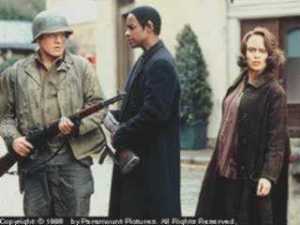 4. The Killing Game (Parts 1 & 2) (Voyager) Though it took Voyager about three years to get really good (and it took the departure of Kes and the addition of former-Borg Seven of Nine to the crew to really get it going), this mid-fourth season two-parter was wonderful in that it took the actors out of the roles that were familiar to us and put them into new roles—when their own memories/personalities are blocked and they’re cast as characters in a World War II scenario on the holodeck by the Hirogen, a race intent on hunting down and killing as prey every other species it runs into.
 3. You Are Cordially Invited… (Deep Space 9) I believe this was the first wedding between main characters in any of the series, and it was definitely the first episode out of the lot to center around two of the main characters getting married to each other. It’s no secret: Worf is my absolute favorite Star Trek character, so any episode focusing on him was going to make me happy. But in addition to that, I loved the storyline between Worf and Dax—unlike the ill-conceived romantic storyline they gave him with Deanna Troi on TNG, because she was so wrong for him on so many levels—the relationship with Dax worked because she not only knew all of the Klingon rituals (and the language), she could, and would, stand up to him when need be. She could take him in hand-to-hand combat and yet still maintain her soft feminine side. Plus it was great to see the Klingon marriage rituals.
 2. The Best of Both Worlds (Parts 1 & 2) (The Next Generation) Resistance is futile. (Not.) Ah . . . the Borg. Humanoid species assimilated into a cybernetic civilization where they all become part of the hive mind. Things came to a head in the Season 3 finale when Captain Picard was assimilated by the Borg to become the liaison between the Borg and the rest of humanity as Locutus so the Borg could assimilate everyone else. The season ended with Lt. Cmdr. Will Riker firing on the Borg cube on which Capt. Picard was located . . . oh, no! We had to wait the whole summer to find out what happened! It was their first true cliffhanger season finale and probably the best two episodes out of any made in the entire history of the franchise.
1. Endgame (Voyager) Everything in the series built up to this, the final episode. And they pulled out all the stops: time travel, the Borg, the birth of a baby, mental illness, and death of beloved characters. While I’ve already admitted that “The Best of Both Worlds” is the best of the entire franchise, the reason that it’s not #1 and “Endgame” is boils down to this: “Endgame” made me cry. Voyager is my favorite series out of the entire universe (even though its episodes may not necessarily be as strong when compared to TNG) because of the cast of characters, the way they gelled, and the overall story arc: that they were 70,000 light years from home and doing everything they could to get back. Unlike TNG’s series finale, which was just a setup for the film that was already in production and not a true endcap to the series, Voyager’s final episode was actually the payoff we viewers had been craving for seven years. And it made me cry—the only other episode that ever brought a tear to my eye was the one in which Dax died in DS9 (but that was because Terry Farrell, the actress, was leaving the show to go be on Becker. That’s when I stopped watching DS9.). So, because it elicited an emotional response from me that no other episode managed to do, it gets my #1 spot.
Make POV Work for You: Writing the Male POV
This has to be one of the most popular topics amongst female authors at any conference out there. And the funny thing about it was that until I attended the 2004 ACFW conference in Denver, the first time that Randy Ingermanson taught this subject, I didn’t know anyone had trouble writing the male POV. I’ve actually always found the man’s POV easier to write in than the woman’s. And sitting in that class, though it was highly entertaining, I didn’t really hear anything I didn’t already know about men. I guess because I always found it easier to build friendships with guys growing up, I’ve done a lot more observing of them on a subconscious level than a lot of other women, who only look at them as “the opposite sex,” have.
Several years ago, my aunt Rinn introduced the women in our family to a fabulous little book that, to me, is the absolute best resource on writing the male POV ever. There are two versions of it, but I’ll call it by it’s shorter name: Men Are Like Waffles, Women Are Like Spaghetti (the version I own has the word Single in front of Men and Women in the title).*
This book gives the best analogy as to the differences in the way men’s and women’s brains (and therefore thought processes) work than anything else I’ve ever read. Basically the concept is this:
- Men’s thought processes are a series of boxes—like a waffle—and they can only be in one box at a time. If they’re in the “working on the car” box, they can only think about working on the car; if they’re in the “watching football on TV” box, heaven help you if you try to engage him in a conversation about anything other than football (or possibly the TV itself, since it’s in the box with the football game); and sometimes, they go into the “nothing” box—when you ask him what he’s thinking about and he says, “Nothing,” he really means it, apparently.
- Women’s thought processes are like a plate of spaghetti. Each idea/train of thought is its own noodle, but it crosses over and touches so many others that it’s very easy for us to jump from noodle to noodle to noodle and back to the original one without any effort at all. Every thought and issue in our lives is interconnected with just about every other thought and issue in our lives.
Now, these aren’t absolutes. I’m one of those women who can jump from spaghetti to waffle and back again easily. There are times when I get into the “zone,” whether it’s watching TV, writing, reading, or whatever, and I will not respond to anything that isn’t related to what I’m doing. I can also very easily compartmentalize my emotions and set them aside (in a “box”) to be dealt with at a more opportune time. When I have a purpose or goal (such as getting a work project done when I worked in a large office environment), I got annoyed at anyone who brought up anything not directly related to the project at hand. So there are crossovers. There are some men who can jump from idea to idea to idea with no effort. So don’t just take these as stereotypes that every man is this way all the time. It’s just a really good starting point for figuring out the differences in how we act/react/interact with each other.
As a result of experiencing life in boxes, men are by nature problem solvers. They enter a box, size up the “problem” that exists, and formulate a solution. In their careers, they consider what it will take to be successful, and they focus on it. In communication, they look for the bottom line and get there as quickly as possible. In decision-making, they look for an approach they can “buy into” and apply as often as possible.
A man will strategically organize his life in boxes and then spend most of his time in the boxes he can succeed in. This is such a strong motivation that he will seek out the boxes that “work” and ignore the boxes that confuse him or make him feel like a failure. . . .
A man also takes a “success” approach to communication. If he believes he can successfully talk with the opposite sex and reach a desirable outcome, he will be highly motivated to converse. If, on the other hand, conversation seems pointless or women seem impossible to understand, he loses his motivation to talk and clams up. “Hanging out with the guys” can become a pattern for men—sometimes they truly enjoy the male bonding, but other times they’re avoiding the consistent conversation women often enjoy.
(Bill & Pam Farrel, Waffles/Spaghetti)
How often have you heard a man ask, “Is there a point to this?” when in conversation with a woman? If he doesn’t say it out loud, he’s probably thinking about it. So get that into his viewpoint with your heroine who rambles. Want a great internal conflict for your hero? Put him in situations where failure is guaranteed. Give him a problem he can’t solve, a decision that can’t be easily made without the heroine’s (rambling) input.
But one of the most important things to know about men is that they say what they mean and mean what they say. They don’t mince words, they don’t beat around the bush, they don’t drop hints and hope someone else will catch on and understand what they’re not saying. Now that doesn’t mean that they say everything that’s on their mind—they can be very judicious with the words they choose to let loose, which gives lots of opportunity for subtexting. But he’s not only not going to try to wheedle and hint his way into something, he’s going to get extremely frustrated by a woman who does.
There’s so much more good stuff in this book that I wish I could post the whole thing here, but I’ll respect their copyright and refrain—but I will encourage you to find a copy of this book (you can probably buy it used on alibris.com or Amazon, if you don’t want to pay ten bucks for it new), because it will be one of your best writing resources you’ll ever own.
Now, for fun, here’s a list (from the book) of the Top 25 Reasons Why It’s Great to Be Male:
1. We know stuff about tanks.
2. A five-day trip requires only one suitcase.
3. We open all our own jars.
4. We go to the bathroom without a support group.
5. We leave a motel bed unmade.
6. We kill our own food.
7. We get extra credit for the slightest act of thoughtfulness.
8. If someone forgets to invite us to something, he can still be our friend.
9. Everything on our faces stays the original color.
10. Three pair of shoes are more than enough…maybe too many.
11. Car mechanics tell us the truth
12. We can sit quietly and watch a game with a friend for hours without thinking, “He must be mad at me.”
13. Same work, more pay.
14. Gray hair and wrinkles only add character.
15. We can drop by and see a friend without having to bring a little gift.
16. If another guy shows up at a party in the same outfit, you just might become lifelong friends.
17. Your pals will never trap you with, “So, notice anything different?”
18. We are not expected to know the names of more than five colors.
19. We are totally unable to see wrinkles in our clothes.
20. The same hairstyle lasts for years—even decades.
21. We don’t have to shave below the neck.
22. A few belches are expected and tolerated.
23. Our belly usually hides our big hips.
24. We can do our nails with a pocketknife.
25. Christmas shopping can be accomplished for 25 people on the day before Christmas and in 45 minutes.
(You can find even more, along with several of these, on the post Fun Friday—Why Men Are Never Depressed)
*Note: This is a book written from a religious perspective, and I do not endorse nor support everything within it. As I said, it helped me in understanding the differences between how men’s and women’s thought processes work, and I can then take that with me into my own worldview of how those thought processes should lead men and women to interact with each other—like equals, always and forever.
Make POV Work for You: Show Don’t Tell (Part 2)
Okay, one more contest judging anecdote. I’m currently judging entries in a first-three-pages contest for a small RWA chapter in the Midwest. I got through six or seven of them while waiting at Valvoline for my oil change and tire rotation. Every single one of them used the verb peeked in their first three pages! Why do I mention this? You’ll see in a moment.
For now, let’s return to our review of Showing vs. Telling and how it ties in with deep POV.
THE FIVE SENSES (see also Showing vs. Telling—Do You See What I See? and Showing vs. Telling—Do You Smell What I Taste?)
I mentioned on Tuesday two signposts of telling in previous posts (WAS and FELT), but would like to add a few more when it comes to sensing:
- Character SAW/WATCHED (She saw him running down the street.)
- Character HEARD (He heard a knock at the door.)
- Something SMELLED adjective. / Character SMELLED something. (Something smelled like it was burning.)
- Something TASTED adjective. / Character TASTED something. (The sweet taste of the apple filled her mouth a moment before she realized it was poisoned.)
- Character TOUCHED something. / Something TOUCHED character. / Character FELT something. (He looked down when he felt something brush against his leg and saw a cat.)
- Candy watched Mike throw open the door and storm out of the house. OR
- Mike threw open the door and stormed out of the house.
- Mark glanced up from his book when a rhythmic tapping interrupted his concentration. “Will someone please get the door?”
- The door rattled in its frame with the force of the pounding on the other side.
- A knock on the door—like the sharp report of a rifle—shattered the stillness of the room.
- Character KNEW (She knew he was unlikely to ever change his mind. vs. He was unlikely to ever change his mind.)
- Character THOUGHT (He thought she might consent to stay awhile longer. vs. Maybe she would consent to stay awhile longer.)
- Character WONDERED (She wondered if he would ever stop tapping his fingers. vs. Would he ever stop that infernal tapping?)
Here’s how this ties in with POV. When we “tell” that a character saw something (She watched him running down the street), we are holding the reader back from truly being inside the head of the character. When I see something, I am not (usually) cognizant of the fact that I am in the process of “seeing.” I just experience the action going on outside of me. So how does this work in prose? Let’s look at an example from Candy’s point of view:
The second example shows the action through Candy’s eyes as she experiences it. We’re right there with her, not held back from her like an objective observer which is what happens when we tell our readers that the character is seeing, hearing, thinking, knowing, etc. Yes, occasionally we need these telling phrases to make a complete sentence/thought. But before writing them, we should ask ourselves if there is any other way to phrase the sentence so that the action is more immediate and seen only through the lens of our character’s eyes.
Most of the sensory information we include in our writing is seeing and hearing. With hearing, it’s a little harder than seeing, because what someone hears is not immediately recognizable at times. Take the example I used above, He heard a knock at the door. Most likely, he is not going to know who is on the other side of the door, and since we are talking about writing in deep POV, I as the author cannot step outside of my character to say who is knocking at the door if the viewpoint character does not know. So I must see if there is another way I can rewrite it:
One way some writers try to get around this is just to replace the words “he heard” with a pet-peeve phrase: “there was” (There was a knock on the door). The main reason not to use this phrasing at all (or with as limited use as you can) in your writing is that it is passive-nonspecific. In this example, we have replaced a somewhat active verb (heard) with a passive verb (was) and a specific subject (he) with a nonspecific subject (there). Neither of which is deep point of view!
THE SIXTH SENSE (see also Showing vs. Telling—The Sixth Sense and Internal Dialogue)
Establishing POV and viewpoint—from the level of omniscience to who the viewpoint character for each scene is—is all about the narrative which, in Deep POV, should be the character’s stream of consciousness. I’ve mentioned before and I’ll say it again: writing in Deep 3rd POV is very similar to writing in 1st Person POV. You want to be as deeply embedded in the character’s mind as if they were the ones speaking, not you. Telling signpost words to watch out for here are:
But here, again, is when you need to balance the desire to show with the overuse of certain narrative devices, like the rhetorical question (such as the third example). You don’t want your narrative to be so overloaded with questions inside your character’s head that they appear wishy-washy because everything is always in the form of a question. You also want to be cautious about overusing italicized direct internal thoughts except for emphasis. In most manuscripts, places where direct internal thoughts are used could be easily changed to third person and serve to deepen the POV.
MAKE IT ACTIVE (see also Showing vs. Telling—Puppets, Cartoon Characters, or Live Action?)
Using passive verbs is just like being passive in life—you don’t want to do it. Depending on the type of story you’re writing, you may want to choose soft, descriptive verbs or you may want to choose bold, aggressive verbs. But whichever verbs work best for your story, try to use the active form of them as often as you can! Go through your manuscript and using the “Highlight All Items Found in: Main Document” option, highlight all instances of (whole words) was, wasn’t, were, weren’t, had, and hadn’t (once it finds all instances, you can change the font color or use the highlight feature to color them all at the same time). Then start eliminating those occurrences by replacing them with more active, descriptive verbs. Let your characters’ emotions and the intensity of the scene lead you toward choosing the correct verbs to use to convey what your reader needs to know about your character’s thoughts and emotions—without “telling” the reader what those thoughts and emotions are!
Oh, and do some peeking at the verb choices other writers use by being aware of them when you’re reading and make sure you’re not getting repetitious or cliché with the choices you make.


