My Characters’ Christmas Greeting
I was going post this on Friday, but it made me laugh so hard, I couldn’t wait to share it.
The heroes of my four released contemporary novels—George Laurence (Stand-In Groom), Major O’Hara (Menu for Romance), Forbes Guidry (A Case for Love), and Bobby Patterson (Love Remains)—wanted to wish y’all a merry Christmas:
Subplots–Decorating a Christmas Tree
I originally ran this article in 2006 . . . and I thought it would be fun to run it again, given the time of year.
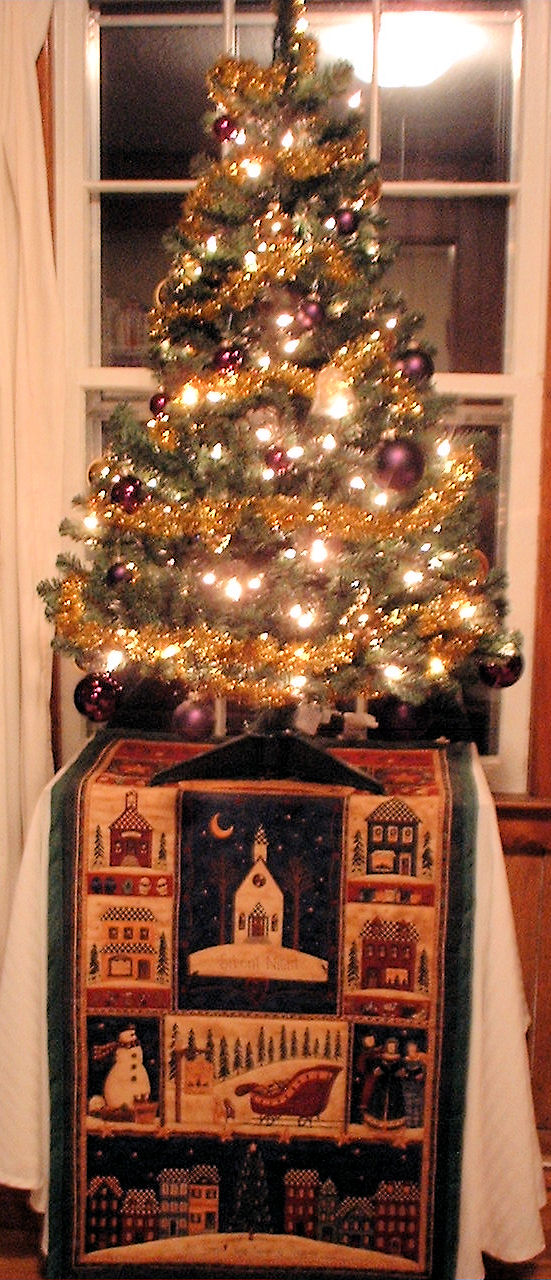 I’ve lived on my own for a little more than ten years [ed. almost fifteen years now!]. In 2005, for the first time, I bought a little, pre-lit, 4-foot, artificial Christmas tree. Then, I had to decide how to decorate it. I had a small box of eclectic ornaments collected and received over the years that I could have used, but I really like cohesiveness and uniformity in the decorations in my home. So I chose to adorn it with glass balls in dark purple and gold (some shiny, some matte) with gold garland and a gold and white angel at the top. Some might find it boring, but I loved it. It was pretty, I liked to look at it, and it represented me—purple is my favorite color and in combination with gold reminds me of home (Baton Rouge where I spent every summer and eventually went to college at LSU. If I had a ten-foot tree, I would probably not do just two colors of glass balls. I would use all of my childhood ornaments and find others that represented me as well—because a large tree doesn’t look as unkempt or overwhelmed with a variety of shapes and colors.
Subplots are much like Christmas ornaments. Imagine your story as a Christmas tree:
You have your story structure (the tree itself)—the conventional structure of your genre/your plot at its most basic form.
You have your main characters: The lights.
Then you start adding ornaments.
Setting: gold glass balls
External conflict for the POV characters: red glass balls
Internal conflict for the POV characters: green glass balls
Spiritual conflict for the POV characters: blue glass balls
If you have a “small tree” (a short story or novella), you are going to have a hard time fitting much more than this on your “tree.” Even in short category fiction, there isn’t really room for much other than the main plot involving two POV characters.
 However if you have a “large tree” (a full-length novel), there is much more room to add more ornamentation:
Additional POV characters: the themed ornaments you’ve picked up everywhere you’ve ever traveled
Subplot A*: animated Hallmark ornaments
Subplot B**: all of those felt reindeer and Santa Clauses you made in G.A.s or Sunday School
Minor characters: tinsel and garland
- *Subplot A—perhaps involves those additional POV characters and seems to be separate from the main plot but ends up having an effect on the story’s outcome.
**Subplot B—perhaps involving the antagonist and his schemes for derailing the main plot.
Do you have to put every single ornament on the tree?
No. Nor do you have to explore every idea for a subplot you have. Have you ever seen a Christmas tree so overloaded with ornaments that you couldn’t see the tree or the lights because of everything hanging on it? Have you ever seen a tree fall over because the weight either isn’t distributed properly or was just overwhelmed? You don’t want your novel to be like that overwhelmed tree. But you don’t want a Charlie Brown tree, either.
I’ve had manuscripts in the past that were like a tree starting to lean to one side because all of my ornaments were hooked onto the main plot. One of the first rules of developing a subplot is to take a minor character who is involved in his or her own plot and start writing that plot as well—interrupting the main plot when it will build the most suspense—all the while making sure it is relevant to the main plot.
When writing Ransome’s Honor, I had a brainstorm. I’d written early in the manuscript (in a desperate measure to try to stir up the story) that the hero’s mother and sister were coming to town. But it wasn’t until the sister, Charlotte, came on stage that I realized she was just the subplot I’d been needing. I suddenly found myself not only writing in her POV, but seeing how she provided much of the plot and conflict for Book 2 of the trilogy, and became vitally important to the ultimate climactic conclusion in Book 3. Charlotte’s appearance made me realize I had a ten-foot tree, not a four-foot tree when it came to the Ransome Trilogy!
What about you? Do you have a large tree or a small tree. What kinds of ornaments (subplots) are you decorating it with?
Fun Friday–Playlist First-Line Christmas Poem

Awhile back, we did the playlist first-line poem. I’m adapting it for the Christmas season! Just in case you’ve never played, here’s how you do it:
Using your iPod, your MP3 player, your iTunes, your Windows Media Player, (set on Shuffle/Random) or Pandora.com or AccuRadio.com set to your Christmas music playlist, create a “free-form poem” by writing down the first line of a song, then skipping to the next song. Try at least 20 and see what you come up with—and feel free to arrange/group them so they make some kind of sense. (When you run out of “skips” on Pandora, just refresh the page.)
Here’s mine:
—————————————————-
It’s the holiday season—
Oh, by gosh, by golly, it’s time for mistletoe and holly.
The holly and the ivy. . .
Holly’s in the window!
I just came back from a lovely trip along the Milky Way,
Over the river and through the woods—
City sidewalks, busy sidewalks.
I saw three ships go sailing by
In the little village of Bethlehem.
I don’t much care if I am the last in line to see
Frosted windowpanes, candles gleaming inside.
The snow is snowing, and the wind—it is blowing.
Oh the weather outside is frightful;
It’s a marshmallow world in the winter.
I pray on Christmas,
Seven days a week, every week of the month, and every month of the year:
I’ll be home for Christmas.
Oh, there’s no place like home for the holidays!
I’m doing my Christmas dreaming a little early this year—
I’m dreaming of a white Christmas,
Chestnuts roasting on an open fire,
A snow covered house on a hilltop.
I believe, I believe.
I’ll have a blue Christmas without you.
I never will forget the station where we met,
The song that you sang so sweetly.
The flame we kindled hasn’t dwindled at all.
I really can’t stay.
Hark how the bells, sweet silver bells, all seem to say, “Throw cares away!”
I heard the bells on Christmas Day:
Jingle bells, jingle bells, jingle all the way!
The jingle bells are jingling, the streets are white with snow;
Old Mr. Kringle is soon going to jingle the bells that’ll tingle all your troubles away—
Sleighbells ring—are you listening?
It came upon a midnight clear,
The blessed dawn of Christmas Day.
There’s a new little boy in the neighborhood—
Jesus, Jesus, oh, what a wonderful child!
It’s the most wonderful time of the year—
Have yourself a merry little Christmas!
Costume Drama Thursday: Victoria & Albert and The Young Victoria

Victoria & Albert
 I posted several months ago about the new historical series proposal I’d just completed, which is set in England and features the Great Exhibition of 1851 as a central event that ties the three books together. The reason I know anything about the Great Exhibition is from one of the last costume-drama miniseries produced by and aired on A&E, Victoria and Albert. Even though I was far more interested in the works and time period of Jane Austen when V&A aired in 2001, it aired during the semester I was taking the second half of my British Literature course, so I watched it due to my general interest in the era (and a love for history, romance, and costume dramas).
 Before watching V&A, I was most familiar with the lead actress, Victoria Hamilton from her role as Henrietta Musgrove in the 1995 (best, definitive) version of Persuasion (it was only after seeing P that I recognized Victoria Hamilton in her bit role as Mrs. Forster in P&P). Because I only knew her as Henrietta, a silly young girl, I was concerned at her ability to pull off the range of emotion and maturity surely needed for Queen Victoria. And about the fact that she has a somewhat high, girlish, squeaky voice. And it took me a long time to figure out that Jonathan Firth, who’d played Lord Arthur Goring in An Ideal Husband, was Colin’s (much) younger brother.
I have to admit—I didn’t know much about the life and marriage and reign of England’s longest-reigning monarch. I knew more about the era named after her than about her. And I must say, I thoroughly enjoyed the miniseries when it aired, and the several times I watched the recording I made of it until a few years later when I bought the DVD. Like many of the A&E/BBC miniseries costume dramas, it takes things slowly, showing the development of the characters over a period of time. It does focus more on their courtship and early marriage—then the timeline speeds up in the second half. It also does something that no other movie I’ve seen about Queen Victoria does: It explores their home life and their relationship with their children, especially eldest, Bertie, who became King Edward VII in 1901, upon Victoria’s death (also lending his name to an era, the Edwardian era, though he died in 1910, just when it was really getting in full swing).
I highly recommend this film for anyone interested in learning more about Queen Victoria and the Victorian age. And I highly recommend you watch it before you watch . . .
The Young Victoria
 This is one of those British-made movies that released in the UK ages before it made it across the Pond to the US. It released at the beginning of 2009 in the UK, spent time generating buzz and screening at film festivals for the next eleven or so months, and finally entered wide release in the US at the end of December 2009. It opened New Year’s weekend in Nashville—we went to see it on New Year’s Eve. We’d already been prepared for lavish sets and cinematography as well as fabulous costumes. And we were not disappointed—though the sets and costumes in V&A were lovely, the cinematography and display on the big screen made YV much more of a visual feast. We were also not disappointed in the movie itself.
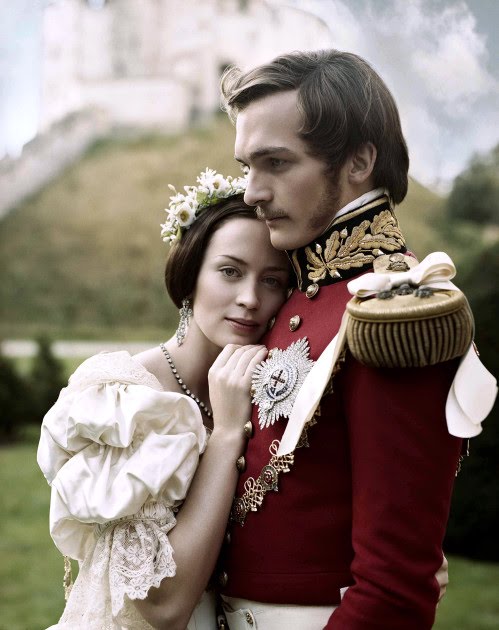 As the title suggests, this movie does not try to tell the entire story of Victoria’s reign, but only covers the year before Victoria’s ascension to the throne and the first three years of her reign. Unlike V&A, in which Victoria falls in love with Albert quickly—whereas it takes Albert a little longer—in YV, we’re given a more traditional romance story, in which Victoria and Albert fall in love with each other somewhat easily and quickly during their courtship. Because this was a cinematic film instead of a more staid A&E/BBC costume drama, it shows a more sensual side of these two people (though it’s very sweet—nothing embarrassing or overt). Both movies dig into the politics of those years, though YV does a much better job of drawing us into these political intrigues because of the casting of Paul Bettany as the Prime Minister, Lord Melbourne, on whom Victoria depended greatly during the early stage of her reign.
There’s another P&P connection in this movie as well . . . Rupert Friend, who plays Prince Albert in YV played Mr. Wickham in the 2005 version of P&P. I liked him much better as Albert!
Several events are portrayed in both films, which makes an interesting comparison (especially the loud arguments they apparently occasionally had). And if you’ve seen YV but not V&A yet, let me warn you—you’ll probably be disappointed with V&A. It’s not as much of a “romance” as it is a “history with a romance thread.” V&A’s scope is broader, trying to cover as much about Victoria’s reign, marriage, and family as possible, whereas YV is focused solely on the romance between these two people.

Have you seen either or both of these movies? Which do you like better?
.
The Problem with First-Person Narrators–or, Why *November Christmas* Didn’t Work for Me
Watching the Hallmark Hall of Fame Christmas movie on CBS the Sunday of Thanksgiving weekend is something of a tradition in our family—mostly because it preempts the shows we usually watch at that time and on that channel, and we’re too lazy to see if there’s anything else worth watching on (probably not).
So we watched November Christmas last night. (Caution—spoilers below. Stop reading now if you DVR’ed this last night and haven’t watched it yet.)
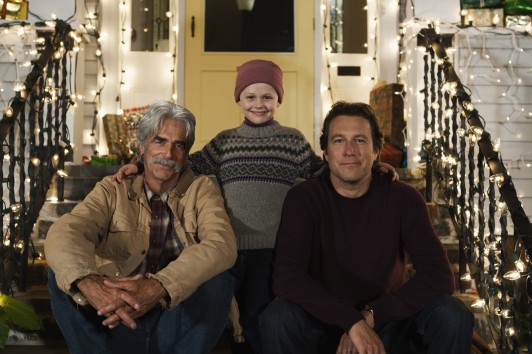
A young woman drives down a snowy two-lane road. She stops and takes a picture. She drives into the town and pulls up in front of the library. People there greet her as if they know her. She hurries over to a circle of waiting children and picks up a book—a book entitled November Christmas. She starts talking about the book to the children.
And I turn to my dad and say, “I guess we know the little girl with cancer survives.”
Which pretty much spoiled the rest of the movie for me, because it removed any jeopardy, any emotional investment I might otherwise have made in the characters/movie. Yes, the characters came together and pulled off an early Halloween and an early Christmas for this little girl with cancer (I assume leukemia, though it’s never specified). But because I already knew that the little girl went on to live and grow up, it didn’t really mean as much as it could have it the child’s survival had been in question. There was no reason to frame this movie with the grown-up version of this child reading the story to other children fifteen years later. It would have been so much better if they’d started out in the “fifteen years ago” time frame, then gone up through Vanessa standing in the snow with her snowglobe and gone to a dark screen there; then, they could have flashed “Fifteen Years Later” and shown her as an adult returning to town for a joyous victory after leaving us wondering if she lived or died.
And this is the problem I have with most books written in first-person narrative, especially those that have any measure of suspense or threat to the life of the main character. Because, with the exception of books narrated by “ghosts” (e.g., The Lovely Bones), if an “I” narrator is telling the story, as a reader, I know that the main character survives everything thrown at him/her.
I have to admit, I watched this movie primarily because John Corbett and Sam Eliot were in it—and I love watching both of those actors. And they did great jobs in their roles (but, again, knowing that the little girl lived stole the emotional resonance from their scenes—though when Sam Eliot’s character talked about losing his son, I did choke up a little).
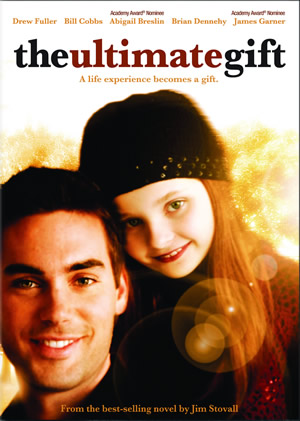 I have to compare this to another little-girl-with-cancer/Christmas movie I’ve watched recently, and that’s The Ultimate Gift. I didn’t choose this one—it’s one my parents got from Netflix. It’s a combination of an inheritance-with-lots-of-strings-attached story and a little-girl-with-cancer-plays-matchmaker-for-her-single-mom story. And it actually works. It was an engaging movie. They don’t come right out and let you know the little girl has cancer (I knew from seeing the previews for the Hallmark movie that the little girl had cancer) but it’s revealed as the guy gets to know her and her mom better.
Here’s the rub—The Ultimate Gift, with the way the cancer was revealed and progressed and how the story moved along in it, should have had enough emotional resonance to have me blubbering by the end of it. But I sat through it dry-eyed. November Christmas could have also had me blubbering, if they hadn’t spoiled the ending of the movie within the first three minutes. But, still, both are pretty good movies.
Have you seen either or both of these movies? What did you think of them?
Adrenaline-Fueled Panic
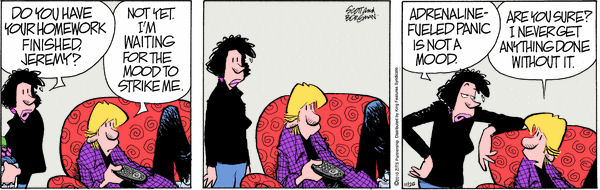
See, I’m not the only one . . .
Post-Surgery Photos
As those of you who’ve been following for the last few weeks know, I had surgery last Wednesday to plate the two bones (broken tibia, fractured fibula) in my right ankle. I went back day before yesterday to have my post-surgical wound-check with the P.A. (and for those of you who might have been praying, unfortunately David, my doctor’s P.A., is married after all).

Words can’t express how good it felt to have that splint (cast-like structure that wrapped around the sides of my legs and bottom of my foot in a U-shape) removed. I suffer from dry skin, eczema, and psoriasis, so my skin itches pretty much nonstop anyway—but wrapped up for a week . . . I was miserable. (And that white fuzz you see in these pictures is where the cotton-batting underlayer of the splint stuck to my skin, it’s not mold or hair!)

This surgeon, Dr. Olive (who, according to everyone we’ve talked to since I pulled his name off Google, turns out to be the best/most highly regarded orthopedic surgeon in Hot Springs), instead of writing NO on the limb not being cut on, “autographs” the limb he is working on, so that’s why his name is written down my leg (and I’m pretty sure he used a permanent-ink marker, because I’ve scrubbed and scrubbed at it the last two days, and it’s barely faded).

Dr. Olive also uses plastic surgery–style under-the-skin stitches, which means I should have very little scarring (which thrills me, since I’ve always been rather vain about my “skinny” ankles). Though this looks a little worse than it is because of the marks left from the splint/wrappings, you can compare this post-surgical view to the pre-surgical views here and here.

The two lines that look like bruises under the incision on this side of my ankle are actually bruising/scabbing from where the original splint that was put on me at the ER abraded the skin. It still feels pretty raw and burns at times—worse than the actual incisions upon occasion!

P.A. David was lucky in this shot that my left leg wasn’t bouncing up and down like a dog’s when the “sweet-spot” is hit in a belly rub or back scratch, because just the light, gentle rub-down with alcohol on the gauze pads was enough “scratching” to send me straight to Elysian Fields after a week of not being able to get to all the places that itched.
Though he was more in favor of putting me in another one of those cast/splints for two more weeks, until my next appointment, after I swore a blood-oath that I wouldn’t put any weight on it, he agreed to let me go with the walking boot and an ACE-bandage wrap (with sterile bandage pads protecting the incisions underneath). And he told me that since the scars look so good, he’s going to let me go ahead and get it wet (i.e., take a shower) in another week instead of after the next appointment. He also told me that the screw that they had to put through both bones to pull them back into position will have to be taken out no more than twelve weeks after surgery. Hopefully, if I keep doing as well as I’ve been doing, they’ll be able to take it out by the end of December/beginning of January, saving me a trip back here in February.
It’s nice to be on the healing and recovery side of surgery, but I’m still frustrated at continuing to have to wait until I can get around better. Don’t worry, I’m following my doctor’s/P.A.’s orders to the letter, but still, after almost fifteen years of complete independence, it’s hard to admit my limitations and ask for help.
New Laptop


Not-so-Fun Friday: Ouch, Part II
When we last left our plucky heroine, she was off to the surgical center to get her ankle bones plated back together. Now, back to our story.
I had to be at the surgical center (a small, formerly doctor-owned hospital adjacent to the building the ortho’s office is in, all of which is now owned by St. Joseph’s Mercy Hospital) at 1 p.m. on Wednesday. As soon as I rolled up to the window in the waiting room, they looked at me and said, “We know who you are!”
As always, my reputation preceded me (and I was the last surgical patient they had coming in that afternoon). I sat and chatted with my parents for a few minutes before they came and got me to take me back for prep. I went into the bathroom and and peed in a cup (an eight-ounce Styrofoam coffee cup!!) and then was taken into a curtain area to change into a lovely open-backed hospital gown.
The nurse tried starting an IV in the back of my right hand, but even after a shot of lidocaine, I was about to come off the bed because it hurt so badly. So she pulled it out and ended up getting it into the top of my arm about a hand’s-width down from my elbow (so now I have a lovely bruise on the back of my right hand). The worst part of where she ended up putting the IV is that she had to tape it down over the hair on the back of my arm.
The assistant anesthesiologist came out and talked to me about the happy stuff—and we determined that since I’ve had such a bad reaction to anesthesia and pain meds before, they’d do a nerve block on the leg which would keep them from having to dose me up with heavy-duty painkillers post-surgery.
The lead anesthesiologist came in and they had me roll onto my stomach. They gave me just enough “milk of amnesia” to make me very relaxed and loopy before they started poking and prodding the back of my leg (and the assistant had never done one of these blocks before, so I got the blow-by-blow of what they were doing—which included, if I remember correctly, a couple of very painful shots into the back of my knee). Once that was done, I decided to stay on my stomach, because it had been a long time since I’d been able to stretch out like that—I spend so much time sitting or hunched forward to lean on countertops or rails that it felt good to be in a completely straightened-out position. Mom and Dad came back for a few minutes to pick up the stuff I wouldn’t need anymore (our wheelchair, the boot and compression stocking, etc.), and then it was good-byes and they wheeled me back to the surgical chamber. The lovely thing about being on my stomach is that they pushed the gurney right up to the side of the surgical table and I was able to just roll over onto it on my back.
After a little more laughing and joking (this has been my theme throughout this entire ordeal), the anesthesiologist put the oxygen mask on me and told me to breathe deeply, that he was starting to administer the good stuff. If he ever asked me to count down from 100 (or even 10), I don’t know—because two breaths later, I was gone. (I was ready to go, though, because I’d stayed up until almost 4 a.m. the night before finishing an editing project.)
Next thing I knew, I was waking up in recovery. Apparently there are a few minutes I can’t remember (just checked with my parents about anything embarrassing I might have said—nothing to that effect, but there are a few blank minutes there). Blessedly, I did not get sick, either from the anesthesia or the painkiller they gave me in recovery. In recovery, my lower back was killing me—from an hour or so lying flat on that hard surgical table—but the painkiller they gave dealt with that readily.
When Dr. Olive got in, he discovered that the tibia and fibula were somewhat separated, so in addition to plating both bones, he had to put a long screw in that goes through both bones to pull them back together. That long screw will have to come out eventually—probably about six months from now.
By the time they got me to my room, I was much more alert and aware. My surgery started around 2:30 p.m. and it was right at 4:20 when they got me to my room (I know, because the wall clock in the room needed to have its battery changed and they had to set it). Mom and Dad stayed with me until about six o’clock—long enough to see that I could keep down the chicken broth and Jell-O they brought me. Then I was on my own for the rest of the evening. Thank goodness they have cable at the surgical center—I was able to watch all of my favorite HGTV and Food Network shows (did anyone else see the Throwdown episode featuring the Pioneer Woman?). By this time, my stomach was growling (and, no, watching Food Network wasn’t helping), so I asked the nurse if it was possible to get some solid food (all I’d had to eat in twenty-four hours had been that broth and Jell-O). The kitchen was already closed by that time, but they did have soup, so she brought me some veggie-beef (Campbell’s) and crackers and a Sierra Mist. While it wasn’t nearly as satisfying as what I was looking at on TV, at least it was something.
I never sleep well away from home—and especially when forced into an unusual position (I’m a side-sleeper, not a back sleeper) with a pillow that’s the equivalent of a two-inch slab of granite. I did manage to doze between 2:30 and 5:00 a.m. and then again from 5:30 to 7:00 a.m., when my doctor’s PA, David, came in for rounds. We discussed pain management, and he decided that since I was in so little pain the morning after surgery—with no pain meds having been administered throughout the night (the nerve block wore off about 12 hours after administration, or around 2:30 in the morning, and the last pain meds they’d given me were just after surgery) that he would send me home with orders to take two aspirin a day (to ward off blood clots) and over-the-counter meds for pain management.
That was at 7:15 a.m. Around 7:30, they brought me my breakfast (eggs, ham, grapefruit, coffee, milk, and oatmeal that I didn’t eat). Mom came around 8:30. But it was still almost 11 a.m. before I got to leave. And, of course, we had to go through the drive-thru at Starbucks on the way home.
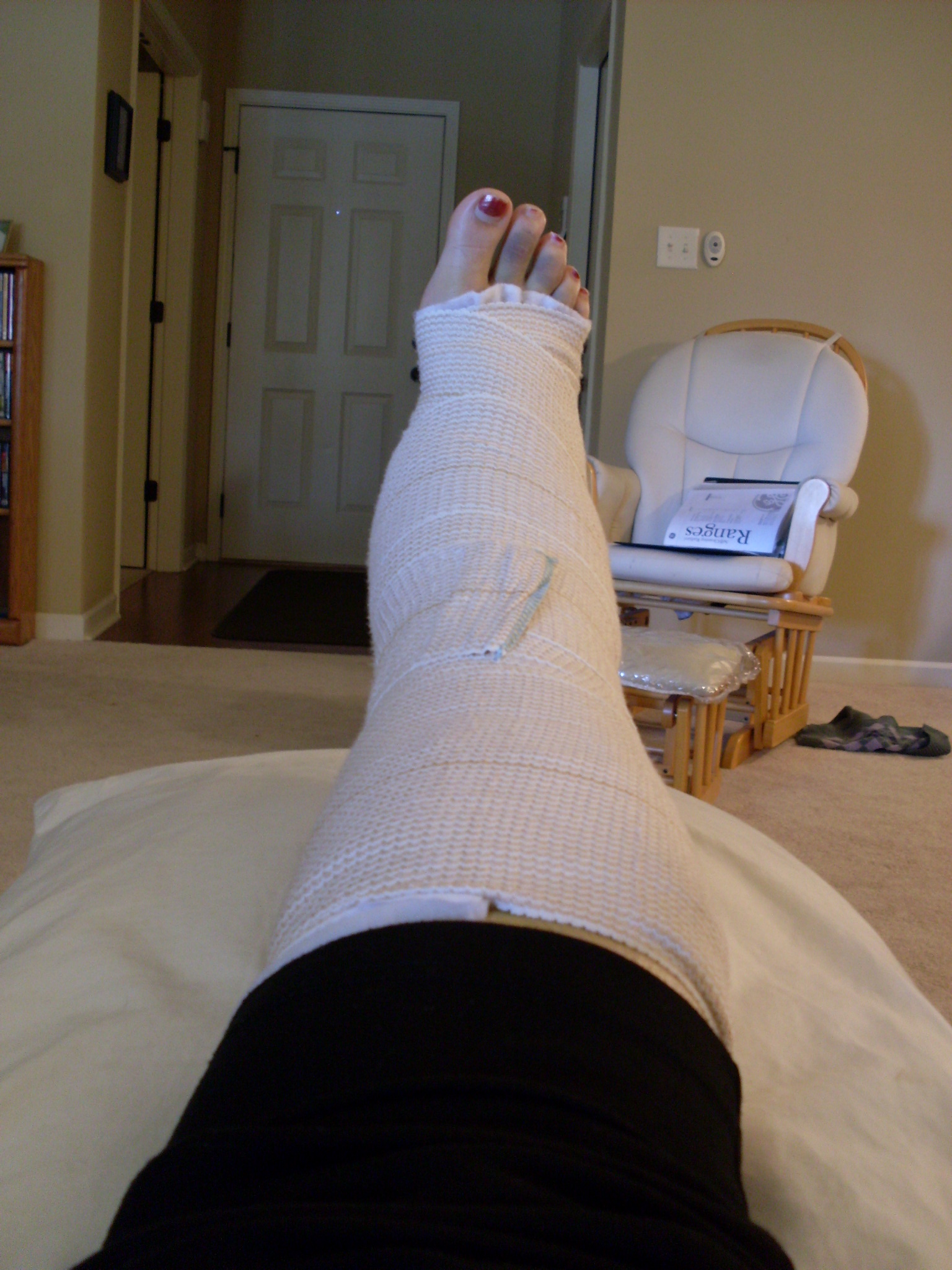
So, now I’m back at “home” (my parents’ house) and keeping my foot elevated as much as possible to try to get the swelling down (no, my toes are not gangrenous—that’s bruising leftover from the original dislocation injury) so that when I go back to see David on Wednesday, everything will look fine for me to be put back into the boot and possibly to start trying to put a little weight on it.
Now, it’s back to re-reading The Art of Romance* so that I can get it finished by the end of the month.
- *When I opened the file last night, I discovered that the word count in the combined file was showing just over 68,000 words. This confused me, because I know the counter has been sitting at 65k for quite some time. Then I realized . . . I never got around to recording the word count of the chapter I finished at the library at Trevecca two weeks ago. I wonder why that is.
Home from the Hospital
Now the healing begins.
I’ll fill you in on the details of everything tomorrow, but just wanted to thank everyone for your prayers and positive thoughts. I did have to stay in the hospital overnight, which I was hoping I wouldn’t have to do, but I’m now home (at home with Mom and Dad) with my laptop, my Starbucks sugar-free caramel latte, dog snoring in her bed to my left, and a couple of pillows under my foot—all accompanied by the noise of the construction guys installing the drywall in the new closet/sitting-room addition to my parents’ master bedroom.
While lying awake for several hours last night, I forced myself to think about Caylor and Dylan; and though I didn’t have any epiphanies about their story, it did put them back in my mind. So today, I’m going to go back and read through the first 2/3 of the manuscript that’s already written and try to blitz through the rest of the manuscript—hopefully by the end of the month, since I won’t have anything else I can do between now and then. 😉

 KayeDacus.com