“Say What?”–What Direction Is Your Dialogue Going?
If you don’t take away anything else from this series, one of the most important things we have to learn about dialogue is that in a novel, dialogue must impact the story and the story must impact the dialogue. The plot(s) and conflicts of the story are what should drive the dialogue so that what your characters say pushes the story forward.
Yesterday, I gave a visual example of how our brains naturally think that when we see a page with dialogue on it, the story will be moving. Therefore, when we write dialogue, we need to keep that in mind. There’s a very popular self-help book out on the market called Don’t Sweat the Small Stuff. Well, I’m going to co-opt that title and say Don’t Write the Small Stuff. Yes, we’re going to have hellos and goodbyes in our dialogue—that’s not what I’m talking about. What I’m talking about are the long conversations with a friend about nothing of great importance—about that movie on TCM we both watched or our excitement over the upcoming new movie Australia and how glad we are that Russell Crowe turned down the main male lead and Hugh Jackman was cast instead, and wondering how large a role David Wenham will have.
Those conversations, while important to my day-to-day relationships with friends and family, aren’t necessarily important to the “plot” of my life. But when I talked to my dad about whether or not I’m going to try to find a full-time job or continue freelancing after the end of the year, that’s a directional conversation—it’s showing in which direction the plot of my life story is going.
Tom Chiarella puts it this way in Writing Dialogue: “What your character says is directed by the needs of the story.”
Put dialogue in the driver’s seat in scenes where you need to drive conflict. Make your character want something that he needs to get from another character. Will he just walk up and ask for it? Or will he commence in small-talk first and then get around to asking for it? And how will the other character react to this request?
“All good dialogue has direction. It’s a mishmash of needs and desire on the part of an individual character weighed against the tension inherent in the gathering of more than one person. . . . This is the stuff that fills the spaces between us, even when we don’t recognize it. As a writer, you have to learn to trust that it’s there” (Chiarella, 21)
Going back to the example I used last week of how we greet people, have you ever thought about the emotion behind the way you choose to greet someone? When I see someone I know and they ask me how I’m doing, I always say hello back, and maybe add a “you look great” (if I mean it) and hope they forget that they asked me how I’m doing—because I really don’t want to answer. See how that might work for a character who’s hiding something or who doesn’t really like to talk about herself? That’s dialogue that gives direction to the development of a character. Or turn that around to a character who not only asks, “How are you?” but persists (“No, I mean, how are you really?”) until it makes everyone around her uncomfortable. (Yes, I actually used to know someone like that.)
How many books have you read that start with dialogue as the first line/hook? That’s definitely directional dialogue, because not only does it kick off the entire story, but it kicks off the tone of the story. It should also immediately introduce the tension/conflict that will be present for the rest of the novel. Starting a novel with dialogue gives you a chance to immediately introduce the main character through interaction with others, giving the reader a chance to come to know the character by experiencing his words and his thoughts as he volleys back and forth with someone else. Of course, snappy dialogue isn’t enough for an opening scene. It really must be providing your reader with the “implicit promise” that Nancy Kress talks about in Beginnings, Middles & Ends.
One major problem with directional dialogue is that the reader can sometimes begin to see it not as natural conversation between people, but as a tool the writer is using to direct what’s going on in the story. You can’t just have one character interview another so that you can explain backstory (oops, I have Meredith being interviewed by a TV reporter in MFR!). This goes back to what we learned last week by comparing real-life conversations with scripted dialogue. While we need to clean up and rearrange the real-life conversations in order to make them work better on the page, the rhythm of real conversations—pauses, interruptions, silences, reversals (turning what someone said back on them), changes in sentence length, changes in speed/tone, use of idiom/jargon, and use of details already known between the characters speaking (such as the “I see it; I see it” example I gave at the end of the How Do You Say Hello? post).
In the series I did on Showing vs. Telling, I talked about telling backstory through dialogue:
Telling what happened before the story began is, most often, important to the events going on in our stories, whether it’s what someone does for a living, or events from a character’s childhood (“backstory”). I find that dialogue between characters tends to be a good way to get this information across. Most of the time, there will be other characters who do not know all of our protagonists’ pertinent information. Dialogue is immediate, and the beats in between should be active. But it can still be a stumbling block. Here’s an example of what Stein calls “the silliest way that ‘telling’ crops up”:
“Henry, your son the doctor is at the door.”
Dialogue should never be used to convey information to the reader that the character being spoken to already knows. However, a statement like this could work as a way to get the information across if it’s said as a joke, an insult, or something that will elicit a reaction out of another character. For example:
The door opened. Mom looked up and smiled. “Henry, your son—the doctor—is here.”
Craig’s guts twisted and the cereal he’d just swallowed threatened to make a repeat appearance. Would she always compare him to his brother? It wasn’t Craig’s fault editors kept rejecting his novel.
What does this example say about these characters? About what Craig and his brother do for jobs? About how Mom feels about their chosen professions? About Craig’s relationship with his mother?
In the first dialogue example, the mother’s statement is merely the author trying to get information across to the reader. In the second example, it becomes directional dialogue, because it illicits a reaction; and in addition to giving information, it’s a jab at the non-doctor son—characterizing the mother in the scene as well.
So when you go back for revisions—or as you start writing a scene with dialogue—ask yourself if it has direction. If not, try to find it or add it. Otherwise, cut, cut, cut!
“Say What?”–A Delicate Balancing Act
Remember back at the beginning of the series (all the way to last Monday) when I posted the scoring guidelines for several different contests? Most of them required a “balance” between narrative and dialogue as the mark of good writing.
But what is this balance, and how do we know when we’ve achieved it?
Think about a book you’ve read that you found hard to read, or in which you found yourself skipping over paragraphs or even pages of the story. Sometimes, that’s because it’s just not an interesting story to us. But a lot of times, it’s because the author hasn’t managed to balance narrative with dialogue. This is going to vary from genre to genre—literary fiction is going to have much more narrative, for example. But in genre fiction, we don’t want to spend too long inside our character’s head because narrative doesn’t drive conflict—dialogue does. Why? Because dialogue happens between two or more people. And it’s bringing our characters in contact with other characters that will create and sustain conflict.
A lot of times, as novelists, we’re too apt to put our characters in situations where they’re alone, or at least by themselves/isolated even if they are surrounded by people. They’re not talking to anyone. We’re just camping out in their heads, wallowing in their angst, reading them rehashing everything that’s happened to them up to that point in the story—or worse yet, learning their entire backstory.
Let’s look at it a different way:
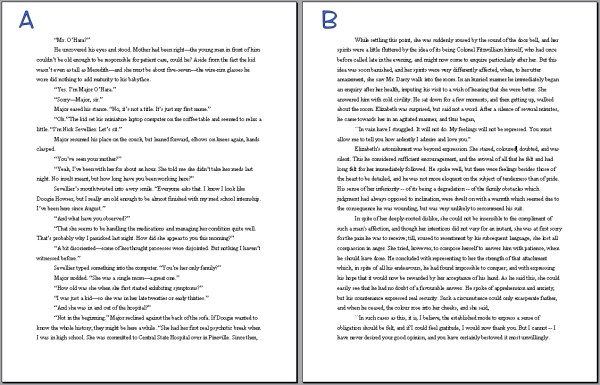
Just looking at a thumbnail image of these two scenes, which would you say is the scene that is actually moving the story forward, the one that has the most potential for conflict?
Most of you probably chose A, right? Well, it might surprise you to know that the scene in sample B is the first proposal scene in Pride and Prejudice. The A example is taken from Menu for Romance when Major is talking to his mother’s doctor. So in A, the dialogue is more about exposition than conflict—Major is giving the doctor important information about his mother, about his own life with his mother. In B, it’s one of the most conflict-filled parts of the story, yet it’s given mostly in narrative.
I know, it’s an unfair comparison to use a current work against a classic, but hopefully, you get the point, which is that there’s a psychological effect of the white-space that dialogue gives on the page that makes the reader believe that the story is moving forward, that there’s more action, more going on in the story than a page full of narrative does.
However, there’s a danger with dialogue, too . . . our characters can become nothing more than talking heads.
Think about it this way: if a screenwriter were to write a scene where two characters are talking about whatever it is that’s drawn them together in the story, but the director told the actors to just stand in one spot, and the cinematographer set the camera so that it just framed their heads as they talked to each other, it wouldn’t make for a very interesting movie, would it? Even if it were the best-written dialogue in the world.
Screenwriters depend on a host of other people to make sure that the intent behind the words they write gets portrayed accurately on screen—the director, the cinematographer, the actors, the location scout, etc.
As novelists, this is all within our hands. We are responsible for making sure the reader can see our characters—what they look like, when they react to something with a facial expression or body language, where they are located in the space, what setting they’re in, where they are in relation to other characters in the scene, etc. Again, this varies by genre—romance novels will have a lot more focus on the character’s physical presence, on what they look like, on where they are in proximity to the other character; mysteries will have more focus on the character’s location in the setting, on his interaction with the “props” surrounding him, on his observation of others’ body language/facial expressions; thriller/horror may have even more of a focus on the setting and surroundings.
But we also need to make sure that our readers know what’s going on in our characters’ heads as they speak. When I’m judging contest entries or critiquing and I come upon an exchange of dialogue that only gives the physical blocking (i.e., where the characters are in the setting, where they’re moving their hands, what facial expressions they’re making), my comments are typically along the lines of: But what’s she thinking? What’s she feeling? How does this accusation make her feel?
Usually, in a first draft, I have a tendency to go either overboard on giving the physical/emotional/visceral reaction during dialogue—or I just have dialogue with a little bit of stage direction. This is why revision is essential to dialogue. When we originally write it, we know the intent behind what’s said, the tone with which it’s said, the reaction it garners from the other characters in the scene. But when we go back, after having been away from it for a while, or when our crit partners get hold of it, we’re in a different head-space and will see where we need to fill in the gaps of emotional, physical, or visceral reactions. (Visceral referring to the deep, instincts each of us has–fight or flight, the uncontrollable gut reactions.)
So in your first draft, allow yourself to write talking heads, or to include lots of narrative with your dialogue. But when you revise, do it as if you’re walking a tight rope—too much dialogue may start dragging you down on one side, too much narrative on the other.
“Say What?”–Where Do I Put the Quotation Marks?
This will probably be review for all of my readers, but we can’t talk about dialogue without talking about the technicalities of it.
Where quotation marks come in relationship to other punctuation can be rather tricky, especially if you’re like me and you read not just American-published stuff, but British and Australian as well. If you’re outside of the U.S. reading this, please understand that the rules I will refer to apply to standards of American publishing. Also, this will focus on the use of quotation marks in fiction/prose writing.
As 99.99% of fiction writers already know, spoken dialogue is enclosed in quotation marks. A change in speaker is indicated by a new paragraph:
“I’m sure they treat you like a celebrity down in Atlanta.”
“Hmm.” The author grimaced. “Yeah—and that’s one of the reasons I’m here now.”
A thrill of excitement rushed up Kirsten’s spine. “Are you here to research a new book?”
“No, but I’m sure this place and its history will give me some ideas. I’m moving here—to teach English and journalism at Boone College.”
“Oh—those lucky students! I’m sure you’ll be their favorite professor.”
“Thanks.” Ms. Hebert sipped the latte. “This is really good. How much do I owe you?”
Kirsten held her hands up in protest. “A visitor’s—or newcomer’s—first cup is always on the house.”
Periods vs. commas. A period is used when what comes after the closing quotation mark is a new sentence (all of the examples above). A comma is used when what follows is part of the same sentence—most often seen with “said/asked” dialogue tags or when an action beat comes in the middle of a line of dialogue:
“If you’ll just look at this,” she held the report out toward him, “I think you’ll understand.”
“I don’t want to look at it,” he said, turning away from her. “Just tell me what it says.”
When the sentence is complete, but you’re using a said or asked-type tag, you would use a comma and keep the attribution lower cased (as in the above example). If you aren’t using speaker attribution but action or introspection as your tag, you would end the dialogue with a period and capitalize what follows:
“I tried to convince myself it looked good.” He shook his head. “But it looked like baby puke.”
Interrupted speech. An em dash is used to indicate an interruption:
“What in the—”
“Look out!” Jeremy tackled her just before the bus hit her.
or
“How could you possibly think”—she jumped to her feet—“this wouldn’t upset me?”
(Yes, the first em dash comes outside of the quotation mark.)
The em dash is also used for interjections/parenthetical elements in the middle of a sentence. These are often what they refer to in drama as “asides.” Like parentheses, you must remember to close your em dash:
“When we went to the Grand Canyon—remember, the family trip back in high school—we went through Santa Fe on the way back.”
The em dash, as you’ll notice, does not have spaces on either side of it. It is achieved in MS Word by typing two hyphens – – (with no space between them) after the word where you want it. The keyboard shortcut is [ctrl][alt][number-pad minus sign] in the PC version of Word and [option][apple][number-pad minus sign] in Word for Mac.
One formatting problem Word has when using an em dash is that at the end of a piece of dialogue, it turns the quotation mark around the wrong way. There are two ways to eliminate this problem. In the PC version of Word, after your em dash, hit [ctrl][‘](apostrophe) then [shift][“]. This should turn the quotation mark the right way (this works for getting the apostrophe to face the correct direction at the beginning of a word, too). Or you can do it the cheap way: type your two hyphens followed by any random letter, followed by the quotation mark, then delete the random letter.
Faltering/Fading speech. An ellipsis is used to indicate when someone’s thought trails off, or to indicate that they’ve gone on and on and on but you’ve saved the reader the tedium of reading something you’ve either already shown before, or that it’s not important (shown through the other character’s bored reaction):
She shrugged. “Well, you know what they say . . .” Her voice drifted off.
“No, what do they say?”
Ellipses can be used at the beginning of a line of dialogue when a character has walked into a conversation in progress.
Quotations within quotations. When you are including a quote within a quote (such as a Bible verse), it goes in single quotation marks:
“When he said, ‘by any means necessary,’ I don’t think he meant bribery.”
(Notice, the comma goes inside the single quotes.)
“I think I know what he meant when he said, ‘by any means necessary.'”
(Like the previous example, the period goes before the single quote mark—because a period won’t change the meaning of the quote.)
“What did he mean when he said, ‘by any means necessary’?”
(Now the punctuation comes after the single quote, because the quoted statement isn’t a question. If I’d put the question mark inside the single quote, it would have changed the meaning of the quote.)
All punctuation would come after an apostrophe at the end of a sentence:
“Good mornin’.”
“How’re you doin’?”
The general rule for closing quotation marks and other punctuation, according to CMS 6.8, is that periods and commas always come before the closing quote mark. In standard dialogue, a question mark, exclamation point or other punctuation all come before the closing quotation mark (not after the speaker attribution if you’re using a said/asked dialogue tag).
When you have dialogue that’s a question or exclamation followed by a said or asked tag (though we’ll talk about eliminating those in another post), the attribution is not capitalized:
“How much is that blanket?” she asked.
Fun Friday–My TV Addictions

As most of you have already figured out, I’m a movie and TV junkie. But since I’ve been focusing so much on movies recently, I thought I’d turn my attention to TV this week. Several weeks ago, I got online and found a site that listed the premiere dates for all of my favorite returning shows as well as the new shows I want to give a shot this year. I’ll try to give you a Top-Ten Shows list at the end, but it’s easier for me to go day-by-day to share with you the shows I’m addicted to.
Mondays
HEROES. I didn’t watch the first season of this show until it came out on DVD, but it’s now one of my favorites.
C.S.I.-MIAMI. I know that lots of folks who love “regular” CSI hate this show, and it’s because of how absolutely annoying David Caruso is in the lead role of Horatio Cane. But that’s actually one of the reasons this is the only one of the CSI franchise that I watch–because Caruso’s cheese factor is hilarious to me.
Tuesdays
The Mentalist. This is a new show for the season, and so far, I’m really liking it!
Fringe. See my review of the pilot episode here.
Wednesdays
Pushing Daisies. I got hooked on this show last year, and was afraid that the writers’ strike would kill it. But they’ve brought it back and hopefully it’ll last a couple of seasons (after that, though, it might get a little long in the tooth).
America’s Next Top Model. I tried to explain why in this post.
Project Runway. Don’t ask me why. I just do. But this season ends in two weeks and will be followed by my MORE favorite reality show TOP CHEF.
Thursdays
LOST. Returns for Season 5 in January 2009. (And fellow Losties, be sure to hop over to the ABC site linked–they have several behind-the-scenes clips up!)
Eleventh Hour. This show premieres next Thursday (10/9), so it’s as-yet unproven. But it stars Rufus Sewell, a wonderful British actor (A Knight’s Tale, Tristan + Isolde, Amazing Grace, The Illusionist, The Holiday)—and it has an interesting concept.
Fridays
Numb3rs. I started watching this show in its second season and was immediately hooked. Love Joel Fleischman–I mean Rob Morrow 🙂 and David Krumholtz as brothers who solve crimes together—one’s an FBI agent and the other a genius mathematician. The supporting cast is great as well.
Crusoe. (Premieres Friday, October 17) You may have seen this one advertised during the Olympics. I’m going to give it a try to see how it translates to the small screen. And it features Sean Bean (Boromir from LOTR) as Robinson Crusoe’s father.
Saturdays
Primeval (BBC America). This is currently the BEST show on TV. I don’t know that I would call it my overall favorite (that has to go to LOST)—but yes, I’m putting it above even Heroes. It’s a cross between Stargate and Jurassic Park—with British and Scottish accents. With each episode, it just gets better and better!
LSU FOOTBALL!!!!!–Of course! Gotta watch my boys play ball.
Sundays
Extreme Makeover Home Edition–Doesn’t everyone?
The Amazing Race. I’ve been hooked on this show for a very, very long time. I think the eleventh (?) cycle–the ones with families–was the only one I didn’t watch all the way through.
Law & Order: Criminal Intent (returning in November for a new “season” on USA Network). This is the only edition of this franchise that I watch—and it’s all about Vincent d’Onofrio for me. I was somewhat disappointed when he went “part-time”—doing only about half of a season’s episodes, with Chris Noth taking over the lead in Vincent’s off weeks. But now Chris Noth is gone (yay!) and is being replaced by (are you ready for this?) JEFF GOLDBLUM! I can’t wait for the new episodes to start!
Army Wives. This is my soap opera. It’s a well-written, superbly acted show.
~~~~~~~~~~~~~~~~~~~~~~~~
Top Five Shows:
5. Army Wives
4. Law & Order: CI
3. Heroes
2. Primeval
1. LOST
“Say What?”–Transcribed Dialogue Assignment
Okay, today is the day for us to compare our transcribed conversations with actual scripted dialogue to mark some differences.
Here’s my transcribed conversation, from last night’s episode of America’s Next Top Model. Contestant Jocelyn is on the phone with her sister (bear in mind, the conversation was most likely edited before airing):
- Jocelyn: Hey.
Sis: [pause] Hey!
Jocelyn: Whatcha doin’?
Sis: What’re you doing?
Jocelyn: Like, at the beginning I was doing good; now I’m not doing so good right at this point in the competition. I haven’t produced a good photo in weeks! And I’m, like, getting so frustrated at myself. I don’t know what’s going on in my mind anymore. I’m like, ‘What are you doing, Joss?’ It’s not like it was when I first got here.
Sis: Well, if you ain’t been doing good the last couple of weeks, you know, they send you home because they afraid that you’re not improving.
Jocelyn: I’m trying.
Sis: Well, you got to try harder.
Jocelyn: I know, I know.
Sis: All right. We behind ya all the way.
Jocelyn: Okay.
Sis: Okay. Love you.
Jocelyn: Love you too.
Sis: ’Kay. Bye-bye.
Jocelyn: Bye.
Obviously, this conversation was cut for length/airtime. But as a writer, do you look at this transcription and immediately start rewriting it so that it flows better as dialogue?
Here’s my next transcription—dialogue from the romantic comedy My Big Fat Greek Wedding, between Ian (who’s just walked into the Greek restaurant) and his friend Mike:
- Ian: Hey, what’s going on?
Mike: Hi, man. How are you?
Ian: Good. You?
Mike: Oh, good.
Ian: Cool place.
Mike: Yeah, it’s adorable. [pauses while flipping through Polaroids] You missed a hell of a party the other night. Look—look at that. [shows Ian a photo] That could have been you with that arm around her.
Ian: You set me up with her already.
Mike: Nancy?
Ian: Hanson’s picnic.
Mike: No, that—no, that was, uh, Pamela. This is Nancy.
Ian: They look the same.
Mike: Well, maybe. So, you want me to set you up?
Ian: They’re all the same, Mike.
Both conversations have small-talk greetings. Both conversations then go pretty quickly into something that indicates story/conflict. In Jocelyn’s case, she has called her sister because she’s scared she’s going to be eliminated from the competition soon. In the movie dialogue, it introduces the idea that Ian Miller is tired of the sameness of all of the girls he’s been meeting.
Look at the difference, though, in the brevity of the exchanges between Ian and Mike in the scripted dialogue. There’s an economy of words used to get this conflict set up, nothing unnecessary. Ian doesn’t go into the background of what happened at Hanson’s picnic—nor even who Hanson is—because it’s something both characters already know. In the exchange between Jocelyn and her sister, after Jocelyn expresses her fear, her sister responds with something Jocelyn already knows: if she doesn’t do well, the judges will eliminate her. If Jocelyn could have scripted her sister’s end of the conversation, I’m sure she would have given her sister some words of encouragement to say instead of “try harder.”
So here’s my “re-scripting” of the live conversation into dialogue:
- Jocelyn: Hey.
Sis: Hey! What’re you doing?
Jocelyn: I’m not doing so good right now.
Sis: Why?
Jocelyn: I haven’t produced a good photo in weeks!
Sis: What’s going on?
Jocelyn: I don’t know. At the beginning I was doing good.
Sis: Why do you think that is?
Jocelyn: I’m so frustrated with myself. I don’t know what’s going on in my mind anymore.
Sis: Has something changed in the last couple of weeks?
Jocelyn: I don’t know. I keep asking myself what I’m doing. But everything’s different than it was when I got here.
Sis: And if you don’t get good photos, they’ll send you home?
Jocelyn: I’m trying.
Sis: Sounds like you need to try harder.
Jocelyn: I know, I know.
Sis: Just remember that we’re behind you all the way.
Jocelyn: I’ll remember.
Sis: Okay. Love you.
Jocelyn: Love you too.
Sis: Bye-bye.
Jocelyn: Bye.
Now it’s your turn. Doesn’t matter how long it makes your comment, post your transcribed conversation and your transcribed dialogue and discuss a little about the differences you found. If you don’t have transcriptions to post, feel free to comment on mine or anyone else’s with the differences you see or take a shot at rescripting some of the live conversations that get posted.
“Say What?”–Uh, Um, Well, So, Wow, Great, Yeah, Really?
I mentioned in yesterday’s post that the “word” most commonly said in our language is “uh” (or “um” or “erm” or “er” or however the particular person pronounces it). If you were to read a dialogue exchange between two people talking off the tops of their heads, you would begin to feel overwhelmed by the number of times “uh” shows up—because it’s the filler we use when we have to give our brains a moment to catch up with our mouths to supply us with the proper words or thoughts.
Also, when we speak, we have a tendency to start all of our sentences/responses the same way:
“Well, did he do it?”
“Well, that’s great.”
“Well, I don’t think so.”
“Oh, I’ve been meaning to call you.”
“Oh, do you really think so?”
“Oh, what now?”
“So did he?”
“So what are you going to do?”
“So we went to the cafe for lunch.”
We don’t notice we’re doing it when we’re speaking because we don’t necessarily log all of the actual words that we hear—we log the meanings of the words we hear, and since those little syllables at the beginning don’t add to the meaning of the sentence, we are pretty well able to filter them out—kind of like we don’t actually “hear” the humming sound the computer makes when we’re using it nor the hum of the refrigerator. They’re words that become white noise to us.
But when we see them in writing like above—or like in two manuscripts I’ve edited recently—not only do they become obvious, they become glaringly obvious.
In a young-adult manuscript I read recently, all of the characters managed to say “wow” about something multiple times each—whether it was the teenaged kids or the parents.
“Wow! This is going to be a great night!”
“Wow! That was so great!”
“Wow! Mom, dinner smells great!”
“Wow! Jane, you look great!”
(And yes, I had to annihilate tons of exclamation points as well!) After the first or second instance of wow it looses its wow-factor. And with everything described as great, the adjective loses a lot of its greatness.
So as you work on your assignment for tomorrow (yikes! I’d better get cracking on that myself!), be sure to note any repetitive white-noise words that are used in the “live” chatter and whether or not they’re used in the scripted dialogue you choose to transcribe.
In Self-Editing for the Fiction Writer, Browne & King quote an acquisitions editor as saying, “The first thing I do is find a scene with some dialogue. If the dialogue doesn’t work, the manuscript gets bounced. If it’s good, I start reading.”
As someone who’s done acquisitions for a publishing house in the past, I can tell you that dialogue is one thing that can make or break a manuscript. Characters either come alive or are shown to be nothing more than cardboard cutouts through dialogue—or puppets who are there merely to disseminate information that the author can’t figure out how to share through narrative. Dialogue has to be intriguing. It has to make the reader curious or tense or amused. Dialogue filled with these white-noise words isn’t going to do that.
In How to Grow a Novel, Sol Stein wrote: “At its best, [dialogue] has a liveliness that makes the words seem to jump from the page straight into our bloodstream like adrenaline. . . . Dialogue involves oblique responses as often as possible. Non-sequiturs, words that don’t follow from what came before, are bothersome in talk, but add flavor in dialogue. . . . The minute characters talk, the reader sees them. And we know readers much prefer seeing what’s happening rather than hearing about it through narration” (91).
I’m going to show my fading brain-skills here, because I can’t remember exactly who said this, but at the ACFW conference two weeks ago, someone gave the example of thinking of our novels like a movie or stage play. If a character is just sitting around thinking, it’s going to get really boring on that screen/stage pretty quickly. That’s why dialogue, especially in the opening scenes of a novel, is vital. Dialogue is active—and interactive. As Stein wrote, “The aim of dialogue is to create an emotional effect in the reader” (94).
Wow. Great. Really? Um, yeah. So are we, uh, well, are we done with this post?
“Say What?” How Do You Say Hello?
When you speak, the words you choose, the inflection you use, your body language, the rhythm of how you speak, and the accent which shapes what your words sound like are a reflection of who you are. Without even realizing it, you have certain idioms and metaphors you use all the time in your speech.
Listen to yourself talk. Let’s start at the beginning. What word/phrase do you use when you greet someone? When I greet a close friend or family member, I use the standard southern hey! When greeting someone in a professional setting, it’s usually hi or hello. One thing most people won’t hear me use in greeting is how are you? unless it’s someone I know really well, because I’ve always believed that question should only be asked if the questioner really cares to receive an honest answer. And, honestly, most of the time I don’t when it’s someone I’m just casual acquaintances with or whom I’m greeting as I walk into a store or into church. (And come on, don’t we all pretty much lie when asked this question? Are we really “fine, how are you?” all the time?)
How many different ways are there to say hello?
 hello; hi; hey; what’s up?; yello; howdy; yo!; bro!; salutations; how’s it hanging?; how are you?; how’s your mama ’n’ ’em?; hail; how do you do?; namaste; glad to see you!; hullo; good morning; top o’ the morning to ya; bon jour; howdy-do?; wie geht’s?; hiya; how’s tricks?; ahoy; how you doin’?; etc.
What words/phrases do you tend to use all the time? Most people would be surprised by how often they say the word like. Just as I tend to use etc. here on the blog a lot, when I speak, I have a tendency to use the phrase, “…and stuff like that” more often than I’m happy with.
Let’s face it: most of us jabber when we speak—after all, uh is the most commonly used “word” in our language. We use clichés and idioms, jargon, industry-specific lingo, and colloquialisms specific to our region of the country (please, let’s not get into the debate over whether it’s Coke or soda or pop or soda-pop). These are the parts of speech you need to train your ears to hear, because they’re the kinds of things that can either break us when it comes to writing dialogue (relying on dog-eared clichés) or they’re the kinds of specific language that can make our dialogue stand out, can make our characters sound unique. For the most part, though, we break all the rules of good dialogue when we talk: don’t let your characters run-on; compress; keep it brief; avoid clichés; don’t lose the tension of the moment; and so on.
Real speech uses very few complete sentences—and occasionally very long, meandering run-on sentences. According to Tom Chiarella in Writing Dialogue, speech reveals “context, character, rhythm, tension, and stresses” of the person who’s speaking.
The Topic of the Week over on the e-mail loop at ACFW is sharing some of our favorite snippets/phrases/idioms we’ve heard recently. The one I shared was something I heard on the radio, where the host of a program called a group of people “clueless as a box of hammers.” That’s the kind of dialogue I’m always on the lookout for—it’s off the wall and unexpected, and it speaks volumes about the character who might say something like that. So start writing down things people say throughout the day—whether it’s a unique way of greeting someone (“Greetings, exalted one”) or a colloquial way of saying thank you to someone (“’preciate ya”). You don’t always have to write it down word-for-word, but do capture the idea and a brief note about the circumstances in which it’s said.
Also, see if you can capture the differences between “home” and “out in public” speech patterns and word choices. When you’re with people you’ve known your whole life, you speak in shorthand, in analogy, referring to shared experiences and circumstances. You don’t have to explain what you mean when you pull out a phrase born from those experiences. For example, my mom and sister would know exactly what I’m talking about if I were to reference my dad’s driving by saying, “I see it; I see it.” Reading this, you might try to infer what that means based on your own experiences with your father’s driving. But it doesn’t really conjure the exact image for you that it does for them.
However, if I were to say to Mom and Michelle, “It’s just like twenty-five years ago when Daddy backed the van into the oak tree in Mamie and Papa’s yard right after saying, ‘I see it; I see it’ in response to Mom warning him about backing up too far and hitting the tree.” That now makes sense to you, but as dialogue between me and my mom/sister, because they already know the backstory, it doesn’t work and comes across as telling through dialogue.
Are you starting to get a sense of how squirrely dialogue can be?
Now I’m going to add to your homework for the week. In addition to transcribing a “real life” conversation (whether from a reality show or one that you actually record in real life) and a scene of dialogue from a movie, I want you to spend the rest of the day listening to yourself talk. How do you say hello? Goodbye? What words/phrases do you tend to use over and over and over? How often do you use the word like or the phrase y’know? What percentage of time are you spending in small-talk and how much in deep and meaningful or conflict-filled exchanges? Come back this evening and report on your findings!
Say What?
“Is the dialogue between characters natural and not stilted, revealing plot and emotion in a way that narrative cannot? Are the characters’ voices distinct and appropriate for the setting (time period or scenario)? Is narrative necessary and well-placed with the dialogue, not overwhelming the reader?”
~2008 ACFW Genesis Contest Score Sheet
“Does the dialogue sound natural and/or realistic? Note author’s use of tags, beats, and word usage- is it appropriate for the character/time period, etc.?”
~GothRom Haunted Hearts Contest Score Sheet
“Is there an effective balance between narrative and dialogue? Does the dialogue read naturally, for the time, and reveal the voices of the characters? Does the dialogue and narrative reveal characterization, move the story and/or relationships forward? Is the narrative skillfully used so that the reader is not overwhelmed with information?”
~Crested Butte Friends of the Library Romance Score Sheet
“Dialogue: Natural; believable; well-balanced with narrative; progresses the story; characters’ voices consistent and individual to their personalities.
“Narrative: Well balanced with dialogue . . .”
~The Sheila Writing Competition Score Sheet
“Is the amount of dialogue balanced in relation to the narrative? Is the dialogue natural and genuine? Is the dialogue appropriate to the category/genre? Does the dialogue have a reason for being there or does it feel superficial? Do the dialogue and narrative serve to advance the plot?”
~Virginia Romance Writers’ Contest Score Sheet
“Is there a good balance between dialogue and narrative? Is there enough narrative to support the action and keep the story moving without being so overwhelming that there’s nothing else going on but internal thoughts of the character? (Think about the movie Castaway…even though he was on an island alone, he still had dialogue.) Is the dialogue natural or stilted? Is the author able to relay important information through dialogue without it coming across as a lecture or one character saying something to another character they already know? Is the dialogue appropriate for the region/era in which the book is set? For the characters’ education and socio-economic status?”
~Kaye Dacus, Critical Reading series
 I hope you get the point from these examples of questions I’ve posted as to what some of the topics we’re going to be delving into in this series on dialogue will cover.
In How to Grow a Novel, in the chapter “Our Native Language Is Not Dialogue,” Sol Stein writes: “Dialogue is a language that is foreign to most writers of nonfiction and many newcomers to fiction. Totally different from whatever language a writer grows up using, dialogue is also a triumphant language. It can make people unknown to the author cry, laugh, and believe lies in seconds. It is succinct, but can carry a great weight of meaning. In a theater, dialogue can draw thunderous applause from people who have paid heavily for the privilege of listening to it. At its best, as in Shakespeare’s best, dialogue provides us with memorable—and beautiful—guides for understanding the behavior of the human race” (pg. 90).
Wow. What a burden to put on this portion of our writing!
Since 99% of writers are readers, we all know when dialogue “works” and when it doesn’t when we read it. We just may not be able to put our fingers on exactly what it is that makes it work or not. Well, that’s what we’re going to try to figure out in this series.
Now, your assignment for this week:
Find a reality show—like America’s Next Top Model or Big Brother or something where the characters are somewhat confined in an area with each other, which leads to sit-down conversations and not just people yelling instructions or encouragement at each other. It needs to be a conversation. Record a couple of minutes of it and then transpose—word for word, um for um, like for like—the conversation into text. Then find a contemporary-set movie that you’ve enjoyed, one that you think has great dialogue (a romantic comedy like You’ve Got Mail or something like that would be good) and transpose a scene of conversation from it (the scene in You’ve Got Mail when Joe stops by Kathleen’s apartment when she’s sick and he brings her the daisies is a good one for this exercise). Aside from all the words that have to be bleeped from the reality show’s conversation, what differences do you find between the “real” conversation and the scripted one? Be prepared to discuss this on Thursday’s post, when I’ll post the examples I find.
Until then, let’s kick the comments off with questions from y’all—what problems are you having with dialogue? What do you want to know about it? Are there any concerns that the score-sheet questions I posted above raise for you?
“Say What?” Series Contest
Every topic-related comment you leave during the “Say What?” series will earn you an entry for a 15-page critique—to be drawn at the end of the series. To count toward the contest, comments must be left before midnight the day the article is posted—so no going back and leaving comments on old posts to get more entries in the contest the last week!
My Tigers Will Rock You
You may be wondering why I haven’t posted anything about my beloved LSU Tigers yet this football season. Well, believe it or not, today’s Gold game against Mississippi State will be the first game I’ve seen so far this season! The first game, vs. Appalachian State, was pushed forward and moved to one of the ESPN channels I don’t get due to the hurricane. The next week’s game was postponed to November, due to the damage caused by Gustav. The game vs. North Texas wasn’t televised (Notre Dame gets on TV no matter who they play or how many games they’ve lost, but heaven forbid the #5 ranked team in the nation should be on TV when they’re playing a team from another division—but I digress). Last week, I was at the awards banquet at the ACFW conference and thus missed the game against Auburn, which looked like a great game (and I had fifteen or twenty text messages on my phone from friends on both sides when I got back up to my hotel room!). So tomorrow, after I put in at least six hours of work on a couple of freelance projects, I’ll be watching LSU vs. Mississippi State, 6:30 p.m. on ESPN2.
Now, in tribute to “my boys,” here’s a little video I found on YouTube:


