Make POV Work for You–Introduction
 Point of View. It’s a term that we’ve all known since we were in elementary school and started reading. One of the questions on every quiz and one of the sections in every book report was what point of view is the story told in? Back then, pretty much all we had to do to answer that question was to figure out if it was told in third person or first person—because until recent years, that was really all Point of View meant. In third person, it was expected that there would be multiple viewpoint characters, and that the author would take us inside any character’s head she wished at any given time throughout the story. So is it any wonder when we start writing that whenever we get feedback from a more experienced author or an editor that says, “Tighten up POV” or “No headhopping” or “POV doesn’t go deep enough,” it’s more confusing than helpful?
In modern-day writing terminology, Point of View has come to mean not only what “person” the story is written (1st, 2nd, 3rd) but also which characters’ viewpoints the story is told through. I’ve already discussed at length the different types of Point of View available to us as writers. In this series, I will touch upon using an omniscient POV, because despite the current taboo against it, it is still a viable—and can be a very effective—choice for the right story if done well. However, because 99 percent of my readers write genre fiction, for which the current standard is limited POV, that’s what we’re going to focus on. And while I’ll mostly be talking about it in terms of 3rd Person POV, those of you who are writing in 1st Person should be able to use most of what we’ll talk about.
When I started looking for resources to use for this series, I was somewhat disappointed and mildly shocked to discover that there really aren’t many available. I ended up getting the book The Power of Point of View by Alicia Rasley, which I’m sure will be a great help, especially as it has exercises and questions that can lead to some great discussion questions for this series. I haven’t had the chance to read through it yet, but even though the entire book is focused on POV, from what I can tell it still focuses more on the structure of POV (person/tense/defining what the different POVs are) and only gives a little page space to crafting deep POV.
But, I’m getting ahead of myself. Let’s start at the beginning of Point of View. For the purpose of this series, it will probably be most helpful to you to choose one novel to examine and use for examples and exercises, preferably your work in progress, just to keep your thoughts and ideas focused.
Once you choose which manuscript you’re going to focus on, try answering these questions:
- What is your purpose for writing this story? (to make people laugh, to teach a lesson, to show how a family overcomes tragedy, etc.)
- What is your story’s genre?
- What Person/verb tense do five recently published books in your genre use?
- What Omniscience do those same five books use? (It’s okay if you can’t answer this one yet, that’s what we’re here for)
- Who are your main characters who need to have a Viewpoint in your story?
This can be tricky, depending on how far along you are in your story and what your genre is. In a romance novel, typically you’re going to try to stick to just two viewpoint characters, the hero and the heroine. However, this is not always the case (for example, Ransome’s Honor which has four viewpoint characters). So this is a question you may need to give some serious thought/consideration to.
Post any or all of your answers, and let’s delve into how we can make a greater understanding of Point of View take our stories from run-of-the-mill to extraordinary!
Fun Friday–Big Bang Theory & Dollhouse

Previously, I’ve admitted that I’m a Star Wars geek. And posting this gives me the perfect excuse for an encore posting of Moosebutter’s John Williams/Star Wars a capella tribute.
I’ve also mentioned a time or two that I used to be a huge Trekkie as well as a lover of the short-lived TV series Firefly and the end-cap movie Serenity (see #3 and #1 on my Favorite SciFi series post), the latter of which led me to a great appreciation for writer/director Joss Whedon.  I also recently posted about a recent fling with the new Battlestar Galactica series. And even though I saw the ending of the series coming from five miles away, I’m extremely grateful for the fact that the beginning couple of seasons sucked me in, otherwise, I never would have found the Real World Template for the hero in the first book of the new series I’ll soon be pitching to Barbour, Tahmoh Penikett (more about him in a moment).
At the beginning of the Fall TV Season, I wrote about all of the TV shows that I was going to be watching this year. Of those on that list, I’m now only regularly watching The Mentalist, LOST, Numb3rs, Home Makeover, and, when it starts back up this Sunday, L&O Criminal Intent (REALLY looking forward to the addition of Jeff Goldblum to the cast!).
Because I dropped a bunch of shows, and because I have a DVR on which I can set up series recordings so I don’t have to actually watch shows when they come on, but rather when I have time to watch them, I’ve added two new shows to this list: Big Bang Theory and Dollhouse.
At the MTCW Christmas brunch, when the topic of being Trekkies and Star Wars fans came up, fellow author/editor Ramona Richards suggested to those of us who didn’t already watch it that we check out the CBS sitcom Big Bang Theory, as it references popular science fiction TV shows and movies in its humor. It took me a few weeks to get around to remembering to set up a series recording of it, but I’m so glad I did. It’s the only sitcom I watch, and sometimes I’m a bit frightened at some of the references that I not only catch but completely “get.” Here are a couple of clips that will hopefully show you why I love this show:
As mentioned above, I became a Joss Whedon acolyte when I fell in love with Firefly and Serenity. Therefore, when I heard he had a new show coming on this spring, I was eager to see it. And then I promptly forgot about it, because I don’t watch anything else on the Fox network, so I wasn’t seeing previews/announcements for the series premiere. Fortunately, I was able to catch the first few episodes on Hulu before they expired, so I got caught up and am now watching it every week. I was even more excited about the show when I learned that my template for Bobby Patterson, a former soldier turned (possibly) TBI agent (that’s Tennessee Bureau of Investigation) in what could hopefully be my next contemporary romance after A Case for Love plays an FBI agent on Dollhouse. Aside from the fact that the casting on this show is amazing (Olivia Williams as the Dollhouse’s director, Reed Diamond as the head of security, and, of course, Tahmoh Penikett, along with many, many alums of other Joss Whedon shows, like Mark Sheppard, Eliza Dushku, and Amy Acker), the concept—a company that has perfected the science of wiping and then reprogramming people’s personalities and memories, ostensibly to be used to fulfill clients’ fantasies, but with a seemingly more sinister purpose that we’ve yet to discover—is one that takes a little bit of what J.J. Abrams started on Alias, with constantly putting Sydney in different looks/costumes/roles in her undercover work, but gives it a sci-fi tweak, because these “Dolls” are programmed to believe they really ARE these new personalities they’ve been given. As with all of Whedon’s other shows (those I’ve watched and those I haven’t), there’s a darkness but also a sense of humor—and an underlying question of ethics and morality—about everything that’s said and every story twist he gives us.
Here are a couple of clips:
For those of you who are TV watchers, it’s your turn. What are a couple of new shows that have taken you by surprise this year that you either anticipated or never saw coming but have come to love anyway?
Marketing Myself
I just got back from lunch with a friend and wanted to drop in quickly before I run back out to Barnes & Noble to drop off some marketing materials. So I thought I’d share a little about what I’ll be doing/taking with me.
First, of course, are the bookmarks for Stand-In Groom, which were provided to me by Barbour:


Then there’s my “about me” flyer, also provided by Barbour:
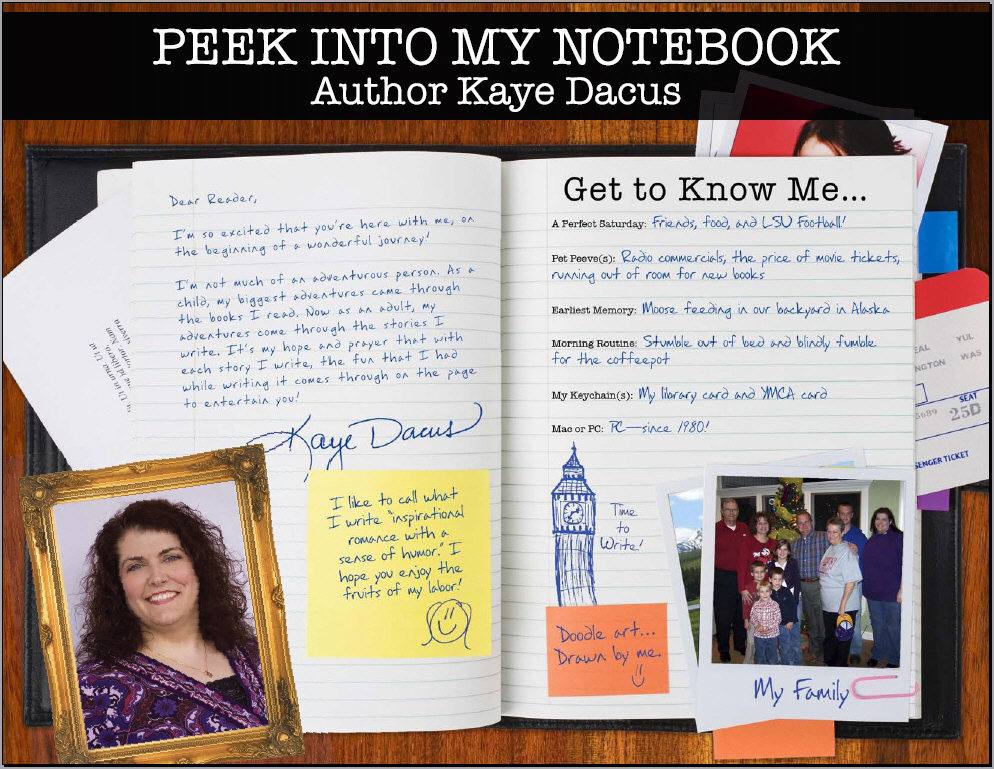
With reading group questions and a blurb about Stand-In Groom on the other side.
I’ve also made up a flyer that has my complete list of contracted books:

And because I’m president of Middle Tennessee Christian Writers, I’ve made up a promotional piece for MTCW also:

And last, but not least, my business card, which, since it has my address and phone number on it, I won’t post here. 🙂
What kind of marketing are you doing, whether you’re published or not? What kinds of marketing materials do you have?
Personalized Font Generator
Since today is tax day here in the U.S., I don’t want to tax you with a serious topic. So here’s something fun you can do. But do your taxes first! I don’t want you blaming me for distracting you from doing your civic duty!
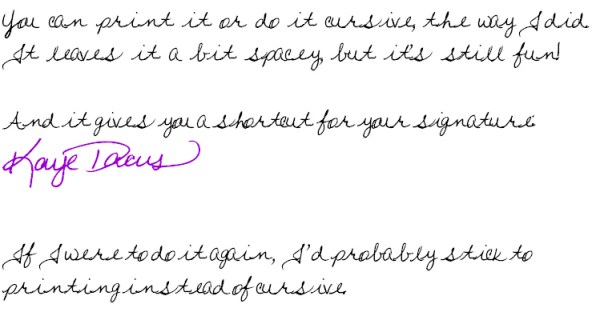
If you have a scanner and a spare hour, here’s a site that will generate a font based on your handwriting:
http://www.yourfonts.com
My Favorite Writing Tools
On the book signing tour, we four spent quite a lot of time talking about how we write, where we write, and what writing tools and supplies we use. So I thought just for fun, I’d share some of my favorite writing tools/supplies with y’all.
First and foremost, naturally, is my desk and my “big” computer.
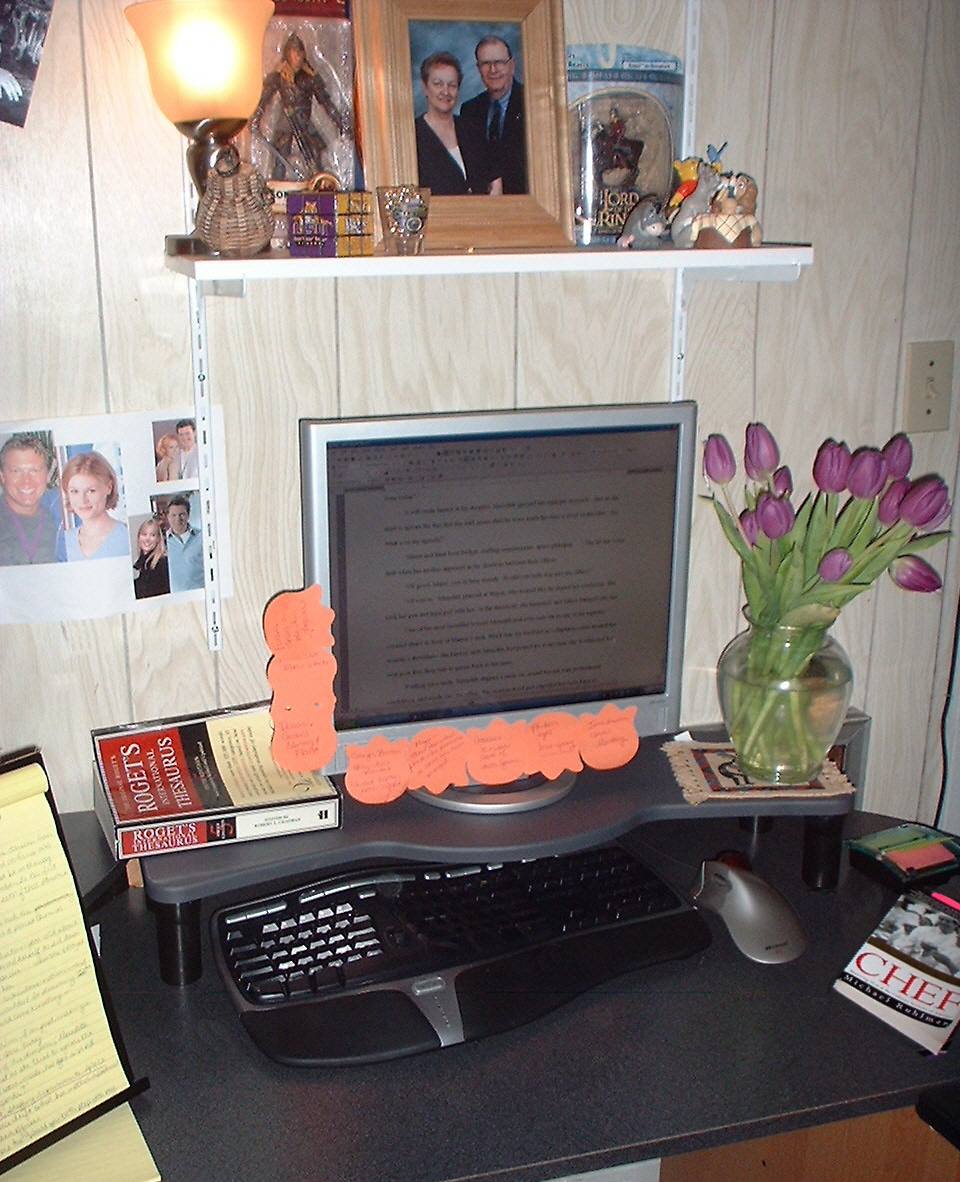
This is where I do most of my freelance editing work, some of my writing, and all of my revisions.
And since there’s a hint of them in the (staged) photo above. . .
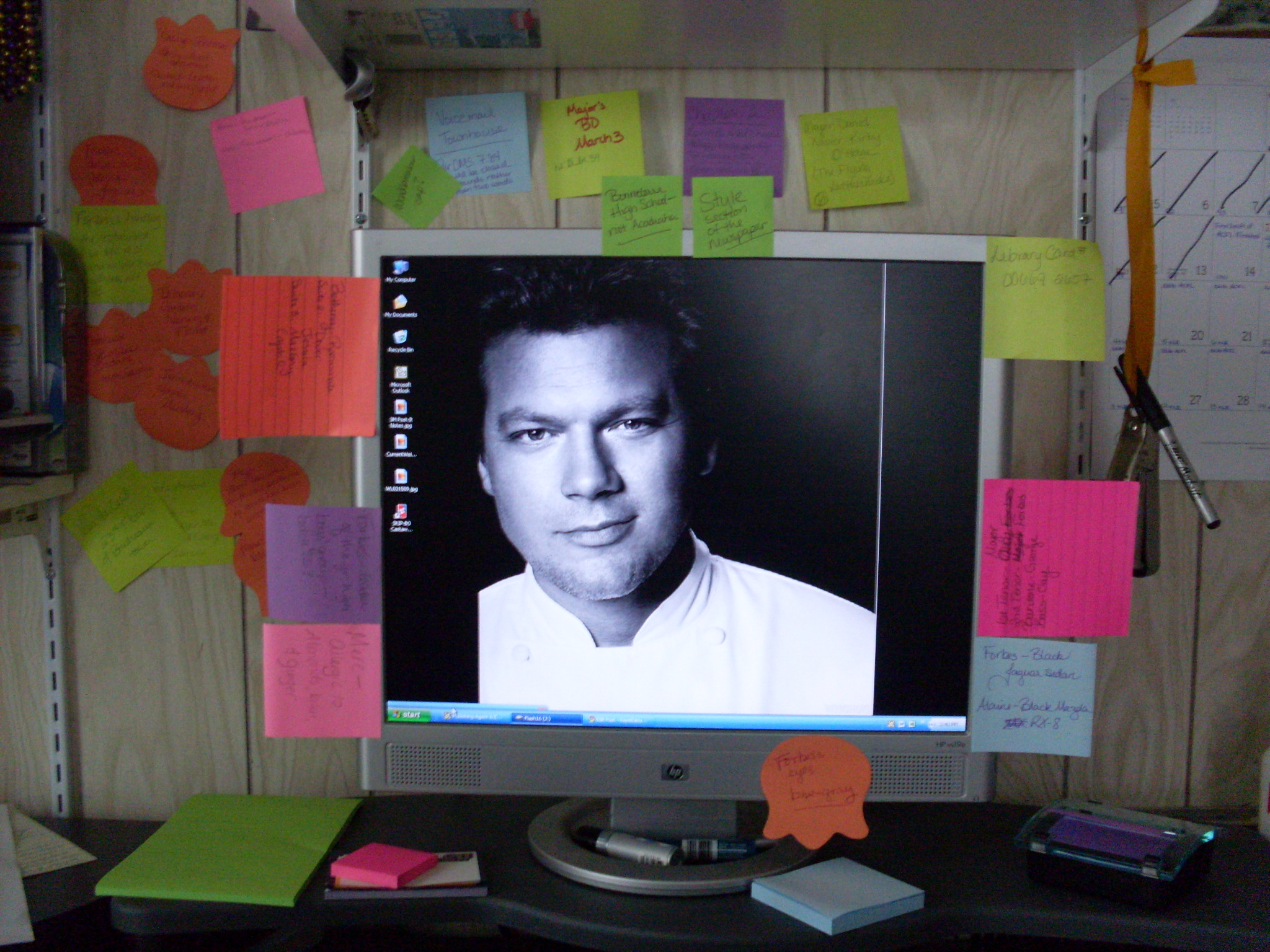
I can’t write without sticky notes! Every size, shape, color I can get my hands on. Including. . .
 . . .
. . . 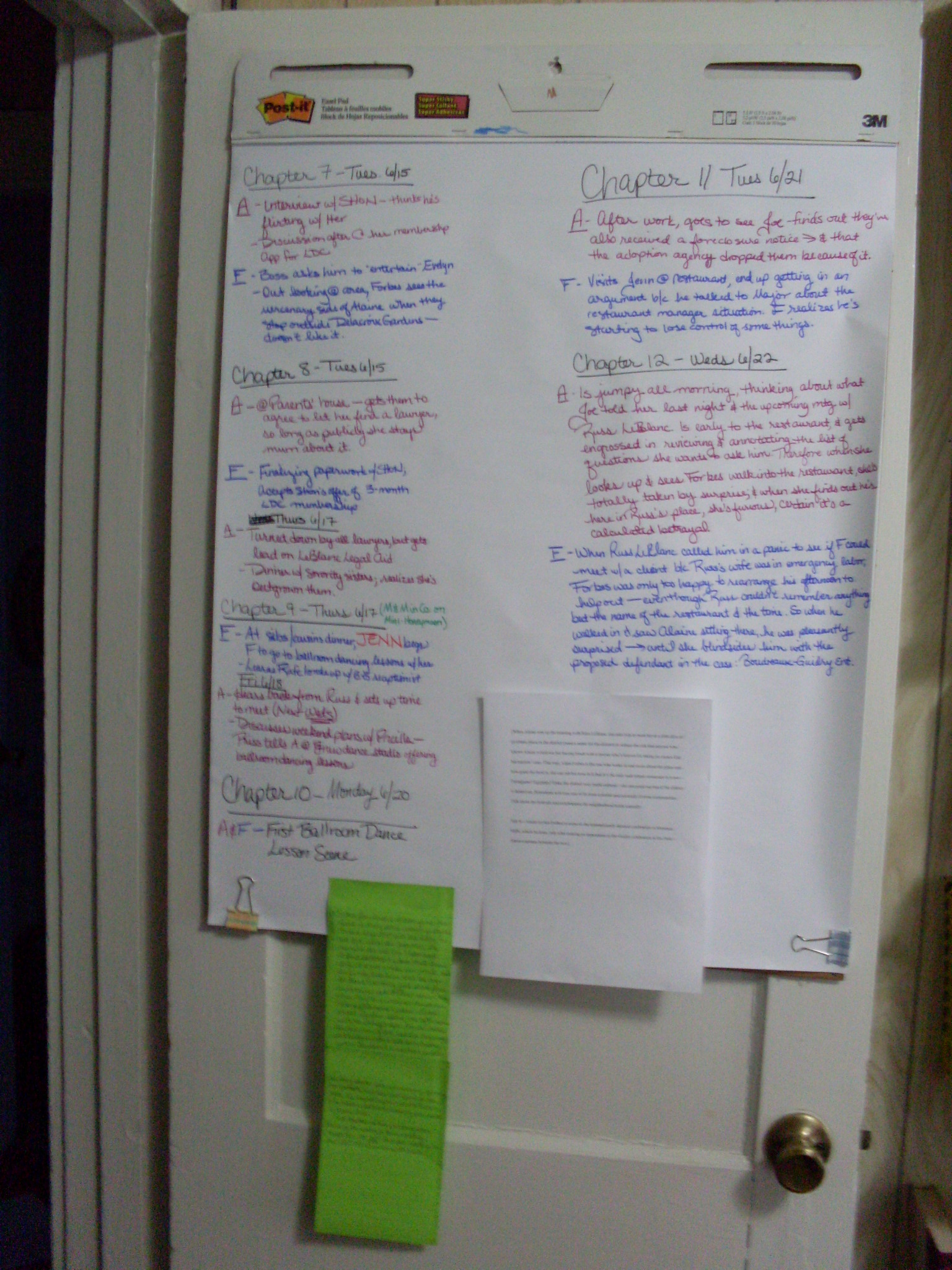
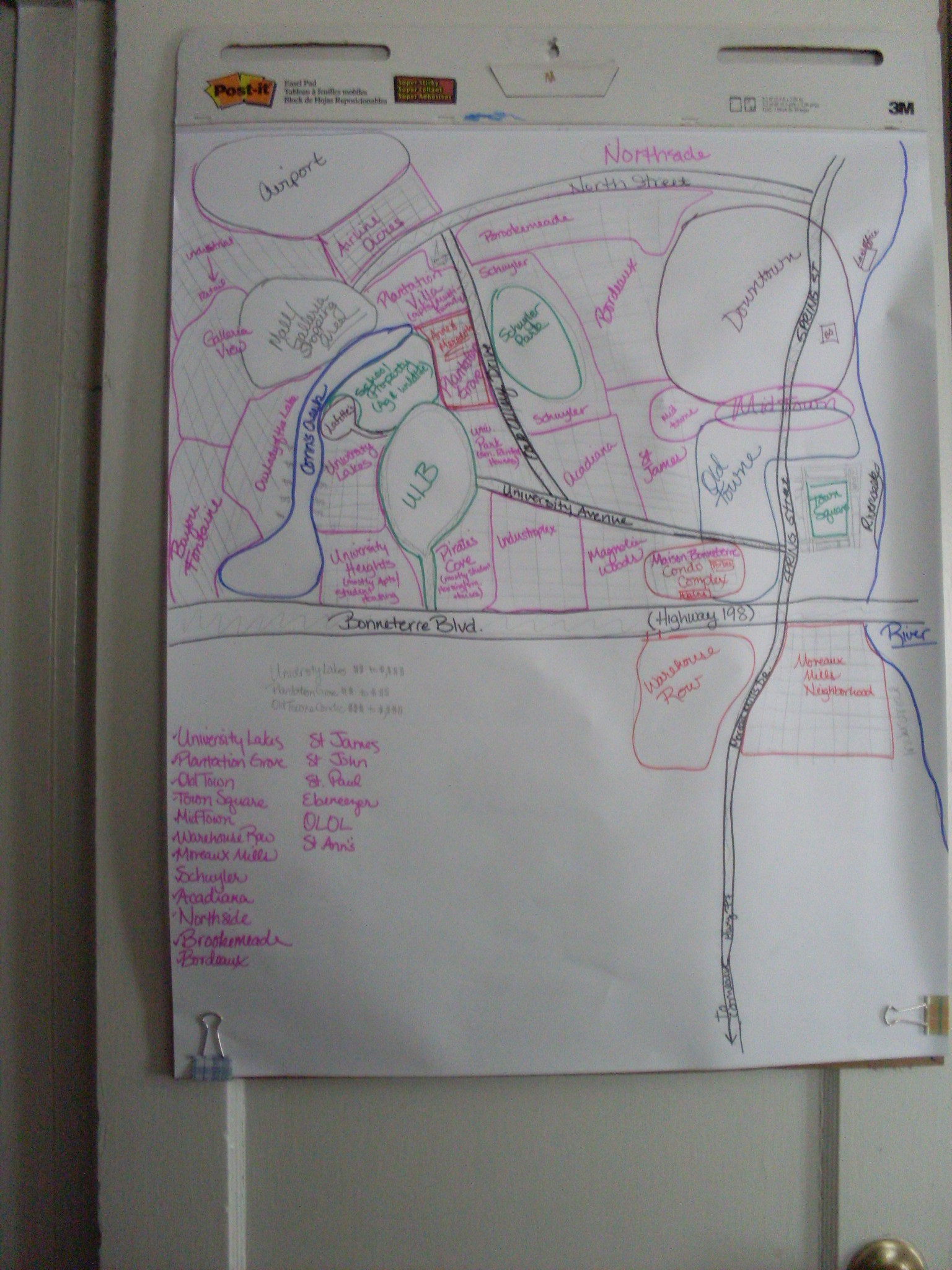
Giant sticky notes (a.k.a. a Post-it brand flip chart). Yes, that’s a rough map of Bonneterre in the first picture!
I may have mentioned here (but don’t specifically remember) that when I’m really needing to tap into my right brain and just let the words flow without unnecessary input from the left side of my brain (such as spelling, grammar, style, and structure), I write by hand. On the book tour, the girls had a good laugh at me whenever I would pull out my spiral notebook to get some writing done. . .
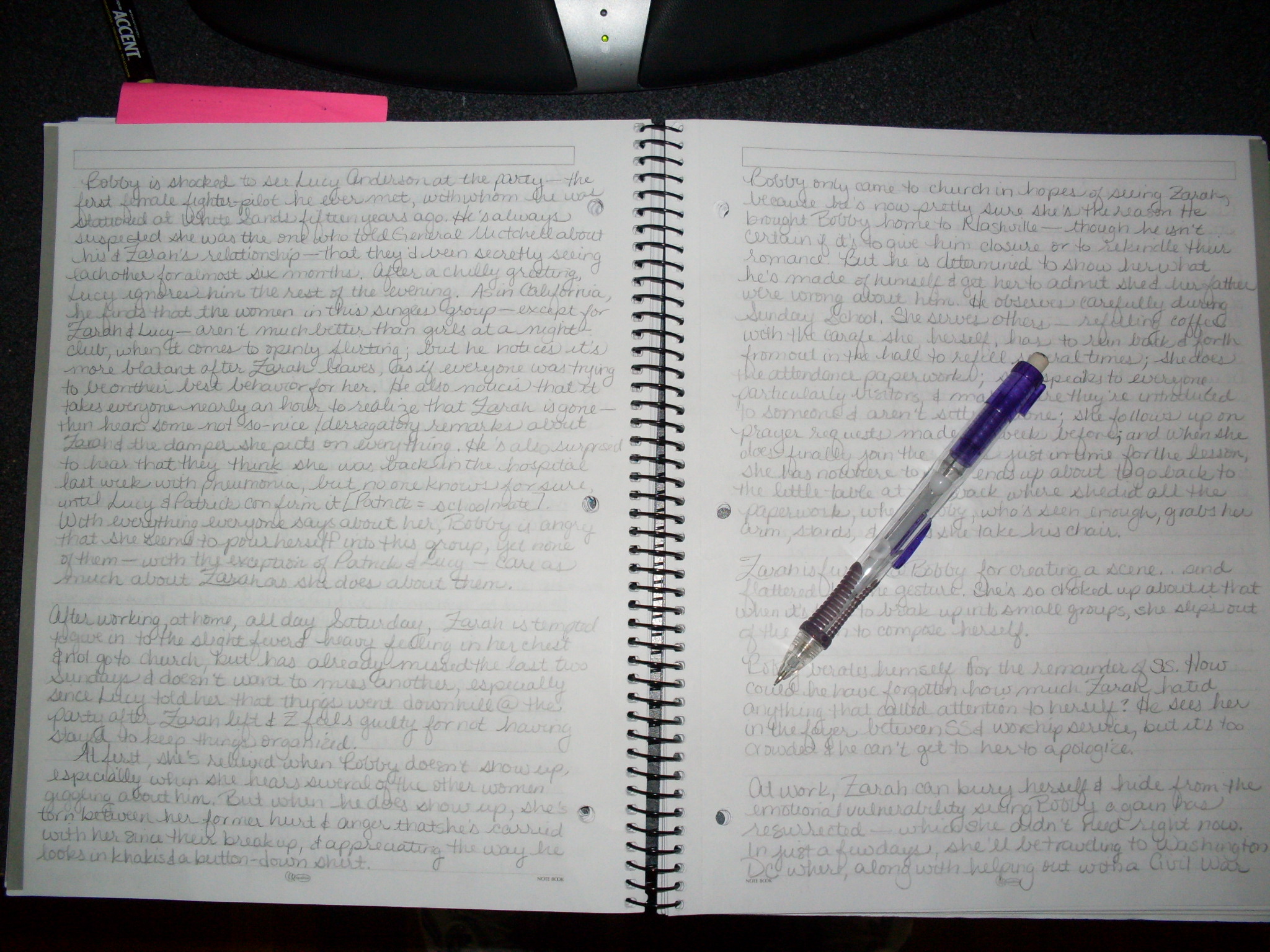
I have a favorite mechanical pencil I use most of the time, since my favorite pens have a tendency to show through on the back side of the page, making it hard to read when I go back to type whatever I’ve written into the computer. Plus, I think there’s something that takes me back to childhood and that uninhibited creativity we all have as kids that comes from writing in pencil.
Speaking of my favorite pens. . .
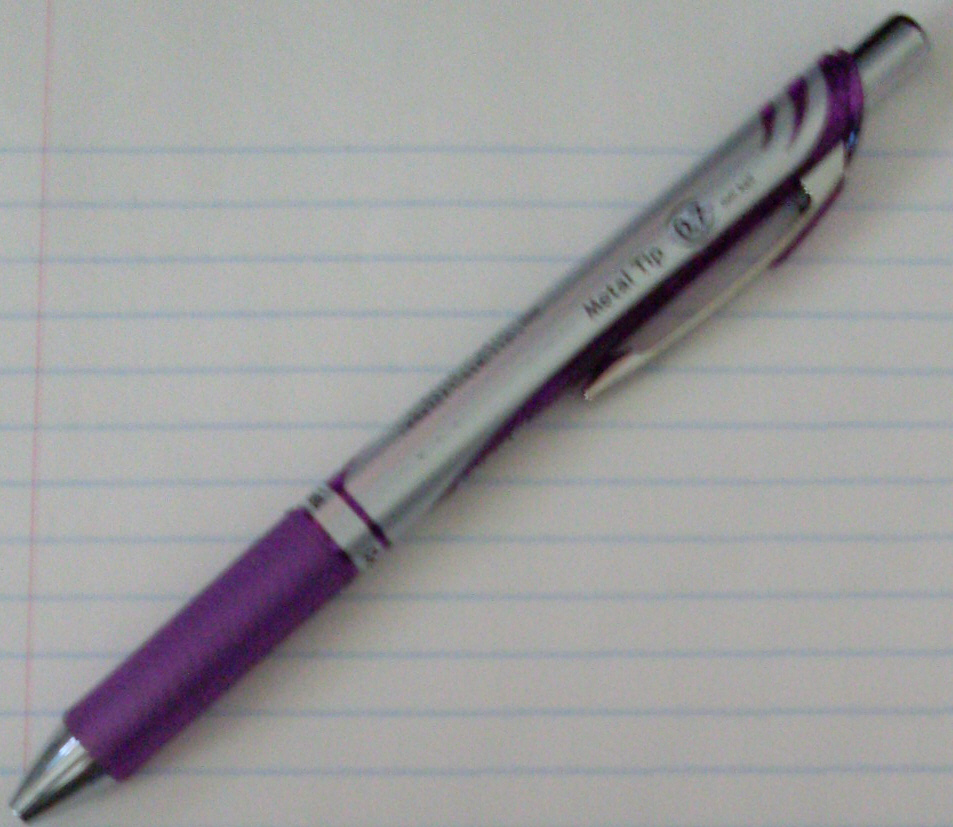
It’s a Pentel EnerGel Liquid Ink Gel pen with a 0.7mm tip—and purple ink, naturally. I took several of these with me on the trip and always carry one or two of them with me in my purse.
Now, because I don’t do all of my writing by hand, just occasionally when I need to get myself out of writer’s block or figure out where I’m going or work on a different story idea, I do have one place/tool which is where and on what I do most of my writing . . .

Because I’m a night person and because after dark is when I’m at my most creative/least distracted, sitting in bed with the laptop computer is when I’m most prolific at writing. And the lapdesk under the computer is one of the best investments I’ve ever made (picked it up at B&N—yes, probably would have paid less than $15 for it elsewhere, but it was purple and I couldn’t resist).
So those are some of my favorite writing tools. What are yours?
Upcoming Series: Make Point of View Work for You
About two years ago, I did a series that introduced some of the basic precepts of what Point of View is in writing fiction:
Point of View (June 2007).
Point of View–Whose Story Is This?
Point of View–How Important Is It?
Point of View–Semantics & Book List
Point of View–Giving POV the Third Degree
Point of View–Showing vs. Telling
Beginning next week (April 20), I’m going to start a new series on Point of View, this time delving into what we mean when we talk about “deep” POV. This is more than just limiting ourselves to one viewpoint character per scene. We’ll look at things we can do to deepen the point of view, draw the reader even further into the story, work with deep POV in describing characters and setting, as well as little changes that can easily be made so that we’re showing, not telling, and we’re no longer holding the characters at arms’ length in our narrative.
But as always, I want to make sure that along the way I try to answer the questions you have about the topic before we get started. So what questions do you have about writing limited/deep POV?
Fun Friday–It’s Time for Another Contest
Okay, everyone. . .it’s time for another contest. Why? Because I have two books coming out in July and I want to get not just signed books but other stuff into your hands.
Now, while the prizes won’t be quite as rich as last year’s 500th Blog Post contest, the prize packages will be similar: a signed copy of the book, a DVD, and a gift certificate to Amazon or B&N or Target—you’d get to choose between a Menu for Romance or a Ransome’s Honor prize package, something like this:
Menu for Romance Prize Pack:
- Signed copy of Menu for Romance
- A John Wayne DVD to be chosen from She Wore a Yellow Ribbon, The Quiet Man, and North to Alaska
- $50 gift certificate to the retailer of choice, listed above ($25 for 2nd place, $15 for 3rd place)
Ransome’s Honor Prize Pack:
- Signed copy of Ransome’s Honor
- A Regency/Royal Navy DVD to be chosen from Persuasion (1995), Horatio Hornblower: Mutiny & Retribution, and Master & Commander
- $50 gift certificate to the retailer of choice, listed above ($25 for 2nd place, $15 for 3rd place)
Now, I need suggestions for what the contest should be. So submit your suggestions, and I’ll announce the contest next Friday!
Writing Techniques
I know I said I was going to write on what I learned about doing book signings today, but something came up in the e-mail loop of my local writers’ group today, and I thought I’d share here what I shared there.
Fellow writer Carol Collett posed a few questions:
- When y’all start a story are you able to sum up the story in one sentence? Or does that come as you get into the story?
- How much do you know about the story before you start writing? Do you know all your subplots?
- Do any of you do any writing in longhand?
Here was my response:
Mary Connealy, MaryLu Tyndall, Christine Lynxwiler and I discussed these very questions at length last week. And the conclusion we reached is that we’re all somewhere in the middle between being a complete seat-of-the-pants writer and a plotter. Because all four of us write romance novels, though, we automatically have a structure to our stories: boy & girl meet, boy & girl fall in love, boy & girl are separated seemingly forever, boy & girl reconcile and live happily ever after. So we know there are certain beats we have to hit with our stories, which we can figure out ahead of time.
Do I know my subplots? Not usually, and that’s where I struggle with writer’s block when I get past the third or fourth chapter of a first draft. At that point in time, I stop writing and just start “living” with the characters and the story. I start brainstorming ideas of who the other people in their lives are: family, friends, former college roommates, neighbors, etc., and look for subplots there. For example, in A Case for Love, I need a subplot for Forbes, and one of his younger sisters just flounced in and begged him to sign up to take ballroom dancing lessons with her. I wasn’t sure where that little subplot was going until I realized that as the social-scene reporter for one of the TV stations, Alaine would be covering the first night of this dance studio’s lessons for her noontime “Talk of the Town” type show. Which puts them both in the same place at the same time. That’s how I usually come up with subplots. They build out of listening to the characters and paying attention to the minor/secondary characters surrounding them.
When I got toward the end of writing Menu for Romance and kept getting stuck, I did something I’ve never done before. I sat down with my notebook and plotted out the remaining ten to twelve chapters. I knew what needed to happen; I knew the setting for the climax; I knew what had to happen to pull them apart. But every time I sat down to write, I was lost as to where I needed to go next. So I figured out how many more words I needed, which dictated how many chapters I needed (my chapters naturally fall between 3,000 and 3,500 words), and I wrote paragraph-long chapter summaries for the remaining part of the novel I needed to write. It made those last few chapters just fly—because every time I sat down to write, I knew what I needed to write. But again, I was already at the point where I knew what needed to happen. I just wasn’t getting there.
To start a new story idea—or just to remember it later—I’ll write a two- to five-page (or longer) summary of the idea. Sometimes, it’s just about the characters in a certain situation (i.e., the meet); sometimes it’s an almost entire idea for a story. Right now, I’m at the point in my journey when I have to be able to summarize the full story idea before writing the novel, because that’s on what the publishing houses are basing their decisions for future contracts. With A Case for Love, I have a five page story summary I wrote about a year ago that’s really helping me out now, because I know the ultimate conflict that I’m building the story toward. Now, I just need to write another seventy thousand words to make it happen. (That’s where subplots come in very handy—and I need a few more!)
As to writing longhand—the gals I was with last week all had a good laugh at me when I dragged out my spiral notebook anytime we had downtime at the book signings (which was quite a few of them). None of them do any writing longhand anymore. I find, though, when I’m writing with pen and paper, that’s when I can more fully enter the right-brain/creative state and just write. Not think about editing or word choice or structure, just let the characters speak to me, let the ideas flow. And I find that when I am writing longhand, I tend to get a lot more ideas of where I’m going with my characters and story—I have notes scribbled all over the top margins of my notebook pages from when I’ve gotten an idea while writing a scene—an insight into a character, a tweak of his/her backstory, something that comes later in the story.
I also have a Post-it brand flipchart/easel pad that I got at Sam’s that I use for brainstorming. I’ve got one sheet stuck to the wall on one side of the office that has a bulleted list of backstory/personality traits for the hero and heroine of Case—in addition to things like the name of Forbes’s law firm where he works, the types of art prints Alaine has hanging in her townhouse, what charities Forbes is involved with, and what sorority/fraternity each was a member of in college. Of course, I’ve also put all of this information into the “character file” I have (in PowerPoint) where I’ve also collected images of the Real World Templates for the characters. But it’s nice to have it there on the wall where I can just glance at it without having to go to a lot of trouble to pull up the file on the computer.
How would you answer Carol’s questions?
Introducing Ransome’s Honor
 RANSOME’S HONOR
Copyright © 2009 by Kaye Dacus
Chapter One
Portsmouth, England
July 18, 1814
William Ransome pulled the collar of his oilskin higher, trying to stop the rain from dribbling down the back of his neck. He checked the address once more, then tucked the slip of paper safely into his pocket.
He took the four steps up to the front door of the townhouse in two strides and knocked. The rain intensified, the afternoon sky growing prematurely dark. After a minute or two, William raised his hand to knock again, but the door swung open to reveal a warm light.
A wizened man in standard black livery eyed William, bushy white brows rising in interest at William’s hat, bearing the gold braid and black cockade of his rank. “Good evening, Captain. How may I assist you?”
“Good evening. Is this the home of Captain Collin Yates?”
The butler smiled, then frowned. “Yes, sir, it is. However, I’m sorry to say Captain Yates is at sea, sir.”
“Is Mrs. Yates home?”
“Yes, sir. Please come in.”
“Thank you.” William stepped into the black-and-white tiled entry, water forming a puddle under him as it ran from his outer garments.
“May I tell Mrs. Yates who is calling?” The butler reached for William’s soaked hat and coat.
“Captain William Ransome.”
A glimmer of recognition sparkled in the butler’s hazy blue eyes—in the dim light of the hall, he appeared even older than William originally thought. “The Captain William Ransome who is the master’s oldest and closest friend?”
William nodded. “You must be Fawkes. Collin always said he would have you with him one day.”
“The earl put up quite a fight, sir, but the lad needed me more.” Fawkes shuffled toward the stairs and waved for William to join him. “Mrs. Yates is in the sitting room. I’m certain she will be pleased to see you.”
William turned his attention to his uniform—¬checking it for lint, straightening the jacket with a swift tug at the waist—and followed the butler up the stairs.
Fawkes knocked on the double doors leading to a room at the back of the house. A soft, muffled voice invited entry. The butler motioned toward the door. It took a moment for William to understand the man was not going to announce him, but rather allow him to surprise Susan. He turned the knob and slowly pushed the door open.
Susan Yates sat on a settee with her back to him. “What is it, Fawkes—?” She turned to look over her shoulder and let out a strangled cry. “William!”
He met her halfway around the sofa and accepted her hands in greeting. “Susan. You’re looking well.”
Her reddish-blonde curls bounced as she looked him over. “I did not expect you until tomorrow!” She pulled him farther into the room. “So—tell me everything. When did you arrive? Why has it been two months since your last proper letter?” Susan sounded more like the girl of fifteen he’d met a dozen years ago than the long-married wife of his best friend. “Can you stay for dinner?”
“We docked late yesterday. I spent the whole of today at the port admiralty, else I would have been here earlier. And I am sorry to disappoint you, but I cannot stay long.” He sat in an overstuffed chair and started to relax for the first time in weeks. “Where is Collin? Last I heard, he returned home more than a month ago.”
Susan retrieved an extra cup and saucer from the sideboard and poured steaming black coffee into it. “The admiral asked for men to sail south to ferry troops home, and naturally my dear Collin volunteered—anything to be at sea. He is supposed to be back within the week.” She handed him the cup. “Now, on to your news.”
“No news, in all honesty. I’ve been doing the same as Collin—returning soldiers and sailors home. I only received orders to Portsmouth a week ago—thus the reason I sent the note express, rather than a full letter.”
“But you’re here now. For how long?”
“Five weeks. I’ve received a new assignment for Alexandra.”
“What will you do until your new duty begins?”
“My crew and I are on leave for three weeks.” And it could not have come at a better time. After two years away from home, his crew needed some time apart from each other.
“Are you going to travel north to see your family?”
“At the same time I sent the express to you announcing my return to Portsmouth, I sent word to my mother telling her of my sojourn here. When I arrived ashore earlier today, I received a letter that she and Charlotte will arrive next Tuesday.”
“How lovely. Of course, you will all stay with us. No—I will brook no opposition. We have three empty bedchambers. I could not abide the thought of your staying at an inn when you could be with us.”
“I thank you, and on behalf of my mother and sister.”
“Think nothing of it. But you were telling me of your assignment. Your crew is not to be decommissioned?” Susan asked.
“No. I believe Admiral Witherington understands my desire to keep my crew together. They have been with me for two years and need no training.”
“Understands?” Susan let out a soft laugh. “Was it not he who taught you the importance of an experienced crew?”
William sipped the coffee—not nearly as strong as his steward made it, but it served to rid him of the remaining chill from the rain. “Yes, I suppose Collin and I did learn that from him . . . along with everything else we know about commanding a ship.”
Susan sighed. “I wish you could stay so that I could get out of my engagement for the evening. Card parties have become all the fashion lately, but I have no skill for any of the games. If it weren’t for Julia, I would probably decline every invitation.”
“Julia—not Julia Witherington?” William set his cup down on the reading table beside him. He’d heard she had returned to Portsmouth following her mother’s death, but he’d hoped to avoid her.
“Yes. She returned to England about eight months ago and has become the darling of Portsmouth society, even if they do whisper about her being a ‘right old maid’ behind her back. Although recently, Julia’s presence always means Lady Pembroke—her aunt—is also in attendance.” The tone of Susan’s voice and wrinkling of her small nose left no doubt as to her feelings toward the aunt.
“Does Admiral Witherington attend many functions?”
“About half those his daughter does. Julia says she would attend fewer if she thought her aunt would allow. I have told her many times she should exert her position as a woman of independent means; after all, she is almost thir—of course it is not proper to reveal a woman’s age.” Susan blushed. “But Julia refuses to cross the old dragon.”
“So you have renewed your acquaintance with Miss Witherington, then?” The thought of Miss Julia Witherington captured William’s curiosity. He had not seen her since the Peace of Amiens twelve years ago . . . and the memory of his behavior toward her flooded him with guilt. His own flattered pride was to blame for leading her, and the rest of Portsmouth, to believe he would propose marriage. And for leading him to go so far as to speak to Sir Edward of the possibility.
“Julia and I have kept up a steady correspondence since she returned to Jamaica.” The slight narrowing of Susan’s blue eyes proved she remembered his actions of a dozen years ago all too well. “She was very hurt, William. She believes the attentions you paid her then were because you wished nothing more than to draw closer to her father.”
William rose, clasped his hands behind his back, and crossed to the floor-to-ceiling window beside the crackling fireplace. His reflection wavered against the darkness outside as the rain ran in rivulets down the paned glass. “I did not mean to mislead her. I thought she understood why I, a poor lieutenant with seeming no potential for future fortune, could not make her an offer.”
“Oh, William, she would have accepted your proposal despite your situation. And her father would have supported the marriage. You are his favorite—or so my dear Collin complains all the time.” Silence fell and Susan’s teasing smile faltered a bit. “She tells the most fascinating tales of life in Jamaica—she runs her father’s sugar plantation there. Collin cannot keep up with her in discussions of politics. She knows everything about the Royal Navy—but of course she would, as the daughter of an admiral.”
A high-pitched voice reciting ships’ ratings rang in William’s memory, and he couldn’t suppress a slight smile. Julia Witherington had known more about the navy at age ten than most life-long sailors.
“William?”
“My apologies, Susan.” He snapped out of his reverie and returned to his seat. “Did Collin ever tell you how competitive we were? Always trying to out-do the other in our studies or in our duty assignments.” He recalled a few incidents for his best friend’s wife, much safer mooring than thinking about the young beauty with the cascade of coppery hair he hadn’t been able to forget since the first time he met her, almost twenty years ago.


