Fun Friday: Fall Movies from Flipped to Harry Potter to Narnia

Tuesday, to help Ruth celebrate her birthday, we met up with Joan Shoup and Lori Benton for lunch (and of course a visit to Davis Kidd Booksellers next door):

I wish we could have spent all day with them, but Lori had some more site seeing she wanted to do before heading home to Oregon. So after lunch, and after a stroll around Green Hills mall and a stop for frappuccinos at Starbucks, Ruth and I went to go see a sweet little film called Flipped. Written and produced by Rob Reiner—the guy behind some other sweet little films like When Harry Met Sally and The Princess Bride. And just like those movies, I have a feeling this one will prove to be a sleeper hit.
(For my fellow Losties: Madeline Carroll, the young woman in the female lead—not the little girl, but the teenager—in Flipped played Annie, the young girl who carved the dolls for young Ben in the episode “The Man Behind the Curtain.”)
It’s a cute, cute movie with a unique storytelling style—showing first his viewpoint of a scene, then “flipping” to show her viewpoint of the same scene. Both Madeline Carroll, as Juli, and Callan McAuliffe, as Bryce, are fantastic in their roles (and give that Callan McAuliffe ten more years and he’ll be burning up the screens in every romantic movie being produced!), and the supporting cast, from Aidan Quinn and Penelope Ann Miller as Juli’s parents to Anthony Edwards and Rebecca DeMornay as Bryce’s parents, are fabulous—as is to be expected in a Rob Reiner film. This is one not to be missed.
We also saw previews for Secretariat:
and Life As We Know It:
both of which we’re considering going to see to tide us over until November 19:
And then it’s only a few weeks until the release of Voyage of the Dawn Treader:
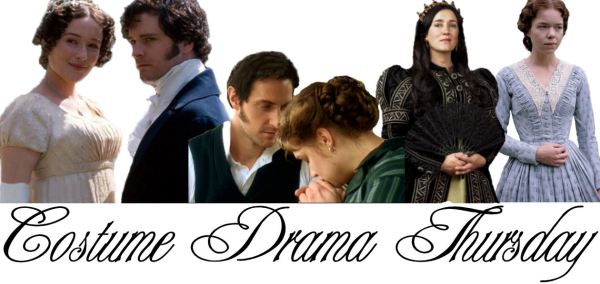
Costume Drama Thursday: Mansfield Park
I have a theory about the Janeite world: Either you like Fanny Price or you like Emma. I’ve never run into anyone who likes both.
Mansfield Park is the longest of Austen’s novels. It’s not my favorite (that would be Persuasion) nor my least favorite (that would be Emma), but there are parts of MP that I truly love—and parts I’m more than happy to skip over.
Fanny Price is plucked from poverty as a child and taken to live with relatives at stately Mansfield Park. Surrounded by entitled and vain cousins, Fanny forges a connection with one—Edmund Bertram. Years later, two neighbors fresh from a life in high society descend on Mansfield Park, sparking a labyrinth of intrigue and affairs. Fanny finds herself being pursued, but not by the longstanding love of her life. Can Fanny listen to her own heart and wait for her true love to notice her?
Despite the 1999 film version which turns MP into a “fun and sexy comedy” that “tells a timelessly entertaining story where wealth, secret passions, and mischievous women put love to the test . . . with delightfully surprising results,” Mansfield Park is Austen’s most serious novel with her most serious characters and situations. At the age of nine, after having been forced to grow up too quickly in her own home, where she’s had to take care of the house and her younger siblings all her life, Fanny Price is sent to live with her mother’s sister, who married a wealthy baronet, at Mansfield Park (introducing one of Austen’s favorite themes right off the top: wealth and social status). At MP, Fanny is basically left to raise herself based on the ideals and morals instilled in her as a child—and because of constantly being berated by her aunt Mrs. Norris, Fanny does her best to become someone who gains no notice for herself, who feels gratitude toward those around her who’ve done so much for her, and to live up to the unrealistic expectations set on her by Mrs. Norris.
 Fanny Price has been called the “moral compass” of all the characters in Mansfield Park, as she has a childlike view of right and wrong, good and evil. She does not see in shades of gray (not only is she still very young when the main action of the story takes place, but she’s lived an extremely sheltered—shall we call it cloistered?—life). However, in the end, it is this naivety, this childlike approach to morality, that saves her when she sticks firmly to her beliefs and effectively removes herself—by way of banishment from Mansfield Park and everyone she has come to love there—from the taint of the bad things brought about by others not living to those same standards.
And without a full exploration of the events that happen in the novel that show us Fanny’s innate goodness and her wonderful simplicity in thought, the viewer of a film adaptation of this novel will never understand exactly how emotionally complex Mansfield Park and Fanny Price are. In addition to exploring that favorite theme of wealth and social status, Austen takes on deeper issues here, such as nature vs. nurture (why did Fanny, raised in the same household as Maria Bertram, turn out to have such strong morals while Maria did not?). As Austen’s third published novel, MP explored an area of life only hinted at in S&S and P&P—sexual promiscuity and sexual attraction vs. love. Fanny is against the theatrical the rest of the young people wish to put on in Sir Thomas’s absence because of its sexual themes and overtures—because those are inappropriate for a group of unmarried young people to be acting out. Would the affair that happens at the end of the novel have taken place without the theatrical? Possibly. But Austen uses the theatrical to introduce the idea that encouraging temptation in a seemingly fun/innocuous way opens the door for a world of sin and pain later.
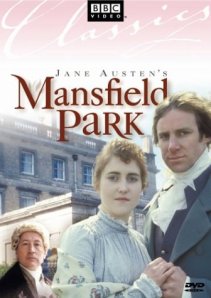
And this is why the 1983 version of MP will be my favorite until someone does another faithful miniseries adaptation of the novel. No, the acting isn’t great. Yes, it has that old style “inside looks like it’s a theater stage not a real house” style cinematography, but it’s the only version I’ve ever seen that actually stays true to the character of Fanny Price and the complex themes Austen explored in the novel. (And a little piece of trivia for Ruth: Jonny Lee Miller, who would go on to star as Edmund Bertram in the 1999 “romantic comedy” version of MP played Fanny Price’s younger brother Charles Price in the 1983 version!)
There are three main adaptations of MP—the 1983 BBC version (the one I like), the 1999 “romantic comedy” version (starring Frances O’Connor and Jonny Lee Miller), and the absolutely botched 2007 version starring Billie Piper and Blake Ritson, which aired during the 2008 PBS Complete Jane Austen Series (read my review here).


What about you? Have you seen MP? Do you like it? hate it? Which version do you like?
The Best ACFW Conference Ever
You’ll be seeing that phrase, the title of this post, over and over and over during the next seven to ten days as the 629 people who attended the 9th annual ACFW National Conference get home, decompress, debrief, and begin to determine exactly what happened from 3 p.m. Friday September 17 through 9 a.m. Monday September 20, 2010.
It’s not hyperbole for me when I say it was my best conference ever. Here’s why:
- Fantastic traveling companions. Fellow MTCW members Kathy Harris (writing as Kate Shiloh) and Patrick Carr rode up with me. We never lacked for conversation the entire five hour drive.
- I was so constantly engaged with other people that I didn’t even think about pulling out my camera to take pictures.
- I quickly discovered a new facet of God’s calling on my life and the reason why God made my attendance at the conference so easy: connecting the right people in the right place at the right time. And until I got there, I didn’t even realize that’s why I was there. And even though I didn’t go into the socializing times with an agenda, there were so many networking opportunities laid before me that could be beneficial for my friends and mentees* that I couldn’t not take steps toward making those connections happen.
- *Saturday night, when talking to agent Steve Laube about my mentees it came out as minions—and I actually rubbed my hands together when I said it. So apparently I don’t have mentees, I have minions. No wonder Jeff Gerke has been after me about writing speculative fiction (sci-fi/fantasy) for his Marcher Lord Press!
- Reconnecting with longtime friends—I think more than anything that’s what killed me about not being able to attend last year’s conference, knowing I wouldn’t get to see and hug and talk face-to-face with people who’ve become part of my life over the last seven or eight years. So that was at the top of my “things to do at conference list.”
- Fantastic meetings—with my agent Chip MacGregor (I’m so excited about what we’re doing to move my career forward), with my publicist for Ransome’s Crossing, Jeane Wynn, with my editors, Rebecca Germany and Kim Moore, along with all of the other scheduled and divine appointments I had during the course of this very long, very fast weekend.
- I met author Bonnie Calhoun, also known for founding both the Christian Fiction Blog Alliance and Christian Fiction Online Magazine. She makes me laugh:
- I taught this year, for the first time. And I taught two classes! Both went better than I expected—but being used to having 2+ hours for my MTCW workshops every month, those one-hour blocks of time went by way too fast.
- I loved connecting with the other authors who were there from Harvest House at our dinner on Saturday night. I feel like I know so much about them through their books, but it’s so different to actually sit down and talk to them.
- I picked up Courting Morrow Little and The Frontiersman’s Daughter in the bookstore and got Laura Frantz to sign them for me!
- I had enough flexibility in my schedule that I was able to have some impromptu one-on-one mentoring time with all of my “minions” along with others who will hopefully join that fold now.
- I averaged about five hours of sleep each night. I was up early each morning so I wouldn’t miss any opportunities at breakfasts and I stayed up late fellowshipping and and socializing and not wanting to miss a single thing.
I could go on for thousands and thousands of words, but I’ll spare you. So I’ll close with my favorite thing about the 2010 ACFW National Conference:
- Every time I ran into one of my mentees, members of MTCW, or friends, it was a “jumping up and down in excitement” moment—their dream editor/agent had asked for a submission, they’d had a great meeting with the published author critiquing their work, they wanted to share a nugget of something they’d learned that was that one last key to revolutionizing their writing and taking it to the next level, they’d had an epiphany about their voice, their brand, the direction of their writing career, and so on. They’d found barriers removed, nerves settled, doors opened, and God paving the way before them in ways they’d never imagined. That’s what made this my best conference ever.
Writer’s Window: Krista Phillips
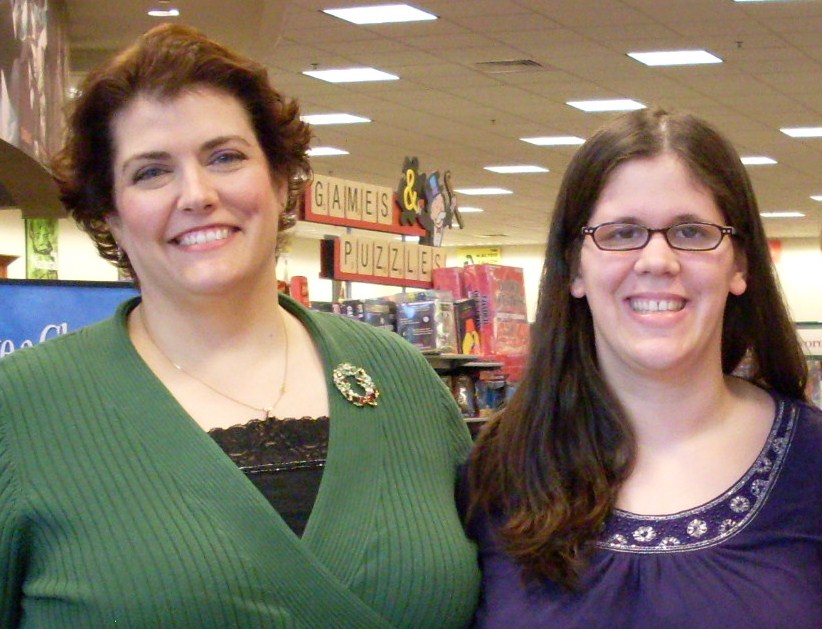
Many of you know that we have been praying for Krista Phillips and her family since earlier this year when they learned their newest addition to the family, Annabelle, would be born with a heart defect. This interview was conducted before Annabelle’s birth in mid-July.
What do you like best about being a writer?
- Having an outlet for my crazy imagination. Before I wrote, I’d be bombarded with scenes and visuals in my head, but I didn’t know what to do with them. I thought I was really weird, because no one ELSE had a strange brain like mine. When I started to write, it was like, AHA! THAT is what I do with them!
What do you like least about being a writer?
- Others’ reactions. “Oh, are you published?” “Where can I buy your book?” “Oh, what do you write?” —then the smirks when I say contemporary romance. Then there are those that don’t understand why I can’t get my books published… if you write one… you just, you know, send it to a publisher and they publish it right? As we all know, the answer is WRONG!
Pop, Soda, or Coke? What do you call it, and what’s your favorite variety?
- Pop. Soda is the last part of baking soda… Coke is a brand name… A cold Coke or Pepsi suits me just fine!
Describe your favorite pair of shoes.
- My tennis shoes. They are gray with a wee bit of pink on them to make them girly but not too much that I’m froufrou, and are super comfortable. Gotta love a good pair of tennies!
What’s the most fun/interesting/crazy/scary/unique hands-on research you’ve done for a book?
- I’m afraid my answer will be kinda lame on this one. I need to stretch myself and do a little better! There was a time when I e-mailed a foster/adoption agency in IL to ask if my situation was plausible. I had NO clue where to start, and was so afraid I’d bother someone or annoy them. I thought my e-mail was very nice and professional, but they wrote back, “We can’t help, but I can forward you to someone who can. What is the compensation for this project?” Um, compensation??? Really??? I wrote back and said there was none, however if the book was published, the helpful person would be in the credits if they so wished. I received no response.
Candles. We all have them. But do you burn them? What scents are your favorite?
- I have them, but they are mostly for decoration. I have some fun Christmas ones I burn during that season, pumpkin or cinnamon, depending on my mood. Other than that, we save candles for when the lights go off! I guess I fear my children knocking them over and our house going up in smoke.
Have you ever re-gifted something someone’s given you?
- VERY rarely. I did one wedding gift because we got two of the same thing and had no receipts/place to return one. So I re-gifted as a wedding gift a year later. I didn’t feel bad though… we never used it or opened it, and it wasn’t like I was giving away something I didn’t WANT… I just had no use for two of them:-). I DID however, get a re-gifted gift for our wedding. We knew it was because the box was taped, and there were food crumbs left on said appliance. Hubby and I got a huge kick out of it!
If you were to write a novel about what your life would have been like if you’d become what you wanted to be at eight years old, what kind of character would the story be about?
- I believe that was my pediatrician stage. My character would be the WORST doctor every because she hates needles and has to practice deep breathing when dealing with blood. In fact, I think that would make a GREAT conflict… a doctor who can’t stand the site of blood and somehow still gets through medical school… wow, I can totally see the possibilities!
What makes you happy?
- Seeing my children giggle. They can try my patience so much, but their giggles and hugs and kisses make it totally worth it.
What makes you nervous?
- Writing contests. I love them… I’m dumb, I know. However, those days before results are announced… I’m nervous as all get out! My carpet has holes from my pacing!
What’s the best piece of writing advice you’ve ever received?
- Write what you know. This actually isn’t advice I’d give most people, however I’d heard it a long time ago and in the summer of 2007 when I was feeling God’s tug to write again, I couldn’t get the phrase out of my head. I realized shortly after that my problem is that I was writing deep dramatic fiction, when what I KNOW right now is fun, upbeat, romance that makes people laugh.
What’s your biggest dream for the future?
- Can I plead the 5th? Really my dream is to write, get published, and be able to stay at home with my kiddos. Now, if somehow someone from my day job sees this, please notate the word DREAM here. I also have a dream of winning the lottery (even though I don’t play it…) and you know the chances of THAT too:-).
Tell us about what you’re currently writing (or your newest release, or both).
- I’m currently editing my newly finished contemporary romance all about sandwiches, literally and figuratively. However, my barely started WIP is about a elementary school teacher who was humiliated in front of millions of people when she participated in a Reality TV show. When the guy who threw her under the bus blows back into her life, almost literally, sparks fly, especially when the press gets wind of it. They battle rumors, bad press, and broken hearts in a quest to put their lives back together again. (Keep in mind: I’m a HUGE SOTP writer… I anticipate the blurb of this story being MUCH better once I’m done!)
Where can people find out more about you/connect with you online?
- I blog on Monday and Friday at http://reflectionsbykrista.blogspot.com and can be followed on twitter at www.twitter.com/kristaphillips.
———————————————————————–
 Krista Phillips always loved to write and started her first full-length novel when she was eighteen. She never completed the novel due to a variety of reasons, mostly her beautiful kiddos who were born! But in 2007, God nudged her heart and told her it was time to start again. Krista is married to with four beautiful little girls and lives in Spring Hill, Tennessee. Her biggest blessing is her loving, supportive family.
Fun Friday: Hey, Hey, We’re the Monkees
 In the summer of 1988, I got a job working as a summertime nanny, taking care of a fourteen-year-old and a seven-year-old. They had cable at their house, and even though we didn’t watch a lot of TV, there was one hour during which we were always in front of Nickelodeon—from 3 p.m. to 4 p.m. when two episodes of The Monkees aired. I’d never heard of this put-together group before then, but it only took one or two episodes for me to fall—and fall hard—for this group of hipsters from the 1960s. (Of course, growing up in the age of the mullet/long hair on guys, all of their riffs on being “long-haired weirdos” took me a while to catch onto—after all, their hair was shorter than that of most of the guys I went to school with.)
With the resurgence of their popularity because of Nickelodeon re-airing the show, their albums were pretty easy to come by—and I bought all of them that I could get my hands on. I also videotaped the shows when I was at the house where I worked, and then I took my tape recorder and recorded tapes of clips of some of my favorite dialogue and songs from the show.
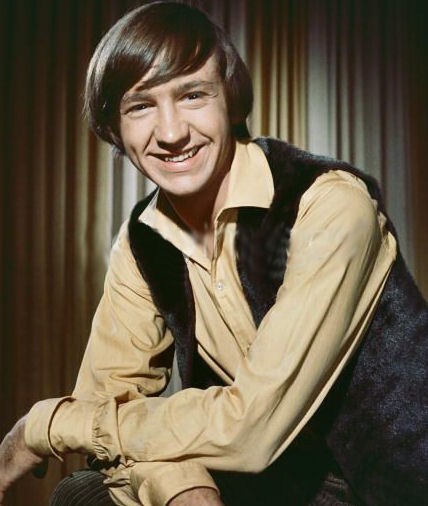 At seventeen, my favorite Monkee was Peter Tork—which, if you know anything about him and anything about me seems odd: I usually go for the dark, intelligent guys, which Peter definitely wasn’t, at least on the show. I must have been able to sense that he wasn’t as ditzy as he played on the show, because I’ve since learned that he’s quite intelligent. But for me, at that age, he was the cutest. (I know, I know, Davy Jones was supposed to be the cute one, but even with the British accent, he didn’t do anything for me.)
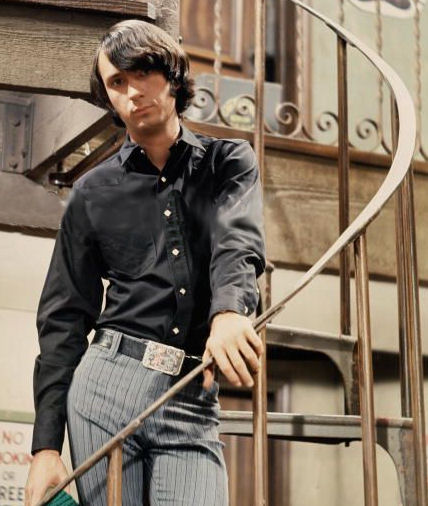 Now that I’m experiencing a little bit of a revival of interest in the Monkees, after picking up a three-CD “greatest hits” set at Sam’s a couple of years ago, I find that I’m more drawn to Mike Nesmith, the stalwart, enigmatic one who seems to be the brains of this particular operation (at least as it was scripted for the show).
Now, I have to admit . . . it’s rare for me to read about the backgrounds/origins/life histories of celebrities whom I like. The more I know about them, the more it can possibly taint my enjoyment of the music they produced (or their movies or their TV shows or their books or whatever the medium happens to be). This is why I will never watch another Tom Cruise movie in my life. Because I know—and not on purpose—way too much about him to be able to see anything but the weird jumping on the sofa scientologist. So I have purposely written this post without looking up any information about the background of The Monkees, as a group or individually, nor any kind of “where are they now” information. I don’t want to know. All I’m interested in is the entertainment I get out of the TV show and their music.
And speaking of their music . . .
In the days before MTV, the Monkees introduced the music video, by featuring one of their songs—sometimes just them singing on a “stage” and sometimes with random footage and sometimes tying into the action happening in the actual storyline of that episode.
There were also some great songs on their albums that never made it onto the TV show:
Now, if you haven’t watched any of the other clips in this post, you should watch the last couple of minutes of this clip. (You can watch the whole thing if you want, but if you don’t have ten minutes, scroll up to 7:00 and watch to the end.)
Hopefully, if you’ve never heard/heard of the Monkees, I’ve piqued your interest and you’ll listen to some samples and discover you like some of their music. If you’ve loved the Monkees for a long time, which Monkee is your favorite? What are your favorite songs? TV episodes?
Costume Drama Thursday: Persuasion

I may have mentioned it before, but it bears repeating: Persuasion is my favorite of Jane Austen’s novels. And to love it as much as I do, it’s amazing to me that there’s ever been an adaptation that I’ve enjoyed.
What happens when we listen to others instead of our heart? After Anne Elliot heeds the advice of her dearest friend and is persuaded to break off her engagement to Frederick Wentworth, happiness eludes her. Eight years later, Anne remains unmarried, and her father’s spendthrift ways have brought her family down materially in the world. When a newly wealthy Frederick returns from the Napoleonic Wars, Anne realizes her feelings remain unchanged. But will Frederick forgive her and offer Anne a second chance at love?
 Why do I love Persuasion so much? Well, to begin with, I was twenty-seven years old the first time I read it—the same age as Anne. For another reason, I, too, fell in love at a young age; and while I was never engaged to him (we never even dated or had a relationship beyond friendship, no matter how much I wished differently), I also experienced the heartbreak of losing that first love. And while, after a few years, I realized he wasn’t the right man for me, that it never would have worked between the two of us, I’ve always harbored the fantasy of one day seeing him again and having him tell me that he’s still in love with me after all these years (no, it’s no coincidence that I have two novels published with this theme—and an idea for another one in the new contemporary proposal I’m working on). And, finally, what’s not to love about Frederick Wentworth?
After reading the book for the first time in 1998, it was time to watch the movie. I expected to be disappointed, because I knew a less-than-two-hour-long movie version could not possibly live up to how much I love the book. But color me shocked when I was able to forgive the filmmakers’ changes/deletions/additions . . . and I actually fell in love with the story that much more due to the way the film (and the main actors, especially Amanda Root and Ciaran Hinds) pays tribute and honor to the source material.
Persuasion, while short, is the most emotionally mature of Austen’s novels—probably because she was older when she wrote it and had experienced more of life. It has one of the most romantic scenes in all of literature—when Frederick overhears Anne’s “loving longest when all hope is gone” conversation with Captain Harville and then writes her The Letter:
So it was with some trepidation that I watched the new adaptation of Persuasion during the Complete Jane Austen series on PBS’s 2008 Masterpiece Classics season. And my fears turned out to be well founded. Here are some of the comments I posted two years ago combined with a look at how the 1995 version differs:
 1. Amanda Root vs. Sally Hawkins (“Anne Elliot”): In the book, though Anne is pained by Frederick’s return after having broken her engagement to him eight years before, she does not sit around pouting all the time, as Sally Hawkins’s Anne does in the 2008 version. Anne has some spunk, some personality, some backbone—which is the way Amanda Root portrayed her in the 1995 version. Anne’s forbearance was born out of what little self-worth she had: she turned him down; therefore, who was she to begrudge him finding a suitable (if silly) wife in Louisa Musgrove? I know that much of this was the director’s fault in the 2008 version, but there seemed to be no sign of life in Sally Hawkins’s eyes at any point in time in the movie. Even in the end, she looked like a dead fish when Frederick kissed her. There’s also a line in the book after she joins her family in Bath when her father remarks upon how much fresher, younger, better (don’t remember the exact adjective) she looks. In the 1995 version, the changes in Anne’s complexion, in her looks, are clear throughout the movie—as are those in her attitude and demeanor; this doesn’t happen in the 2008 version. And never, not once, in the 1995 version does Amanda Root turn with a dead-eyed expression and stare at the camera.
2. Direction/Cinematography: I read somewhere that the 2008 version was filmed entirely with hand-held cameras. The jostling and shaking was more reminiscent of an episode of Homicide: Life on the Street than a BBC period piece. Then there were the times (already mentioned) when Sally Hawkins stares at the camera, sans expression, sans dialogue, which just made it creepy and annoying. Also, the scenes and cuts were so quick and short (why couldn’t the length have been extended to two hours??) that there was never a chance to just enjoy the scenery or the characters or the costumes or anything. Maybe it’s considered old-fashioned now, but the 1995 version was filmed with steady-cams and wide, sweeping views of the scenery/characters—as most theatrical-release historical movies were made at the time.
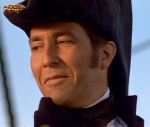
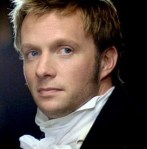 3. Ciaran Hinds vs. Rupert Penry-Jones (“Frederick Wentworth”): I’m sorry, but some young, blond guy with no experience in his face, no sense of humor, no indication that he has anything of the sailor about him will ever be a convincing Frederick Wentworth. Certainly, Rupert Penry-Jones is good looking and wears the period costumes quite well. But he reminded me more of Samuel West, who played Mr. Elliot in the 1995 version, than he did of a genuine Frederick Wentworth. I’m not so stuck on Ciaran Hinds being the “ultimate” Frederick Wentworth that I wasn’t open to the possibility of liking someone else in the role. It’ll just have to be someone other than Rupert Penry-Jones for me (Karl Urban, anyone?). Of course, maybe if we’d gotten to see more of RPJ in the Royal Navy uniform, it might have softened me toward him. (And yes, I know it’s not historically accurate for Frederick to be going around in his uniform on land—especially when he’s paid off and no longer has a ship; but still, Ciaran Hinds wears the uniform quite well.)
4. Changes to the Story: I know that any adaptation of a novel is going to require some divergence from the original source material, either because of the limitations of time or to translate what makes sense on the page but won’t on-screen. The 1995 version, for some reason, changed the backstory behind Mr. Elliot’s and Mrs. Smith’s connection (never really understood it, but it wasn’t all that important to the story). But in the 2008 version, they didn’t just alter the story to fit the length of the film—they actually altered the story structure. The most glaring and heinous crime committed against the novel was the screenwriter’s decision to eliminate the most emotional and crucial scene of the book by transplanting Anne’s “loving longest when all hope is gone” dialogue (the video clip above, from the 1995 version) to two snippets in a conversation with Benwick in Lyme—which Frederick doesn’t even hear. The scene when Frederick overhears Anne and Capt. Harville having the conversation about women loving longest when all hope is gone is the most emotional scene Jane Austen ever wrote—and is what led Frederick to writing her the note telling her he still loved her and that hope still remained for a reconciliation. Which leads me straight into . . .

5. The Absolutely Hacked-up, Mangled, Not-right Ending: I’ve already gotten into some of this above. Let me start this out by saying that the only thing I don’t like about the ending of the 1995 version of the movie is that Anne and Frederick don’t kiss as they sail off into the sunset (which, since the crew is scrubbing the deck and cleaning the cannons, it should actually be sunrise, not sunset). Most of the newer adaptations of historical novels to film do bless us with a kiss at the end—so I was expecting that in the 2008 version. But when I heard the “loving longest when all hope is gone” lines dropped into an insignificant throw-away conversation, I started getting concerned. Then, when the end finally did come, it was almost as if the filmmakers decided they hadn’t liked the way the book ended so they wrote an almost completely different ending! As I’ve said, the scene in the hotel in Bath when Frederick overhears Anne’s thinly veiled confession that she still loves him (while she’s still talking to Harville) is one of the most poignant, romantic scenes ever written in the history of romance novels—and it’s a scene that the 1995 version got as right as the filmmakers could possibly get it. As a lover of Jane Austen’s work, and a scholar of the time period, to see Anne Elliot literally running through the streets of Bath was offensive—not to mention ridiculous, if they’d just followed the actual ending of the book. And I want you to show me where in the book it says that he buys her a house (even if it is Kellynch Hall)! Sure, the book doesn’t say that they sailed off into the sunset together, either, but within months of when this book ends, England was once again at war with France (after Bonaparte escaped from Elba—which is mentioned in the 1995 version). I don’t know that Anne would have actually sailed with him, but after the discussion in the book (and the 1995 movie) that Sophy had traveled with Admiral Croft on most of his ships, it’s a much more logical leap to see them on the deck of his ship than dancing in the front yard of a manor house. (And don’t get me started on how vulgar the waltz was considered in England in 1814.) It’s totally out of character for Frederick Wentworth—his life was the Royal Navy . . . okay, maybe I’m putting a little too much of William Ransome into his character, but still. I was more disappointed with the ending of the 2008 version of Persuasion than anything else about it.

Kiss her, for Pete’s sake!
So, the 1995 version of Persuasion remains squarely at the top of my list of favorite costume dramas. Have you seen Persuasion? What are your thoughts on it? on the different versions?
Conference Prep & Question Time
For those of you who haven’t yet found or taken the time to explore the Writing Series Index page, I wanted to point out all of the posts I’ve written in the past that could be helpful with your last-minute preparations for the ACFW conference this weekend. (And for those of you who aren’t attending, but who are thinking about attending a conference some time in the future, you may want to go ahead and read them, too.)
Beyond the First Draft–The Dreaded Synopsis
Beyond the First Draft—The Query Letter
Beyond the First Draft–Preparing the Perfect Proposal
Beyond the First Draft—The Pitch Sheet and One-Sheet
Beyond the First Draft–Face-to-Face Pitch Sessions
(In addition to the proposal included in the post above, you can see my most recent proposal example here, from my agent’s website.)
Conference Prep Series (August–September 2008.)
Conference Preparedness Series Introduction
Rose McCauley’s Top 10 List
Georgiana Daniels’s Secret to Conquering Conference Nerves
Tracy Ruckman’s Advice to First-Time Conference Attendees
Conference Prep—Nerves and Pitching
Deborah Raney’s Advice for Getting Over Conference Nerves
Lynette Sowell Advises You to Take a Time Out at Conference
Ane Mulligan, “Pitchers” Coach
Conference Prep–Neworking on the Fly
The Scoop on Pitching, by Virginia Smith
Taking Care of “God Appointments” with Lena Nelson Dooley
Jennifer Johnson says, “Prepare to Be Blessed!”
Conference Prep–Home Work
Ronie Kendig’s Spiritual Hot Spots at Conference
Erica Vetsch Helps Us Keep the Wheels Turning After Conference
Amber Miller Asks: What do you do during down-time at a writing conference?
Networking (July/August 2006)
Gas–$3, Book–$12, Networking–Priceless
Networking–What is it, really?
Networking = Name Recognition = Marketing
Networking: Addendum to Building Name Recognition
Networking: Stumbling Block #1–Fear
Networking: Stumbling Block #2–Communication
Networking: Stumbling Block #3—Following Up
Dos and Don’ts of Networking
Networking Refresher (September 2007) (includes more information about networking at writing conferences)
Networking–A Refresher Course
Networking Refresher–The “Soft Sell”
Networking Refresher–Building Name Recognition
Networking Refresher–Is This Seat Taken?
Networking Refresher–Face-to-face editor/agent meetings
Networking Refresher–When Did We Stop Sending Notes?
What questions do you have about conference? Remember, the only stupid question is the one that doesn’t get asked.
Writer’s Window: Sharlene MacLaren
Congratulations to Robin in NC for winning the drawing for Julie Lessman’s book last week.
—————————————————————————————————-

Kaye Dacus & Sharlene MacLaren, ICRS 2009
I met Shar MacLaren for the first time at ICRS last year, and ran into her again a few times at this year’s show. Her books have been on my TBR pile for a while now, and I’ve heard wonderful things about them, so I can’t wait to read them. I’m also hoping to be able to actually spend some time with Shar soon!
Sharlene is giving away a copy of Tender Vow to one lucky commenter. Be sure to get your comment posted by Friday, which is when I’ll draw the winner’s name. (Remember, no need to include your e-mail address in the body of your comment, as long as it’s correct when you sign in.)
Tender Vow
Michigan-born brothers John and Jason Evans took a ski trip in the Rockies, but only one came home alive-John was tragically killed on a daring descent down Devil’s Run, an infamously dangerous slope.
In an attempt to soothe his guilt and grief, Jason sets out to make amends with his widowed sister-in-law, Rachel, by offering to help with her two small children, doing odd jobs around her house, and trying to ease her own heavy burden of grief. A new Christian, he is bent on growing his faith and helping Rachel see her way through the fog of pain and confusion.
Left to raise her three-year-old daughter and newborn son on her own, Rachel Evans is anything but willing to become her brother-in-law’s charity case, particularly since they have a history she’d rather forget. She’s determined to make it on her own but soon finds that God has other plans for her-and for Jason. Can she accept the Lord’s leading and still honor her late husband’s memory?
What do you like best about being a writer?
- I love the “gift” of being able to create stories that will hopefully make an eternal difference in someone’s life. It is always such an honor and humbling experience when someone takes the time to tell me one of my books, or even my writing in general, has struck a chord of desire in their hearts to draw closer to the Lord. That’s a wow! moment for me.
What do you like least about being a writer?
- Oh, me, I am a terrible procrastinator, so I’d have to say my least favorite thing about writing is knowing that even on those days I don’t feel especially creative, I still have to write. Some days I would much rather play!
Pop, Soda, or Coke? What do you call it, and what’s your favorite variety?
- This Midwest gal from Michigan says pop! A soda is vanilla ice cream with ‘pop’ in it–same thing as a float. And Coke, well, Coke is—is Coke, isn’t it?
Describe your favorite pair of shoes.
- Ah, my favorite pair of shoes just got chewed up by my 10-month-old pup, so now they are no more. They were, however, a comfy pair of leather sandals that fit with perfection. Now I am on the hunt for an equally comfy pair. So far, no luck. That stinker pup of mine.
What’s the most fun/interesting/crazy/scary/unique hands-on research you’ve done for a book?
- Hmm, don’t know as it’s terribly unique, but hubby and I recently returned from a three-day trip to Wabash, IN (setting for my River of Hope series, 1926–1930), and we stayed in a wonderful refurbished four-story hotel initially built in 1920. I felt like I was living in my book, as the building had been restored to its original, glorious state.
Candles. We all have them. But do you burn them? What scents are your favorite?
- It’s funny that you ask that because I do have a ton of candles around my house, many of which I’ve never lit! I love the look of a new candle, but once I burn it for three or four hours, it doesn’t look quite as pretty in my bathroom, on my coffee table, or on the kitchen counter. I do love the delicious aromas though, but strangely, I’m more about color than smell. I mean, it has to match the decor, right?
Have you ever re-gifted something someone’s given you?
- Haha, is this confession time? I admit I have re-gifted. It comes in handy in those emergency situations when you just want to give someone something nice but you don’t have time to run to the store. (I also stock up on extra lotions, candles, room sprays, etc. at Bath and Body Works and stick these items in my special “gift” closet.) Trouble is, my daughters sometimes go “shopping” in my closet when they need something nice.
If you were to write a novel about what your life would have been like if you’d become what you wanted to be at eight years old, what kind of character would the story be about?
- Golly, when I was eight years old, I loved cats and dogs so much I thought I wanted to be a veterinarian. That went away later when I learned how much science I’d have to take and also that I’d have to treat animals other than cats and dogs. So, I guess that novel would be about a lady vet who only treated furry animals that purred and wagged their tails–no reptiles, no rodents, no birds, nothing with scales…you get the idea.
What makes you happy?
- My relationship with Jesus, my adoring husband, my precious daughters, their hubbies, my three darling grands, my little office that inspires me to write, cherished friends, my church, my extended family, my ladies’ and couples’ Bible studies, MUSIC, the sound of laughter filling up a room, kisses, hugs, a cozy fire on a blustery winter night, tender love stories. (Did you notice I didn’t list one material possession?)
What makes you nervous?
- Deadlines. Need I say more?
What’s the best piece of writing advice you’ve ever received?
- Pursue your dreams and passions. If you love to write, it’s a good bet God gave you a gift, and when God gives gifts, He likes you to share them. Thus, write as if someone, someday, will read your words. Make each one of them count for His Kingdom—and plan to give God ALL the glory when people start telling you how much they like your stories.
What’s your biggest dream for the future?
- My dreams always involve touching other people’s lives, so I’d have to say my ultimate dream would be to write books impacting enough to steer people straight to the gates of Heaven. Wow! That’s not only a dream; it’s a challenge!
Tell us about your newest release.
- My next release is a stand-alone contemporary novel called Tender Vow. It should hit stores in late August/early September 2010. Here’s a summary: Michigan-born brothers John and Jason Evans take a ski trip in the Rockies, but only one comes home alive—John was tragically killed on a daring descent down Devil’s Run, an infamously dangerous slope.
In an attempt to soothe his guilt and grief, Jason sets out to make amends with his widowed sister-in-law, Rachel, by offering to help with her two small children, doing odd jobs around her house, and trying to ease her own heavy burden of grief. A new Christian, he is bent on growing his faith and helping Rachel see her way through the fog of pain and confusion.
Left to raise her three-year-old daughter and newborn son on her own, Rachel Evans is anything but willing to become her brother-in-law’s charity case, particularly since they have a history she’d rather forget. She’s determined to make it on her own but soon finds that God has other plans for her-and for Jason. Can she accept the Lord’s leading and still honor her late husband’s memory?
Where can people find out more about you/connect with you online?
- Look for me at these various places:
http://www.sharlenemaclaren.com
http://www.sharlenemaclaren.blogspot.com
http://www.shoutlife.com/sharlenemaclaren
—————————————————————————–
 Sharlene MacLaren has always enjoyed dabbling in writing—poetry, fiction, various essays, and freelancing for periodicals and newspapers. Her favored genre, however, has always been romance. She remembers well the short stories she wrote in high school and watching them circulate from girl to girl during government and civics classes. “Psst,” someone would whisper from two rows over, and always with the teacher’s back to the class, “Pass me the next page.”
Shar is a an occasional speaker for her local MOPS organization, is involved in KIDS’ HOPE USA, a mentoring program for at-risk children, counsels young women in the Apples of Gold program, and is active in two weekly Bible studies. She and her husband, Cecil, live in Spring Lake, Michigan with their lazy, fat cat Mocha.
Fun Friday–Sense & Sensibility: A Character Throwdown
When new film adaptations of Jane Austen’s novels are made, there is no sense in pretending we don’t compare the actors and actresses from the various versions. I thought about including the 1981 BBC miniseries, but since I’ve had the DVD of it for a few years (purchased as part of a set) and have never watched it, this will focus on just the 1995 Emma Thompson version in comparison to the new Andrew Davies version. (This is a slightly revised version of the post I originally wrote for the Jane Austen Today blog in 2008 when the miniseries aired during the Complete Jane Austen series on PBS.)
Elinor Dashwood: Emma Thompson vs. Hattie Morahan

In looks, Emma Thompson has Hattie Morahan beaten, hands-down, at least with the way they were made-up/styled in these films. In speaking ability, Emma also has the edge—Hattie has a bit of a lisp at times that makes her sound a bit less refined and intelligent than Elinor is supposed to be. However, in all other respects, including interpretation of the character, I’m going to have to give this one to Hattie Morahan. Morahan was only twenty-eight when filming this, while Emma Thompson was thirty-six. Neither were very close to Elinor’s nineteen when the story begins, but Hattie does look much younger when seen on the screen. Hattie also brings a little less maturity and assuredness to the role. Why is that a good thing? Because in the novel, Elinor is only nineteen years old. She doesn’t know everything, the way Emma Thompson portrayed her. Hattie also has a quietness about her that Emma Thompson tried to adopt but didn’t always manage. Winner: Hattie Morahan.
Marianne Dashwood: Kate Winslet vs. Charity Wakefield

While Charity looks younger, she was actually several years older than Kate during filming (KW was eighteen or nineteen). But age isn’t really the issue here. The better portrayal of this character is soundly Kate Winslet’s. Kate Winslet brought so much more heart and intensity and, dare I say, sensibility to the role. (She weeps better, too.) She also seemed much more comfortable with the lines that are straight out of the novel, whereas Charity was much more believable with the dialogue written by Andrew Davies (not that his dialogue was bad, just not what Jane penned). But I do have to say, I like the warmth that Charity as Marianne initially shows toward Colonel Brandon—the smiles when he’s turning the pages of the music for her, and thinking him the only person in the neighborhood one could have an intelligent conversation with. And I know that tumbled, curly hair is supposed to be a “sign” of the wild, carefree character, but poor Charity’s hair tends to look more frizzy (especially around her face) than a wild tumble of curls. I know that’s probably more true-to-life, but with as refined as everything else is in this film version, it’s somewhat distracting to me to see a close-up of her and have her look like she just woke up and hasn’t styled her hair yet. Winner: Kate Winslet.
Mrs. Dashwood: Gemma Jones vs. Janet McTeer

Though Gemma Jones was only fifty-three when filming the 1995 version of S&S, she looks much older than Janet McTeer who, at forty-six at the time of filming, possessed the looks of the early-forties that Mrs. Dashwood is supposed to be. However, Gemma Jones’s portrayal edges her out for me. Janet McTeer towers over the actresses playing Elinor and Marianne, and comes across as very robust. Gemma Jones brought a palpable sadness and fragility to the role, fitting for a woman newly widowed—and also something that points to the same fragility that Marianne shows later in the story after her heart is broken. Winner: Gemma Jones.
Edward Ferrars: Hugh Grant vs. Dan Stevens

He didn’t have to have piercing blue eyes, a mellow baritone voice, and a nice substance to his carriage for Dan Stevens to edge out Hugh Grant in this comparison for me. (And can I just admit that until I put these two images side by side, I didn’t realize how much Dan Stevens favors Hugh Grant?) Yes, Jane describes Edward as plain, with not much grace—and Dan Stevens is far from plain—but she also described Edward as solemn and somber, not comical and flirtatious, which is how Hugh Grant’s bumbling, stuttering portrayal comes across. Winner: Dan Stevens.
Colonel Brandon: Alan Rickman vs. David Morrissey

I know there are some people out there who feel as adamantly about Alan Rickman in the role of Colonel Brandon as they do about Colin Firth as Mr. Darcy. So, since I’m 100 percent in favor of equal opportunity, I’ll go ahead and offend the Alan Rickman lovers to say I feel he was completely miscast as Colonel Brandon. (Side note trivia: the first name Christopher was made up for that version of the movie.) Yes, he’s a wonderful actor, and did a good job in the role. But he wasn’t the Colonel Brandon who appears in the book. The biggest problem is that Colonel Brandon is meant to be thirty-five years old. Though David Morrissey (at forty-three) was closer to the age of Alan Rickman when he filmed the role (forty-nine) than Col. Brandon’s thirty-five, the age difference between Morrissey and Rickman definitely shows in their faces—David Morrissey is mature without looking old. Alan Rickman just looked old, not to mention the fact that to me, Alan Rickman sounds like he just came from the dentist and the Novocaine hasn’t worn off yet—and he might still have some cotton stuffed up in his mouth. (It also helps that I watched the 2008 version of S&S before I saw David Morrissey’s creepy turn ten years before as Mr. Headstone in Our Mutual Friend.) Winner: David Morrissey.
Mr. Willoughby: Greg Wise vs. Dominic Cooper

Aside from the fact that Marianne is sixteen or seventeen years old and susceptible to an unexplainable infatuation with a dashing young man, in the new adaptation I cannot understand how she could possibly choose Willoughby over Brandon. Because the film is much more drawn out, we see Willoughby in more scenes, but rather than seeing his humor and charm, he just comes across as sinister and conniving. He rarely smiles; and lines that Greg Wise spoke with a lilt and a bit of a laugh in his voice Dominic Cooper speaks with a petulance that makes him come across as rude. And, personally, I just think Greg Wise is better looking. Winner: Greg Wise.
Head to head, there are no actors that are truly just awful in their roles. But I do have my favorites. I hope you do, too!
Costume Drama of the Week: Sense and Sensibility

 My first exposure to Sense and Sensibility was in 1995 when I went with the other women in the singles group at church to see Emma Thompson’s Academy Award–winning film adaptation of the Jane Austen novel. It took me several years after that to actually be able to make it all the way through the book—and long road trips and books-on-tape really helped out a lot with my accomplishment of getting through it the first time.
Even as someone totally unfamiliar with the storyline, though I thought the conclusion of the Emma Thompson version was satisfying, I remember walking away with the feeling that “Helena” (which I thought Elinor’s name was, from the way Kate Winslet pronounced it) should have ended up with Alan Rickman—because, age-wise, they were much better suited for each other. But once I made it through the book, I came to realize how the 1995 version barely scratched the surface of the story. (But Emma Thompson did a much better job of translating such a long, involved story into two hours than the screenwriter of the 2005 adaptation of P&P did. But that’s a whole other blog post.)
So when I heard that a new miniseries version was planned, I started getting excited—especially once I learned that screenwriter Andrew Davies, the writer behind the 1995 version of P&P, had penned the script. Back in 2008, when it premiered, I blogged about it in pieces, but this will be the first time I’ve combined it all in one place—and I’ve revised it now that I’ve watched the miniseries a couple of times with some additional thoughts and comments.

Andrew Davies decided to spice up this adaptation by opening with a “seduction scene” at the beginning. This, more than any rumors that leaked about the adaptation, created a furor in the Janeite world. But the scene we’d all been warned about really didn’t show much of anything, nor did it reveal the identity of the seducer. Even though I know the story, it felt very disconnected from the main action at Norland with Mr. Dashwood’s death.
The first half hour of the movie didn’t seem much different than the Emma Thompson version—down to the scene (not from the book) of Margaret on the floor in the library. In fact, Andrew Davies seemed to have taken Emma Thompson’s lead on the character of Margaret—she is more closely related to Thompson’s version of the character than how the character appears in the book. Also, at times, several of the characters seemed to have taken their acting direction from the Emma Thompson version—especially the actress playing Fanny, who seemed to have studied her lines by repeated watchings of her predecessor in the role.
 I liked the casting of David Morrissey as Colonel Brandon—though I had a hard time not seeing him as a young Liam Neeson. It was also nice to see Marianne smiling at him when he turned the pages of music for her instead of being quite so heartlessly cold to him the way Kate Winslet was in the theatrical version.
Another quibble: never, not once, in the book does anyone call Elinor “Ellie.”
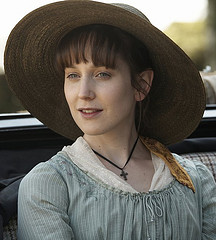 Though I initially made some disparaging remarks about Hattie Morahan’s portrayal of Elinor, after just seeing the first part of the two-part movie, she really won me over in the second half of the movie. I’ll freely admit I was wrong to call her “so plain as to be nearly homely.” I can mark the change in my attitude toward her portrayal of Elinor from the scene when Lucy Steele reveals to Elinor that she (Lucy) has been secretly engaged to Edward for four years. I also quite enjoyed the symbolism of the scene following when Elinor escapes to a cave to mourn the loss of Edward—and even then cannot allow herself the weakness of tears. That may be one of my favorite parts of this new adaptation.
One of my least favorite parts of the new adaptation is the Palmers. Except for the fact that they must be introduced because Elinor and Marianne stay at their home when Marianne is so ill, I didn’t really see the point in having them in this film at all. Of course, I already knew that they would never be able to compare with how the characters were played in the 1995 Ang Lee/Emma Thompson version by the incomparable Imelda Staunton and Hugh Laurie. Aside from the fact that both of them are fabulous comic actors, the script they were given allowed them to pull in much of the humor that Jane Austen built through the absolute ridiculousness of those characters in the book.
I do like the Mrs. Jennings in the 2008 miniseries—probably because we get more of her character, and she’s not as over-the-top as the character in the 1995 version.
As I said before, this adaptation at times felt like merely an expansion of Emma Thompson’s script for the 1995 version, so I wasn’t really surprised to see almost the exact same interaction and dialogue between Marianne and Mrs. Jennings’s butler in London, the only difference being that he was amused rather than annoyed by her.
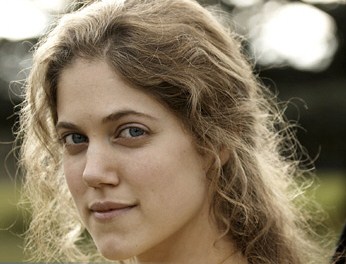 Charity (Marianne) Wakefield’s hair bugged me continuously throughout the film (as did Elinor’s bangs, since that wasn’t the style)—even when they went to the assembly, Marianne’s hair looked unkempt. But at least Elinor’s was less severe, as if she’d taken time to try to style it rather than just pulling it back in a bun. In the 1995 version of the film, the assembly is crowded, just as described in the book—where there are so many people, they’re pressing around them from all sides. In the 2008 miniseries adaptation, the assembly was well attended, but not crowded. They were able to move around with ease, without having to squeeze through a mass of people. Marianne’s fainting, in the book, is attributed (by everyone but Elinor) to the “press” of the crowd and the heat generated by so many bodies so close together. Also, Col. Brandon was not at the assembly in the book. Also, in 1811, which is when the book was published, unmarried girls like Elinor and Marianne and the Steele sisters would have worn white to the assembly, not colored gowns. Colored gowns were worn by married women, matrons, and old-maids (like my Julia in Ransome’s Honor).
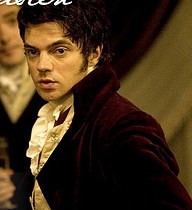 The casting of Dominic Cooper as Willoughby in the miniseries didn’t work for me. In the first half, he comes across as petulant and arrogant; in the second half, he comes across as nothing but sinister and creepy. I understand why Andrew Davies was tempted to pull Brandon into the assembly scene, to give Marianne even more reason to soften to him because he was there to help her when Willoughby disappointed her, however it made the dueling scene confusing. I wonder how many people who’ve never read the book believe that they dueled over Marianne, not over Willoughby’s seduction of Eliza. In the book, the duel takes place off-page. We only learn about it when Brandon tells Elinor the whole story about his ward and Willoughby’s part in ruining her.
There also seemed to be quite a bit of confusion over who was related to whom and how. I was very disappointed in Andrew Davies in this aspect. Marianne calls Fanny “aunt,” when Fanny is her sister-in-law. Sir John Middleton calls Lucy and Anne Steele “our nieces” and then introduces them to Elinor and Marianne as “your cousins.” The Steeles were distant cousins of Lady Middleton, and would therefore not have been considered relations of Elinor and Marianne, since they were only (distantly) related to Lady Middleton by marriage. Then, the worst offense of all, someone refers to Edward as Elinor’s cousin. Edward and Elinor are not related at all, with the exception that Edward’s sister is married to Elinor’s half-brother. Again, it concerns me that this would be quite confusing to those who aren’t familiar with the story as to how all of these people are connected with each other, since the screenwriter couldn’t even keep everyone straight with the right relationship titles.
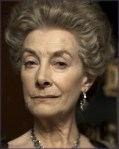
 The two best additions to this adaptation, which were left out of the 1995 version, were Mrs. Ferrars and Anne Steele. Both came across just as I’d imagined them in the book, and the scene when Anne lets slip the truth of Lucy and Edward’s engagement was priceless.
And the actress playing Lucy, though insipid instead of humorous, was actually pretty enough to believe that Edward would have fallen for her, unlike the one in the ’95 version.
The score for this adaptation was written by Martin Phipps, who created the music—including a heart-rending piece, “Northbound Train”—for the 2004 BBC adaptation of Elizabeth Gaskell’s North & South, as well as the newest adaptation of Persuasion (unfortunately, none of these soundtracks are available commercially in the U.S.). There were a couple of times, especially in the second part, when, if I closed my eyes, I could have been watching N&S, because the theme and instrumentation of the music was so similar.
I did read somewhere that Charity Wakefield (Marianne) is an accomplished and professionally trained pianist and singer. They could have made much more use of this.
The resolution of the Marianne/Brandon relationship bugged me in this adaptation. First, why, if Brandon has his horse right there, would he walk back to the house carrying Marianne after she collapses in the rain? Second, the whole comparison between Brandon’s courting Marianne and his taming a horse and training a hawk was borderline offensive. Third, what I want to know is when someone is going to get the timeline of the relationships right. Edward and Elinor are married long before Marianne and Brandon’s relationship begins to mature to the point that they marry. Marianne is courted by Brandon for about a year as she, along with their mother and Margaret, visits Elinor and Edward at their vicarage at Delaford (i.e., Elinor and Edward are already married throughout Marianne and Brandon’s courtship).
What version(s) of S&S have you seen? What are your thoughts?
Tomorrow: a head-to-head throwdown between the actors/actresses in the major roles in the 1995 & 2008 versions.


